
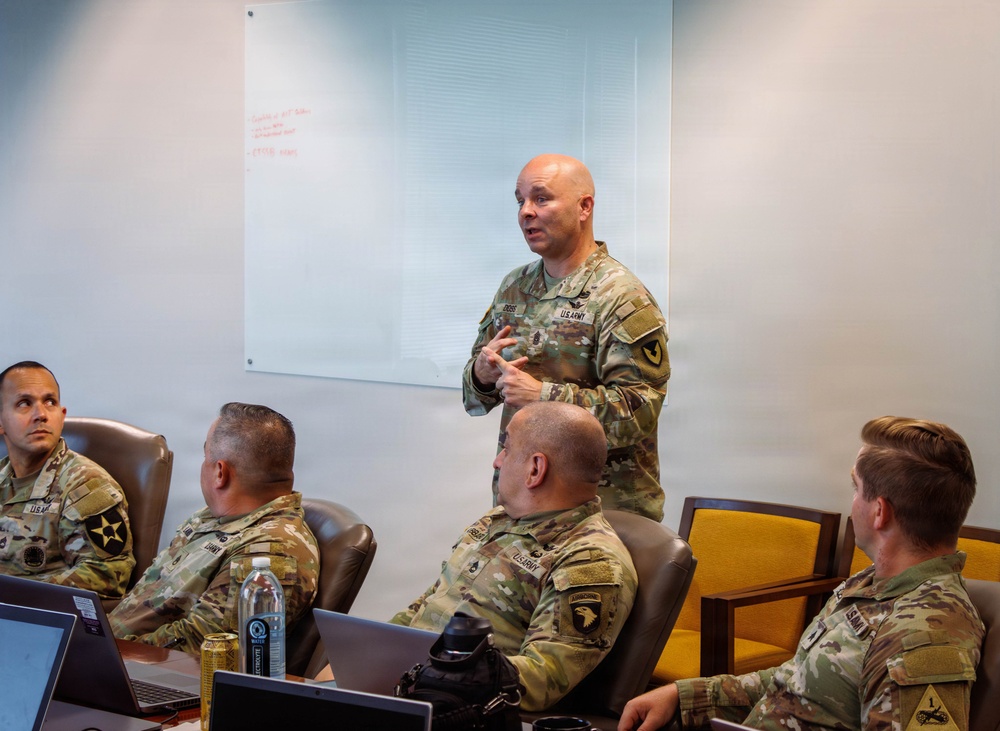
Photo By Jeremy Coburn | Command Sgt. Maj. Christopher Doss, the command sergeant major of the U.S. Army...... read more read more
 Subscribe
Command Sgt. Maj. Christopher Doss, the command sergeant major of the U.S. Army Aviation and Missile Command, led a two-day maintenance workshop on Aug. 27-28, targeting a major overhaul of how the enterprise conducts Phased Maintenance Inspections.
The workshop, held at AMCOM headquarters, brought together Aviation maintainers, leaders, subject matter experts and aviation staff to develop and validate a standardized phase maintenance program. The effort is part of a mandate assigned to the Army Aviation Improvement Committee to ensure standardization in training soldiers across Combat Aviation Brigades (CABs).
"Building combat power is absolutely critical to our ability to fly and to train our pilots," Doss said. "We have a significant mission set in terms of required flying hours, but we have a very young force, particularly within our noncommissioned officer ranks. We need to make sure we are developing the necessary skills to manage major maintenance projects.”
Doss addressed the immense responsibility placed on junior leaders. In many aviation units, young sergeants are put in charge of phase maintenance on aircraft. While these young NCOs are highly skilled technical maintainers, Doss noted they often lack formal preparation in larger operational skills like project management, long-term forecasting, standard operating procedure refinement and performance tracking.
"When I started my first phase, I wasn't thinking about process improvement and the associated planning to align our schedule with the flying hour requirements," Doss said. "I was just trying to complete the task as quickly as possible without additional delays. The management of these large events is where we should focus our training efforts."
To build the new framework, the Aviation Improvement Committee evaluated best practices from across the aviation enterprise. Developers drew successful concepts from the 160th Special Operations Aviation Regiment (SOAR), the 1st Armored Division Combat Aviation Brigade, several Aviation Support Battalions and the AMCOM Aviation Maintenance Directorate.
Rather than dictating a top-down solution, Doss structured the workshop to gather "flight line truth" from experienced personnel currently working in the field. Facilitated alongside retired Command Sgt. Maj. and AMCOM sustainment advisor Tod Glidewell, the working sessions allowed subject matter experts to challenge assumptions, validate maintenance tasks, and establish clear measures of performance and effectiveness.
"I didn't want to just issue a directive and say, 'This is how we are going to do business,'" Doss said. "I wanted to validate these tasks based on real flight line experience and solicit feedback from the guys out there doing the work. I want to make sure we are solving the right problems, not the wrong ones."
Sgt. Aaron Decker, a maintainer with the 1st AD CAB at Fort Bliss, Texas, stated that the collaborative effort is necessary for the wider force.
"The effort is necessary because it is beneficial to develop one standard for all Army Aviation," Decker said. "There are so many nuances, and this will help mitigate issues when coming across unknown maintenance problems.”
The working group also recognized that units are currently operating in high-demand environments with limited personnel and funding. Doss emphasized that the workshop was not meant to criticize any unit's current program, but to empower leaders to advocate for the resources they need.
Beyond establishing a standardized training rubric, the workshop's goal is to generate actionable policy and governance recommendations to present to the Aviation Branch. These recommendations could reshape existing Army regulations to better protect phase-maintenance teams, integrate quality control and streamline supply chains. Additionally, a Microsoft Teams channel was created for subject matter experts to share ideas across the force rather than waiting for soldiers to PCS to share best practices.
The workshop also introduced attendees to key enterprise resources. Among the guest experts were Tom Hill, a retired sergeant major who leads the DA Form 2410 Hotline and Billy Barnes, the training branch chief of the AMCOM Logistics Assistance Representative (LAR) University.
“Whatever improvements that are made for Army aviation will benefit aviation LARs worldwide as we work alongside the maintainers in the units,” Barnes said.
"We are all committed to helping solve these problems," Doss said. "We want to validate these tasks, incorporate them into doctrine and establish clear ways to measure success so we can give our commanders the bank time they need to train our pilots safely and effectively."
At the conclusion of the workshop, subject matter experts prioritized their recommendations based on operational impact, safety and feasibility. The validated findings will be compiled to help shape the future of Army aviation maintenance policy.
Mr. Glidewell provided more insight into the future: “We’re already looking at how the Army can train, maintain, and conduct business differently in the future. To accomplish that, we need to understand what our maintainers and operators are experiencing every day on the flightline and correlate that with data to optimize and improve readiness in the future.”
We’re already looking at how the Army can train, maintain, and conduct business differently in the future. To accomplish that, we need to understand what our maintainers and operators are experiencing every day on the flightline and correlate that with the data if we’re optimize and improve readiness going forward in the future.
| Date Taken: | 09.03.2026 |
| Date Posted: | 09.03.2026 08:57 |
| Story ID: | 573873 |
| Location: | REDSTONE ARSENAL, ALABAMA, US |
| Web Views: | 25 |
| Downloads: | 0 |

This work, AMCOM Workshop Targets Standardization of Phase Maintenance Inspections, must comply with the restrictions shown on https://www.dvidshub.net/about/copyright.


No keywords found.




