
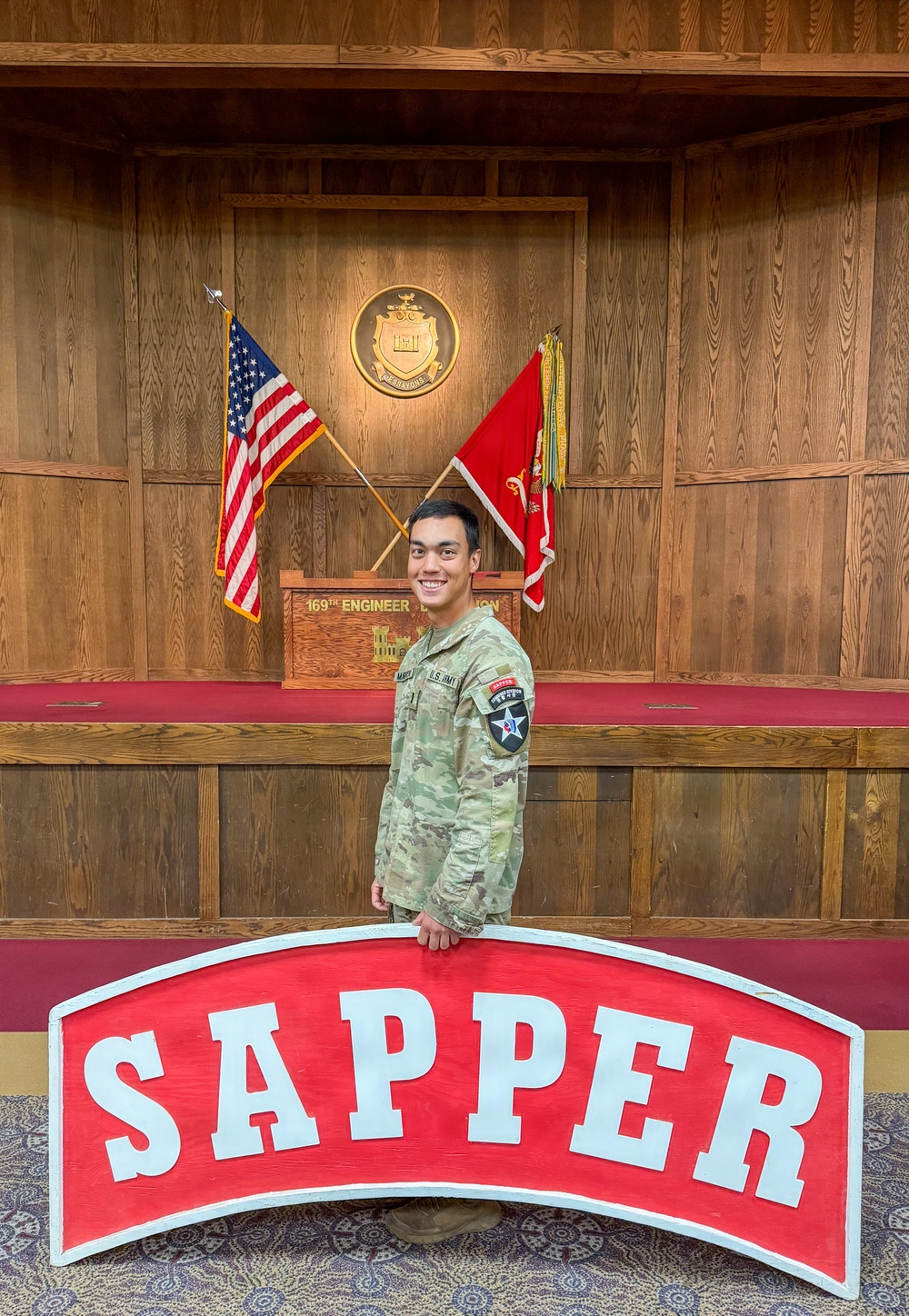
Courtesy Photo | U.S. Army 1st Lt. Quinn Maretzki of 11th Engineer Battalion, 2nd Infantry...... read more read more
 Subscribe
CAMP HUMPHREYS, South Korea — For 1st Lt. Quinn Maretzki, earning the Sapper Tab was more than a personal accomplishment. As the first "Jungle Cat" in six years to travel from the Korean Peninsula and graduate from the U.S. Army Sapper Leader Course, his achievement represents an opportunity to help prepare the next generation of engineers to follow him.
Maretzki, a platoon leader assigned to the 630th Clearance Company, 11th Engineer Battalion, 2nd Infantry Division/ROK-U.S. Combined Division (2ID/RUCD), recently completed the demanding 28-day Sapper Leader Course at Fort Leonard Wood, Missouri, joining the ranks of Army engineers who have completed one of the Army's premier leadership courses.
"For a lot of engineers, it's a goal, and for me it had been a goal for a long time," Maretzki said.
The Sapper Leader Course develops combat engineers and other selected Soldiers through demanding physical, technical and leadership training. The course is divided into two phases: general subjects and patrols.
During the first phase, students receive instruction and are evaluated on subjects including obstacle emplacement, specialized breaching operations, mobility, countermobility and survivability. Students also conduct rappelling, knot tying, land navigation and demolition training, along with a series of physically demanding events, including runs and a 12-mile foot march.
The second phase transitions students into a field environment, where they apply their skills during patrols and a field training exercise. Students are evaluated in leadership positions while conducting missions ranging from raids and ambushes to engineer-specific tasks such as demolitions, reconnaissance and engagement area development.
For Maretzki, the challenge was as much about leadership and mental resilience as it was technical proficiency.
"Probably one of the hardest things I've ever done, physically and mentally, all of the above," Maretzki said.
When exhaustion, limited sleep and the cumulative pressure of the course began to take their toll, Maretzki said his fellow students motivated him to keep going.
"You don't earn your tab," he said. "The other people in the class, they earn your tab for you."
That team mentality extended thousands of miles back to Korea.
Maretzki credits his leadership, fellow Sappers, mentors and Soldiers within the battalion with preparing him for the course and providing him the opportunity to attend. Among those who played an important role was his former first sergeant, who helped him prepare physically, mentally and academically.
Maretzki said battalion leaders also worked extensively with the Engineer Regiment and Sapper Leader Course to secure opportunities for Soldiers stationed in Korea to attend.
"I was the first, but they've been working, I'd say, tirelessly between the Engineer Regiment and the schoolhouse," Maretzki said. "What they've done, I think, will create so many opportunities for the battalion to go to Sapper School."
Those opportunities are already being reinforced at the unit level.
The Jungle Cat battalion conducts a Sapper train-up program designed to prepare future candidates before they depart for Fort Leonard Wood. The program includes academic instruction twice a week and physical training tailored to events students will encounter during the course, including distance running and ruck marching.
Now that he has returned from the course with his own Sapper Tab, Maretzki plans to contribute to that program.
"My main focus would be just bringing everything back to the battalion," Maretzki said. "I really want to try and get more Sappers to the course."
That knowledge also directly supports Maretzki's responsibilities as a platoon leader.
His support platoon consists of horizontal construction engineers who use heavy engineer equipment to support route clearance and survivability operations. Their work includes clearing obstacles along routes and preparing fighting positions that allow larger formations to survive and maneuver on the battlefield. Maretzki described Army engineers simply as "problem solvers."
"We're able to enable every other warfighting function through our work, through our mobility, countermobility and survivability efforts," Maretzki said. "We're able to adapt to so many different types of missions and help enable whatever the larger fighting force may be to accomplish their mission."
The Sapper Leader Course gave him another set of tools to accomplish that mission.
Maretzki said operating while tired, hungry and under pressure reinforced the importance of adaptability and clear communication—lessons he plans to incorporate into training his platoon.
"You really learn how to give clear communication, giving very strict and very clear instructions, so everyone understands exactly what to do," he said.
His approach reflects a leadership philosophy centered on leading by example while giving Soldiers and noncommissioned officers opportunities to develop.
"I try my best to lead from the front, to set a good example for my Soldiers," Maretzki said. "But I also want to create an environment where my Soldiers are free to make mistakes and really free to develop into their own leadership styles."
Despite becoming the battalion's first Jungle Cat in six years to return to Korea from Fort Leonard Wood with a Sapper Tab, Maretzki is reluctant to make the accomplishment about himself.
Instead, he hopes his graduation demonstrates what other Soldiers in the battalion can accomplish and encourages them to pursue opportunities they may initially believe are beyond their reach.
"I would say that I'm really not special or anything like that," Maretzki said. "I would hope that it helps them to see that if I could do it, so could they."
For Soldiers considering the Sapper Leader Course, his advice is equally straightforward.
"Step outside of your comfort zone and just join the train-up and trust that process," he said. "And just take that step because you don't want to self-eliminate."
For Maretzki, taking that step resulted in a Sapper Tab. For the Jungle Cats who follow him, it represents something larger: reopening a pathway between engineers serving on the Korean Peninsula and one of the Army's most challenging leadership courses.
"Take that chance to be maybe the first to do something and not be afraid to do that," Maretzki said. "The result of you taking that first step really could help a lot of other people along the way and, hopefully, open new doors and be an asset to the larger force as a whole."
Stationed on the Korean Peninsula, the 2nd Infantry Division/ROK-U.S. Combined Division remains the U.S. Army's premier combined division, committed to maintaining readiness, strengthening deterrence and standing ready to Fight Tonight in defense of the Republic of Korea.
| Date Taken: | 08.25.2026 |
| Date Posted: | 09.03.2026 03:26 |
| Story ID: | 573861 |
| Location: | KR |
| Web Views: | 22 |
| Downloads: | 0 |

This work, First in Six Years: 2ID/RUCD Engineer Earns Sapper Tab, Opens Door for Others, by MAJ Eileen Poole, identified by DVIDS, must comply with the restrictions shown on https://www.dvidshub.net/about/copyright.

No keywords found.




