Orders From Higher: CWO3 Spencer Concludes 26 years of service
Photo By Cpl. Brian Long |
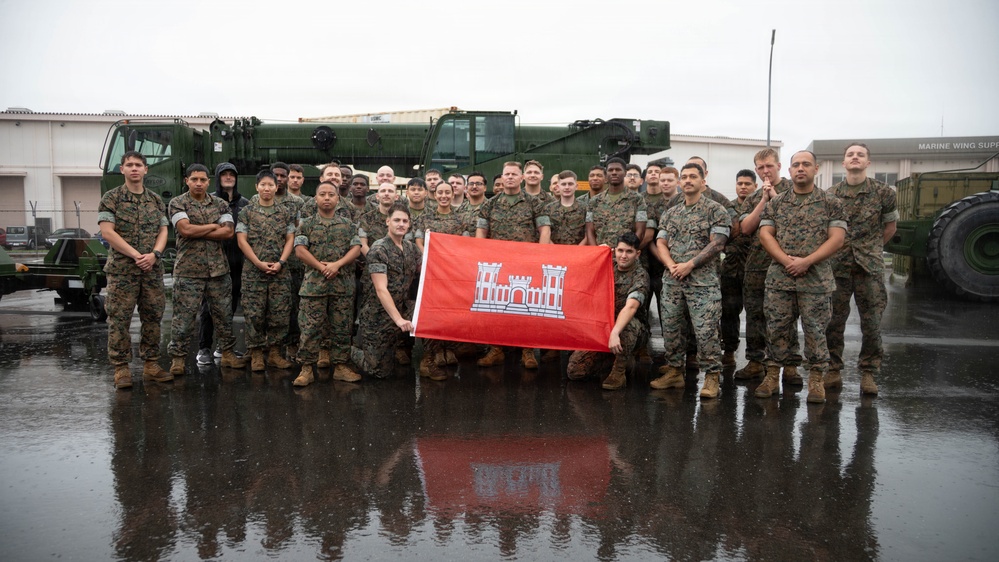
U.S. Marines with Heavy Equipment, Marine Wing Support Squadron (MWSS) 171, Marine......read moreread more
Photo By Cpl. Brian Long | U.S. Marines with Heavy Equipment, Marine Wing Support Squadron (MWSS) 171, Marine Aircraft Group 12, 1st Marine Aircraft Wing, pose for a group photo at Marine Corps Air Station Iwakuni, Japan. June 26, 2026. MWSS-171's Chief Warrant Office 3 Eric Spencer concluded his service in July of 2026. (U.S. Marine Corps photo by Cpl. Colin Thibault) see less
| View Image Page
Orders From Higher: CWO3 Spencer Concludes 26 years of service
MARINE CORPS AIR STATION IWAKUNI, Japan – The phone line went quiet for 20 seconds. On one end of the line was Chief Warrant Officer 3 Eric Spencer, the Heavy Equipment Officer in Charge for Marine Wing Support Squadron (MWSS) 171, Marine Aircraft Group 12, 1st Marine Aircraft Wing. On the other end was Chief Warrant Officer 5 John Miller, Spencer’s longtime mentor and friend.
The results for the Chief Warrant Officer 4 promotion board had just been released, and for the second time, Spencer’s name was not on the list.
“Are you alright?” Miller finally asked, his voice heavy with caution. “You good?”
Spencer laughed. “John, look, I know you’re getting old and forgetful, but let me remind you who was certain I’d get selected. That wasn’t me.”
He was not jaded, nor was he angry. He was entirely at peace. Spencer loved operating and leading in heavy equipment for over two decades, but a parallel calling discovered while in the Marine Corps Reserve remained just as defining: life as a Christian preacher. Whether he stayed in the uniform for a few more years or hung it up at that moment, he felt secure knowing that regardless of his will, his career was in God’s hands.
“I’m convinced because of my faith that God didn't have it in His plan for me to get selected for [Chief Warrant Officer] 4,” Spencer said. “Especially for what I want to do. I’m not getting younger, and my kids aren’t getting younger. I’d like to have more time with them. I feel He knows me better, and it’s not His plan for me to [stay in the Marine Corps].”
Had he been promoted to Chief Warrant Officer 4, Spencer would have likely faced mandatory three-year orders to the Marine Corps Engineer School at Fort Leonard Wood, Missouri. It would have meant extending his time in service and keeping him away from his family and his goal of returning to the pulpit.
Spencer’s non-selection served as a clear confirmation of his next steps. In July 2026, he will retire from the Marine Corps, concluding a 26-year career of military service.
Spencer’s path began when he enlisted in the Marine Corps Reserve in 2000. Born into a legacy of military service, Spencer is a third-generation Marine, following in the footsteps of his father and grandfather. Growing up working for his father’s construction company in Indiana, Spencer was familiar with heavy machinery and had a specific goal: he wanted to run heavy equipment in the United States Marines.
When Spencer’s Marine Corps recruiter said that he could only guarantee a spot in the engineering field, Spencer refused to sign. After some time, a compromise was found; Spencer would join the Marine Corps Reserve to secure the specific military occupational specialty of a heavy equipment operator.
He served eight years in the Reserve with 6th Engineer Support Battalion, 4th Marine Logistics Group. In 2003, he deployed to Iraq with E Company, 1st Platoon, 2nd Heavy Equipment Motor Transport, which was attached to 7th Engineer Support Battalion.
It was during his time as a reservist that Spencer encountered a common active-duty perspective toward “part-time” Marines.
“In the Reserves, you often hear active-duty Marines talk down, saying ‘reservists are nasty,’” Spencer recalled. “But you treat [reservists] well and they'll fill the gaps. If you give them the opportunity, they will step up.”
Starting in 2006, Spencer would balance his commitments as a Marine reservist with his calling to preach full-time.
“I really enjoyed it,” Spencer said. “I had complete control of my time. Preaching full-time allowed me to make my own schedule, go visit people, and I had much more time to study.”
In June of 2008, Spencer decided to transition to active duty, where he checked into 3rd Combat Engineer Battalion, 1st Marine Division, at Twentynine Palms, California. Shortly after checking into his new unit Spencer was deployed to Afghanistan with the unit in 2010.
Throughout his career, Spencer explained that his leadership style was guided by a simple philosophy: “Treat Marines like adults. Give and receive respect. It has to be a team effort, and you can't focus on yourself.”
This approach faced a major test in 2010 while Spencer, a sergeant at the time, was serving with 3rd Combat Engineer Battalion at Twentynine Palms. He was tasked with supervising and mentoring a junior Marine widely considered to be one of the most difficult in the platoon.
Rather than relying on raw authority, Spencer chose to give him respect first, rather than demanding he earn it. By giving respect, Spencer gave the Marine some room to breathe, letting him shed his defensive posture and thrive. He invested time into his junior, patiently teaching him the individual details of heavy equipment licensing so he could learn to operate and lead independently in his job.
Spencer’s leadership strategy worked. The junior Marine eventually took over the majority of the heavy equipment licensing workload, even finding a discarded typewriter to process official licensing forms.
When Spencer’s senior officer later noted that Spencer was the top-rated Sergeant in the unit, Spencer tried to give the credit to his junior Marine. His Chief Warrant Officer stopped him, asking one rhetorical question. “Where did he learn to run that program?”
That small interaction taught Spencer how important it is for a leader to train their juniors to be independent; A Marine can be judged by the performance of his or her junior Marines. Spencer continued to pass that lesson to any noncommissioned officers in his charge.
“That’s why I tell my NCOs all the time: you want to reduce the amount of work you do? Train your assistants,” Spencer said. “The better they are at their job, the easier it is for you.”
In 2011, Spencer pinned on the rank of staff sergeant. Around this time, he was becoming increasingly worried about “the HSST.” The Headquarters Marine Corps Special Duty Assignment Screening Team screens and assigns Marines depending on the needs of the Marine Corps to demanded special duties outside of their normal field of work, such as recruiting or drill instructor roles.
Spencer knew that leaving the engineering field would pull him away from the heavy equipment and the hands-on leadership he loved. To protect his passion and remain a technical authority on the ground, he applied for the Warrant Officer program. He was selected and received his commission as a chief warrant officer with the military occupational specialty 1310 (engineer equipment officer) in 2016.
Over his 26 years of service, Spencer's assignments took him across the fleet. He spent three years in Okinawa with 9th Engineer Support Battalion, 3rd Marine Logistics Group, followed by a tour at Camp Lejeune, North Carolina, beginning in 2019, where he served with 10th Marine Regiment, 2nd Marine Division, 2nd Combat Engineer Battalion, and Combat Logistics Battalion 22, 2nd Marine Logistics Group, deploying with the 26th Marine Expeditionary Unit in 2023. In July 2024, he returned to MCAS Iwakuni for his second tour on station.
Spencer’s leadership emphasizes a strict focus on his Marines rather than personal awards. In one instance, when only two awards were allocated, he refused to seek personal recognition.
“You don’t have to seek recognition,” Spencer said. “Recognition will seek you if you do the right thing. Learn from mistakes, own up, and give recognition. Awards belong to the Marines doing the work.”
Spencer’s focus on his Marines and the deep care he expresses for his platoon, is rooted in his foundational view of leadership: “Treat the platoon like a family. Good or bad, they are your family ... What's on your collar isn't for you. It's there so you can protect them from any unjust treatment.”
He also makes it a point to be honest with his subordinates telling his junior Marines to learn from the mistakes he has made so as not to repeat it themselves.
As he prepared to retire in July 2026, Spencer looked out at the Marines of MWSS-171 with a sense of completion. He is ready to move on because he has total confidence in the corporals and sergeants he is leaving behind to guide the next generation of Marines.
“The reason I'm confident is I don't have to do much,” Spencer said. “The ones that move up are, nine times out of ten, very capable Marines. I have no concern about Marines continuing to be Marines.”
26 years ago, Eric Spencer joined the Marine Corps wanting to operate heavy equipment. Over the course of his career, his focus shifted from the heavy machinery he commanded to the responsibility of leadership. With experience from the Reserve and active duty, as a noncommissioned officer, staff noncommissioned officer, and a chief warrant officer, he didn’t just master his trade, but built, trained, and inspired the next generation of Marines. Having left an undeniable mark on the lives of those he led, Spencer is now ready to return home to his family and begin a new chapter dedicated to his ministry and serving his community.

 Subscribe






