TACOM AI innovations transforming tech manual writing
Courtesy Photo |
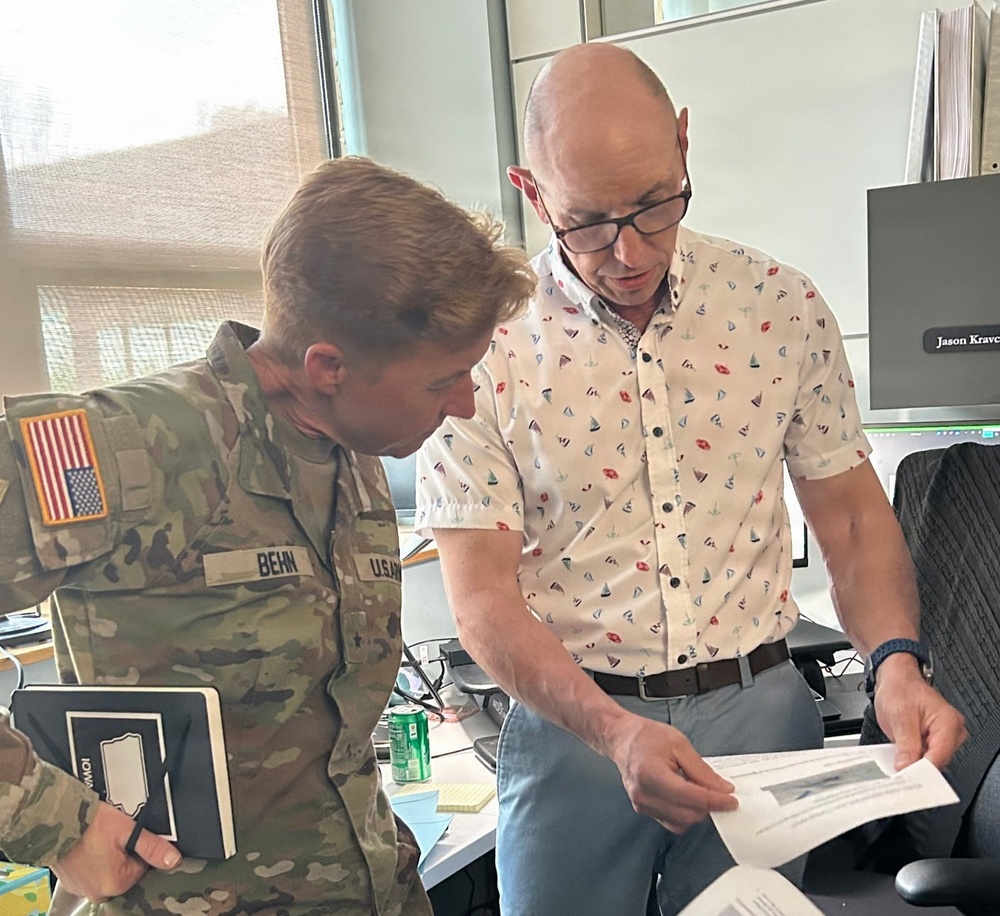
In April 2026, Jason Kravchuck (right), a technical writer for Force Provider, shows......read moreread more
Courtesy Photo | In April 2026, Jason Kravchuck (right), a technical writer for Force Provider, shows TACOM Commanding General Brig. Gen. Beth A. Behn a page from a technical manual he is creating using generative AI. (U.S. Army photo) see less
| View Image Page
TACOM AI innovations transforming tech manual writing
By ANN ZANIEWSKI
TACOM Public Affairs
NATICK SOLDIER SYSTEMS CENTER, Mass. – An innovative idea doesn’t always arrive with fanfare.
Sometimes, it starts with a task and a simple question: Could artificial intelligence improve the process of writing technical manuals?
Jason Kravchuck discovered the answer is ‘yes’ – and created a solution that’s part of a technical writing transformation poised to impact Soldiers across the Army.
Kravchuck, a technical writer for U.S. Army Tank-automotive and Armaments Command, harnessed the power of generative AI to build a tool that reviews technical manual work packages in seconds, saving significant time and enhancing quality.
“This is a force multiplier,” Kravchuck said.
The tool proved so effective that in June, it was integrated into AXIOM – TACOM’s newly launched, command-wide AI agent.
Kravchuck’s innovation is just one example of how TACOM teammates are leveraging artificial intelligence to sharpen the command’s operational edge.
Technical writing is a key facet of TACOM’s mission. The command oversees roughly 60% of the Army’s technical manual library, supporting more than 9,000 manuals for everything from vehicles and weapons to uniforms.
At TACOM and across the Department of War, accelerating AI adoption to drive faster, smarter operations is a top priority. The Pentagon rolled out Google Cloud’s Gemini for Government, housed on the GenAI.mil platform, in December to three million military, Civilian and contractor personnel.
“TACOM solves the Army’s toughest challenges,” said Brig. Gen. Beth A. Behn, TACOM commanding general. “Integrating data-driven analytics and AI decision support tools across our programs helps ensure the Soldiers we support receive what they need, where and when they need it.”
Late last year, Kravchuck was tasked with creating a new manual for the TEMPER Air-Supported Shelter Hospital, a rapidly deployable tent system. He had never written a manual from scratch and faced a tight deadline. With the blessing of his supervisor, Joseph Kleinfeldt, he decided to tackle the project with GenAI.mil, an endeavor that leveraged his background in information technology.
Kravchuck developed a script that audits the content of technical manual work packages against military standards. When he puts a package in GenAI.mil, the script uses a series of logic gates to score the language, clarity and other formatting elements while flagging any problems – all within about one minute.
“It allows me to catch a lot of things that I might miss, or that a new writer would miss,” he said. “And it makes you feel more confident that your first pass is going to be better.”
Kravchuck said his method has slashed production time by as much as 40% and rework by 50%.
Efficiency isn’t the only benefit. The tool eliminates inconsistency across authors and is great at spotting mistakes that slip past human eyes, increasing error detection by 15% to 20%, Kravchuck said. In one instance, the logic gates found a wrong measurement for pounds per square inch and fixed it across multiple work packages.
Kravchuck has led training on the system for his colleagues within TACOM-Soldier Division.
“We are seeing early signs that it translates well to different equipment types, proving the method’s scalability,” he said.
As Kravchuck was developing his tool, Jason Drenzek, the head of TACOM’s Electronic Publications team, was designing and building AXIOM.
AXIOM, which stands for Augmented XML Integration and Output Management, is an AI agent that builds, validates and refines the language used to format technical manual data. It essentially serves as a one-stop shop for developing and reviewing publication content.
“Before AXIOM, and before AI models were good enough to create agents like AXIOM, it was common for a technical writer to develop one to three work packages a day,” Drenzek said. “With AXIOM, we’ve been able to crank out as many 35 to 40 per day, per writer.”
Along with AXIOM, Drenzek has created two other new AI agents: Milly, a military standard research assistant, and CopyCat, which can extract graphics and technical illustrations from PDF files and recreate the data.
He said AI is reshaping technical writing – and TACOM is a leader in that transformation.
“There is a legitimate paradigm shift in how publication development is taking place, especially with timelines,” he said.
More than 200 people participated in an AXIOM rollout event on June 25. While interest in AI is booming, both Drenzek and Kravchuck stressed that humans aren’t going anywhere. AI is not intended to supplant people, they said, but empower them.
“Bottom line: This isn’t about replacing people,” Kravchuck said. “It’s about taking noise out of the process so reviewers can focus on actual risk, not wordsmithing.”