
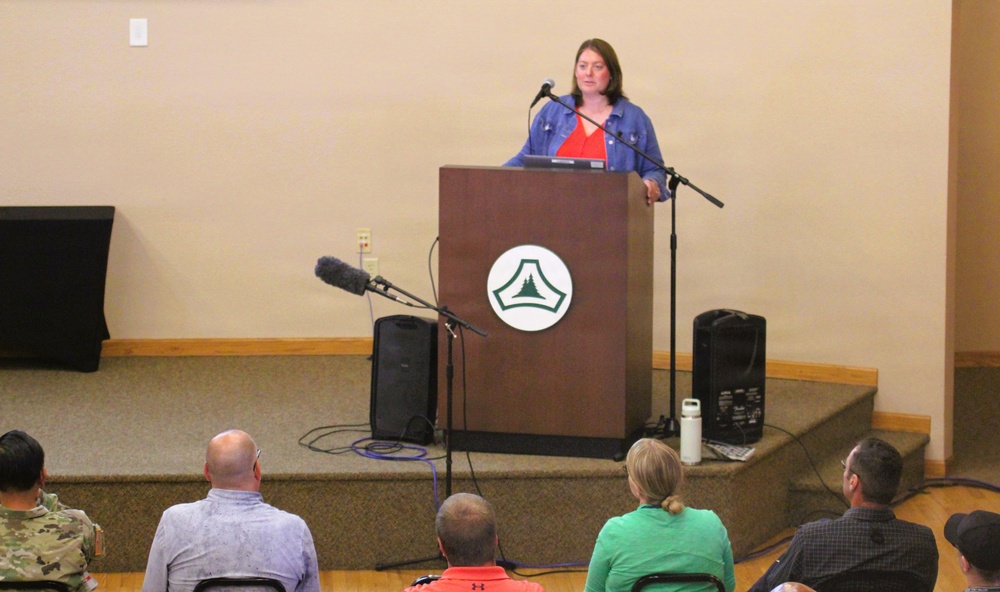
Photo By Scott Sturkol | Liane Haun, director of the Fort McCoy Directorate of Public Works, provides a...... read more read more
 Subscribe
Fort McCoy is investing in the future of its infrastructure as the installation continues to expand and adapt its capabilities to support Soldiers, training organizations and the Army Reserve mission.
Liane Haun, director of the Fort McCoy Directorate of Public Works, highlighted numerous ongoing and planned construction projects during the Aug. 27 Garrison Town Hall in Building 905. The projects range from individual facility improvements to major construction initiatives that are reshaping portions of the installation.
One of the clearest examples of that transformation is the 1600 block campus, where Fort McCoy is building modern facilities specifically designed to support transient training and mobilization operations.
A four-story barracks building near the Fort McCoy Commissary and Fort McCoy Exchange is nearing completion and turnover to the installation. Two additional officer-quarters buildings south of the Directorate of Emergency Services complex are under construction and are expected to be completed next summer. The officer quarters will provide 320 beds.
The campus also includes plans for two additional brigade headquarters buildings that are progressing through the design process.
Haun said the projects demonstrate how Fort McCoy is positioning itself to meet current and future Army training requirements.
The 1600 block development is particularly significant because the new facilities replace or supplement aging infrastructure while creating purpose-built space for the large numbers of Soldiers who come to Fort McCoy for training and mobilization.
The investment comes as Fort McCoy continues to serve as a major regional training platform for the Army Reserve, National Guard and other military organizations.
“It’s kind of coming to completion really quickly,” Haun said while discussing the 1600 block campus.
The modernization effort extends well beyond the 1600 block. At the Sparta-Fort McCoy Airport, Fort McCoy is preparing to replace its air traffic control tower, Haun said. The project will include a temporary tower to maintain airfield operations while the upper portion of the existing tower is replaced with a larger facility.
Building 100, which houses the garrison command group, is also nearing completion, with remaining work including interior improvements, utility connections, landscaping and furniture installation, Haun noted.
Additional future projects include a complete renovation of McCoy’s Community Center, construction of three classrooms for Regional Training Site-Maintenance, bridge replacements, improvements to the South Post Housing wastewater system, and replacement of water reservoirs.
Another planned project at Building 2187 would consolidate numerous Soldier and civilian in- and out-processing functions into a single location, creating a one-stop facility rather than requiring customers to visit multiple locations across the installation.
Fort McCoy is also planning for potential future growth associated with institutional training. Haun discussed preliminary plans for a potential new complex for the 98th Army Reserve Training and Evaluation Command. The organization previously operated at Fort McCoy before moving to Fort Knox in 2010.
The proposed complex, located north of the Fort McCoy Noncommissioned Officer Academy, could provide approximately 400 beds and associated facilities. The project is currently estimated at approximately $147 million.
The potential development illustrates the connection between infrastructure and Fort McCoy's broader mission. As training requirements and the number of organizations using the installation evolve, the post must have the facilities and infrastructure necessary to accommodate them. Haun also pointed to the importance of replacing aging infrastructure before it becomes a larger operational problem.
Fort McCoy’s planned bridge replacements and improvements to wastewater and water systems are examples of projects that may receive less attention than new barracks or headquarters buildings but are essential to maintaining the installation's long-term ability to support its mission.
The installation’s approach is increasingly one of modernization rather than simply maintaining what already exists.
The 1600 block is a prime example. New barracks, officer quarters and planned headquarters facilities are creating a modern training campus while helping Fort McCoy accommodate the demands of today’s Army.
At the same time, projects such as the Community Center renovation, RTS-Maintenance classrooms and Building 2187 consolidation are addressing longstanding facility requirements. Together, the projects represent a broad infrastructure strategy: improve aging facilities, build new capacity where mission requirements demand it, consolidate services where practical and prepare Fort McCoy for future growth.
As Haun’s town-hall update demonstrated, Fort McCoy’s infrastructure work is not limited to a single construction project or portion of the installation. It is an ongoing effort to ensure the post remains capable, efficient and ready to support the Army's training and mobilization requirements well into the future.
For an installation whose mission depends heavily on its ability to receive, house, train, and support large numbers of military personnel, modern infrastructure is itself a mission capability, Haun said. The continued development of the 1600 block provides a visible example of that investment — and a look at how Fort McCoy is building the infrastructure needed for the Army's future.
Fort McCoy’s motto beginning in 2026 is “Training the Total Force and Shaping the Future since 1909.” The installation’s mission: “Fort McCoy strengthens Total Force Readiness by serving as a training center, Mobilization Force Generation Installation, and Strategic Support Area enabling warfighter lethality to deploy, fight, and win our nation’s wars.”
And Fort McCoy’s vision is, “To be the premier training center supporting the most capable, combat-ready, and lethal armed forces.”
Located in the heart of the upper Midwest, Fort McCoy is the only U.S. Army installation in Wisconsin. The installation has provided support and facilities for the field and classroom training of more than 100,000 military personnel from all services nearly every year since 1984.
Learn more about Fort McCoy online at https://home.army.mil/mccoy, on Facebook by searching “ftmccoy,” on Flickr at https://www.flickr.com/photos/fortmccoywi, and on DVIDS at https://www.dvidshub.net/unit/FMPAO. Also try downloading the My Army Post app to your smartphone and set “Fort McCoy” or another installation as your preferred base.
Fort McCoy is also part of Army’s Installation Management Command where “We Are The Army’s Home.”
| Date Taken: | 09.02.2026 |
| Date Posted: | 09.02.2026 17:54 |
| Story ID: | 573831 |
| Location: | FORT MCCOY, WISCONSIN, US |
| Web Views: | 27 |
| Downloads: | 0 |

This work, DPW director: Fort McCoy infrastructure projects position installation for future missions, by Scott Sturkol, identified by DVIDS, must comply with the restrictions shown on https://www.dvidshub.net/about/copyright.


No keywords found.




