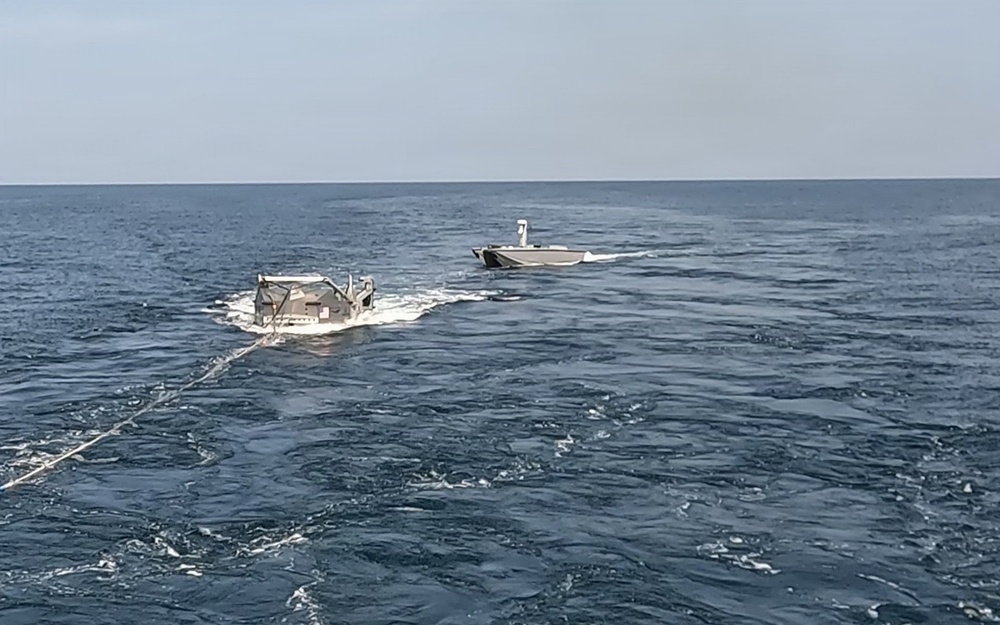
The Navy has taken a major step toward enabling persistent unmanned operations by using a robotic towed connector to repeatedly capture, refuel and release an unmanned surface vessel (USV) at sea.
In seven months, a Navy-industry team moved from concept to real-world testing using the T38, a Navy-owned remotely controlled USV built by Maritime Tactical Systems Inc. (MARTAC), and Sealartec’s towable capture and connection device (TCCD), a robotic refueling system.
The contracting partnership also helped Naval Air Warfare Center Weapons Division’s Blue Water Instrumentation (BWI) address a broader operational challenge: keeping USVs and their sensors on station longer during critical testing of advanced long-range capabilities without increasing reliance on crewed support ships.
“At NAWCWD, our immediate focus is supporting hypersonic and precision long-range fires testing, where flight profiles can extend thousands of miles beyond fixed-range boundaries and require data-collection assets to be distributed across a vast area,” said Spencer Holloway, director of BWI’s Future Capabilities Office. “But the underlying challenge applies more broadly— every time an unmanned vessel must return to port for fuel, we lose persistence, reduce coverage and redundancy, and interrupt the mission.”
During the Aug. 11 demonstration, the team ran dozens of full-cycle capture, refuel and release exercises at sea in addition to the pierside demonstrations, according to Holloway. The training support vessel USNS Vindicator (TSV 5) towed the TCCD and transferred a total of 400 gallons of fuel to the T38 during the event.
In total, the refueling system completed about 100 connection cycles over the course of a few days leading up to and including the event, according to Amitai Peleg, CEO of Sealartec.
Ronald Raymer, branch head for capability, innovation, science and technology integration at U.S. Fleet Forces Command, also took part in the refueling demonstration. He said unmanned refueling can strengthen fleet readiness by enabling greater use of USVs.
“This will allow us to have greater reliance on unmanned vessels instead of manned and we can push the USV into higher threat areas without risking manned vessels and personnel,” Raymer said. “It will also allow us to distribute greater capability into an area without having to invest in large expensive manned vessels and the refueling supports that.”
The event took place in waters off Joint Expeditionary Base Little Creek-Fort Story, Virginia, and was sponsored by U.S. Fleet Forces Command, Naval Surface Warfare Center Dahlgren Division and Naval Surface Warfare Center Carderock Division.
The milestone also brought together BWI, BWI’s Future Capabilities Office fleet management team and industry partners MARTAC and Sealartec. Together, they executed an underway refueling demonstration designed for USVs.
The Littoral Combat Ship Mission Modules Program Office (PMS 420) and the Navy’s Portfolio Acquisition Executive for Robotics and Autonomous Systems also provided contracting support that enabled BWI to partner with MARTAC and Sealartec and to run the demonstration.
Peleg said the Sealartec team gained insights that will help refine the design process of the TCCD. They walked away with lessons about broader operational processes involving the launch, refueling and recovery of USVs.
“Another major takeaway involved our roadmap for transitioning from a remotely operated refueling process to a fully autonomous architecture,” Peleg said. “The USV will approach the refueling device, communicate via automated protocols, and guide itself into position using maneuvering algorithms—virtually eliminating human dependency from the loop.”
Holloway said the short timeline from inception of the TCCD to on-water demonstrations came from the collaboration between government and industry, which allowed the team to respond quickly to changes when needed.
“Working directly with our industry partners allowed us to bring the platform, control systems, operators, and engineers together as one integrated team. We could make changes, test them on the water, and iterate quickly based on what we observed,” Holloway said.
Karl Van Deusen, senior vice president of MARTAC, said working with Sealartec and BWI opened new learning opportunities for the company.
“Testing together in an operational environment allowed the team to identify improvements, apply lessons learned and refine future concepts of operation for unmanned maritime systems,” Van Deusen said.
The demonstration showed the role of government-industry collaboration in moving the TCCD from concept to on-water testing in seven months.
“At industry conferences, we hear a lot of talk about how defense organizations want to adapt to the rapid pace of technology by streamlining procurement and operating more like agile startups,” Peleg said. “BWI didn’t just talk about that mindset; they demonstrated it.”
BWI’s next milestone is an end-to-end autonomous refueling demonstration that will test vessel rendezvous and approach, capture, fuel transfer, disconnection and return to mission as a single evolution.
“The immediate work has two parts: Reducing command-and-control latency to improve precise maneuvering during operator-assisted testing and integrating next-generation local positioning systems to aid in autonomous refueling,” Holloway said.
| Date Taken: |
09.02.2026 |
| Date Posted: |
09.02.2026 16:26 |
| Story ID: |
573828 |
| Location: |
POINT MUGU NAWC, CALIFORNIA, US |
| Web Views: |
50 |
| Downloads: |
1 |
PUBLIC DOMAIN

This work, Naval Air Warfare Center Weapons Division’s Blue Water Instrumentation refuels unmanned surface vessel at sea using robotic towed connector, by Latasha Chavez, identified by DVIDS, must comply with the restrictions shown on https://www.dvidshub.net/about/copyright.