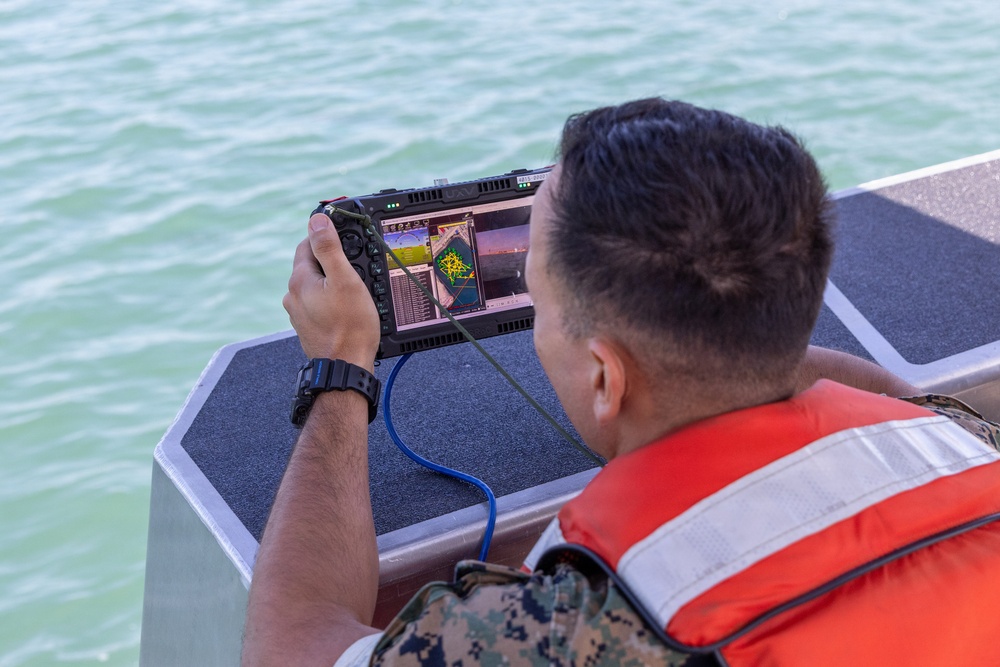
Photo By Kristiana Gehly | The Unmanned Surface Vessel (USV) underwent a Field User Evaluation (FUE) which allowed Marines to receive hands-on practical application and testing in Camp Pendleton, CA, August 17-28, 2026. During the event, fleet users learned how to utilize waypoint navigation, deploy targets, verify locations, and finally put the system to the test on the water. The testing afforded Marines the opportunity to give feedback on the system to the program office during the development phase to ensure relevance and human-system interface in a near-operational environment. see less
| View Image Page
The Unmanned Surface Vessel enhances Littoral Explosive Ordnance Neutralization
In a world of increasing and evolving explosive threats, Portfolio Acquisition Executive Marine Corps (PAE MC) remains one step ahead of the fight. Program Manager Combat Support Systems (PM CSS) is developing solutions that enable increased standoff for Marines to detect, investigate and neutralize threats.
The innovation of Explosive Ordnance Disposal (EOD) and Littoral Explosive Ordnance Neutralization (LEON) systems will provide Marine EOD Technicians with the confidence to operate in contested environments while preserving combat power, increasing operational reach, and minimizing exposure to explosive threats.
The LEON System of Systems (SOS) consists of five increments of capabilities to include a Remotely Operated Vehicle, diver equipment, Unmanned Underwater Vehicle, Unmanned Surface Vehicle, and an Amphibious Unmanned Ground Vehicle. LEON enables EOD to confirm and mark hazards and obstacles from very shallow water to the beach zone.
In late August at Camp Pendleton, the PM CSS Explosive Hazard Defeat Team tested an Unmanned Surface Vessel in response to a littoral capability gap.The solution: seek a commercial USV solution that is equipped with integrated autonomous driving and payloads that consist of Sonar, Forward-Looking Infrared (FLIR) cameras, Line of Sight (LOS) Communications and Acoustic Communications (AComms).
“The USV is a key part of the LEON System of Systems (SOS). While it provides a search capability, it will primarily enable the other LEON systems to conduct operations below the surface, locating and identifying potential hazards, then relaying that information to the surface for real time updates. The LEON SOS will enable maneuver by identifying safe routes for transit within the littorals,” explained Capt. Timothy Guinan, project officer, Explosive Hazard Defeat Team.
As the Marine Corps’ fourth increment of LEON, the USV will allow LEON platoons to scan for potential hazards and provide a communications capability in the form of a Mobile Gateway Buoy (MGB).
“Unmanned systems allow operations to continue without fatigue. These systems can be launched and left to conduct a mission for upwards of 14 hours covering large areas of the littorals, while it requires minimal manpower to monitor the system,” said Guinan.
The Unmanned Surface Vessel (USV) underwent a Field User Evaluation (FUE) which allowed Marines to receive hands-on practical application and testing. During the event, fleet users learned how to utilize waypoint navigation, deploy targets, verify locations, and finally put the system to the test on the water.
Most importantly, the testing afforded Marines the opportunity to give feedback on the system to the program office during the development phase to ensure relevance and human-system interface in a near-operational environment.
“Unmanned systems have always been a part of the EOD family of systems. But now, we’re expanding that into maritime systems that allow more endurance and less risk for operators,” said Chief Warrant Officer 2 Alfredo Andrade, officer in charge, Explosive Ordnance Disposal Company, 7th Engineer Support Battalion (ESB).
“Some of the conflicts that we are engaged in take a toll on the force, and surging in new forces is costly. It turns into a logistical problem. To preserve the safety and the health of the forces…the USV and the [LEON] program exist to ensure that we have readily available combat power,” explained Andrade.
System engineers with the Explosive Hazard Defeat team and EOD technicians with 7th ESB spent two weeks vigorously testing the USV. The teams first tested the system through calm waters, becoming comfortable with the control system and creating mock mine targets. Then, they challenged the USV through a wide-area search in different sea states just off the Pacific Coast.
“The events were very successful. Everyone was communicating well. The platform itself was running well, had long endurance and gave us good results to refine and further develop the capability,” said Andrade.
As the Explosive Hazard Defeat team keeps fleet feedback in mind, force protection remains at the forefront of the mission.
“I am proud to be part of a long legacy of providing protection to the force so that different elements throughout the Marine Corps can do their mission and do it in the safest way [and] achieve success,” said Andrade. “I’m proud to be a Marine that is on the bleeding edge of innovation.”
The Explosive Hazard Defeat team is continuing modernization through collaboration with the fleet to develop capabilities that increase operational effectiveness and support expeditionary operations.
“It’s important that we deliver reliable equipment to the fleet and that we work to leverage their experience and expertise as we work through the acquisition process,” said Guinan.
The validation of the USV will set a pathway to begin fielding systems to EOD companies in fiscal year 2027 and enable the integration of the LEON family of systems to be fielded in the next two years.