
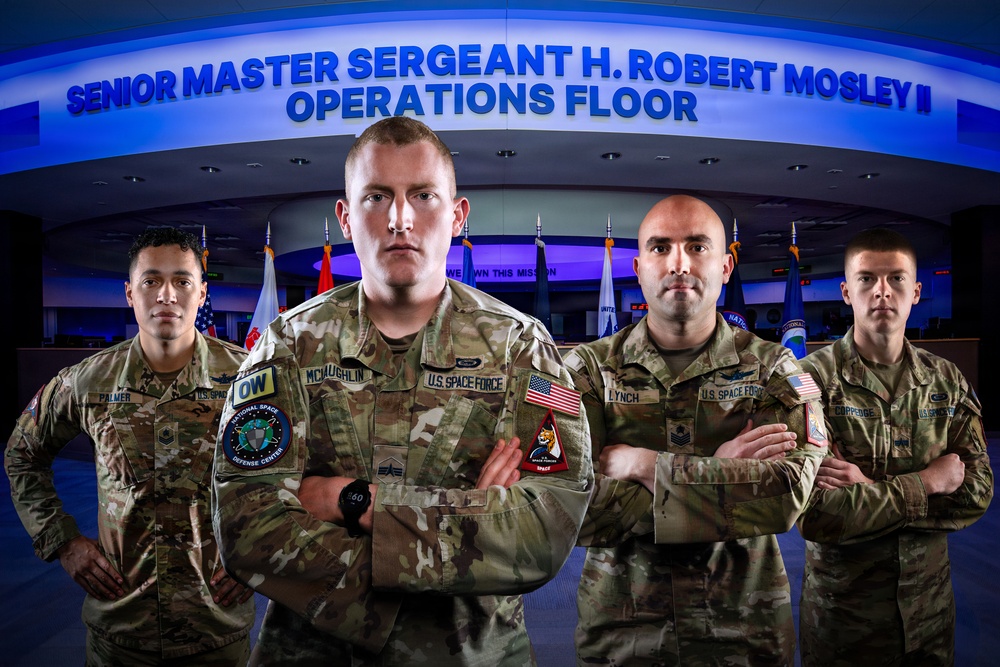
Photo By Dalton Prejeant | From left to right, U.S. Space Force Sgt. David Palmer, National Space Defense Center...... read more read more
Four enlisted Guardians assigned to Space Delta 15 and the National Space Defense Center were recently selected to commission as officers in the U.S. Space Force through two highly competitive military training programs.
Tech. Sgt. Caleb Lynch, Sgt. David Palmer, Spc. 4 Jesse Coppedge and Spc. 4 William McLaughlin will soon trade their enlisted stripes for gold bars, transitioning their years of tactical experience on the operations floor into the commissioned ranks.
The CSO’s Selection
The Senior Leader Enlisted Commissioning Program is a unique path that allows the Department of the Air Force’s most senior leaders to directly select exceptionally performing enlisted members for a commission. For Spc. 4 Jesse Coppedge, NSDC cyber intelligence analyst, this meant being personally picked by Gen. Chance Saltzman, the Chief of Space Operations.
“This achievement was 100% a team effort… it would not have been possible without the unwavering support of my entire chain of command,”Coppedge said. “Navigating the highly competitive SLECP-O process required successive nominations, and I was incredibly humbled to be endorsed at every single echelon of the U.S. Space Force, from my first-line supervisor to the Chief of Space Operations.”
For Coppedge, the motivation to apply came from a desire to expand his influence and pay forward the trust his own leaders showed him early in his career.
“Early in my career, my leadership demonstrated immense trust by empowering me, a junior Guardian, to contribute to Joint Staff level, Combatant Command level and Service level engagements,”Coppedge said. “That trust was transformative and motivated me to commission. I aim to be a servant leader who pays that trust forward and holistically develops agile teams, fosters physical and mentalresilienceand builds cohesive, multidisciplinary units ready to secure our contested space domain.”
A Las Vegas native, Coppedge enlisted in 2023. After arriving at the NSDC in 2024, he worked to master his craft as an analyst while simultaneously pursuing a bachelor’s degree in his free time. Following anon-selectionon his first officer training school application, he was presented with the opportunity to apply for SLECP-O.
“My decision to serve was driven by a desire to contribute to something greater than myself,”Coppedge said. “Working in the U.S. Space Force allows me to apply my skills toward defending our country's most critical assets and ensuring our joint warfighters always maintain the ultimate high ground.”
The OTS Path
Lynch,Palmerand McLaughlin were selected through the Officer Training School application process, each following a different path to the officer ranks.
For Lynch,who works as anNSDCcrew chief anda native of Clyde, Ohio,selectioncame after more than 13 years of enlisted service and five attempts to earn a commission.
Lynch enlisted in the Air Force in 2013 as a space systems operator and has served in assignments spanning satellite command and control, homelanddefenseand orbital warfare. Now atNSDC—where the mission is tointegratespace,intel andcyber capabilities to enablecommand and controlof combat space forces and enhance U.S.space threat detection and defense—looking back,one of his most memorable experiences was helping launch and deploy Wideband Global SATCOM-8.
“My favorite memory of my military service so far is when I helped launch and deploy WGS-8,”Lynch said. “It was such a cool experience being the first to command a satellite and literally telling it to essentially turn on.”
Despite wanting to become an officer early in his career, Lynch nearly decided againstsubmittinghis fifth application before encouragement from NSDC leaders convinced him to try again.
“I was almost not going to apply again as this was my fifth time trying,”Lynch said. “But talking withmyDEL 15 and NSDCleaders, I decided to give it another shot—andthis time it worked. My advice to othersconsideringcommissioningisto notwaitanddon’tassume that youaren’tcompetitive.It took me 13 years and five applications before I was selected.Shoot your shot as many times as it takes.”
For Palmer, an Olathe, Kansas, native who has called Colorado Springs home since 2009, persistence wasrequiredbefore his military career even began. It tooknearly twoyears and two waivers before he was able to enlist.
“Getting through that process taught me early on the importance of persistence,”Palmer said. “Since enlisting,I’vehad the opportunity to grow from learning my technical role to taking on increasing leadership responsibilities and leading others. Being selected for OTS feels like another step in that journey and an opportunity to continue growing while taking on greater responsibility as a leader.”
Today, Palmer serves as an NSDC crew chief, performing sensor management and deconfliction while coordinating efforts between tactical units and higher headquarters.
“The NSDC brings together experts from across the military, intelligence community, and other partners because defending space isn’t something any one organization can do alone,”Palmer said. “Knowing that the work we do directly supports service members operating around the world is what makes this mission so meaningful to me.”
Palmer explained that this operational experience will directly shape how he approaches leadership as a commissioned officer.
“I’ve experienced what it’s like to be on the receiving end of leadership decisions, while also having the opportunity to lead people myself,”Palmer said. “That experience has taught me the importance of understanding the impact decisions have on the people executing them, communicating the ‘why,’ and listening to the people closest to the problem.”
A Dallas native, McLaughlin serves as an NSDC intelligence planner, helping translate intelligence needs and requirements into information operators and planners can use to support the mission.
McLaughlin initially enlistedfor four yearslooking for a stable career and technical training. Once in the Space Force, however, he discovered a mission and lifestyle he wanted to make a longer career. When he considered pursuing a commission, encouragement came from another Guardian making the same transition.
“One of my peer mentors, Jesse Coppedge, told me to stop being scared and just apply,whichhelped encourage me a lot,”McLaughlin said. “My supervisors giving me space to spread my wings and grow also helped me stand out during the application board process.”
McLaughlin said he hopes to use the increased responsibilitythat comes with being an officerto advocate for the mission and the people responsible for executing it.
“I want to be the one to lead the charge to tackle issues head on and pave the way for a new era of growth in the U.S. Space Force,”McLaughlin said. “I want toletnew Guardianswhoare entering the serviceknowthat they are the future of change that the Space Force needs. Ifit’sthe right thing to do, do not wait for someone else to do it for you. Tackle it head on and if you fail,that is okay. Learn from it and keep pushing upwards. We all know the Space Force’s 5th Core value might as well be ‘Change.’ But that is nota bad thing, it is a standard which allows us to grow tomeet future challenges.”
Though their hometowns, careers and paths to commissioningmaysomewhatdiffer, all fourGuardianswill enter the officer corps carrying firsthand experience executingthemission alongside joint service andintelligencecommunity partners.
For Lynch, Palmer, Coppedge and McLaughlin, commissioningrepresentsan opportunity to build upon that experience while taking on greater responsibility for the Guardians and missions they will be entrusted to leadinto the future.
To learn more about the NSDC, visit: www.spaceforces-space.mil/About-S4S/Warfighting-Units/NSDC-National-Space-Defense-Center/
| Date Taken: | 09.02.2026 |
| Date Posted: | 09.02.2026 12:56 |
| Story ID: | 573783 |
| Location: | SCHRIEVER AIR FORCE BASE, COLORADO, US |
| Web Views: | 135 |
| Downloads: | 0 |

This work, Four NSDC Guardians selected to join officer ranks, by Keefer Patterson, identified by DVIDS, must comply with the restrictions shown on https://www.dvidshub.net/about/copyright.

No keywords found.





