
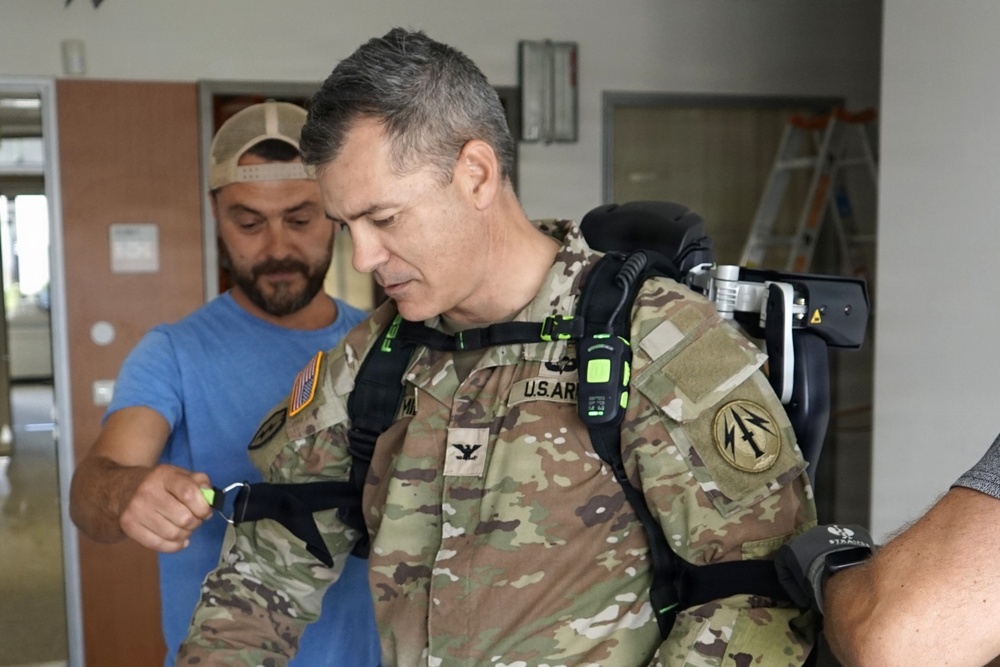
Photo By Natalie Simmel | U.S. Army Garrison Wiesbaden is exploring two innovative ways to empower their...... read more read more
 Subscribe
CLAY KASERNE, Germany — U.S. Army Garrison Wiesbaden is exploring two innovative ways to empower their Directorate of Public Works personnel with technological support: robotic lawn mowers 2.0 and upper-body exoskeletons.
The upgrades come as part of an existing effort to modernize garrison workflows and support frontline personnel, integrating practical automation directly into daily operations.
“I think it's very exciting for each of our directorates, especially DPW, with the amount of manual and physical labor that is done, to look for innovative ways to assist the workforce as well as better accomplish the mission before us,” said Col. Ringo Midles, U.S. Army Wiesbaden Garrison commander.
Upgraded autonomous mowers DPW is experimenting with an updated version of autonomous lawnmowers. While the garrison already uses automated models in several areas across the installation, the upgraded system brings additional operational benefits.
The new model delivers consistent endurance, running continuously for up to eight hours on a single charge. Multi-map storage lets the units transition between designated work zones. Its cutting mechanism features millimeter-precise height adjustments designed for optimal turf health across varied terrain.
As with the previous model, safety remains a priority. The mowers maintain a strict 1.7-meter (about 5.5-foot) perimeter around obstacles and adjust their path when encountering moving objects. Sensors detect people, pets, and small wildlife such as rabbits and hedgehogs, while adaptive learning algorithms refine navigation routes and situational awareness over time.
These autonomous systems free up DPW maintenance teams to reallocate staffing elsewhere on the installation. Where broad-area mowingrequired three- to four-person crews, teams can now scale down to two workers per zone.
“It makes us more efficient,” Midles said. “We are not trying to exchange our staff with new technology; we are trying to support them with it. I would rather see that lawn mower do 80 percent of the work and our skilled workers do the last 20 percent that the robot cannot do and have our manpower directed at other, more pressing matters. We have plenty of work to do.”
During a loan period, DPW is testing the upgraded autonomous lawnmower to evaluate its suitability for use in the installation.
“You have to try them out in order to find where to place investments,” Midles said. “The way this enables a team of DPW workers to be more places and provide better services is exciting to me.”
Exoskeleton support for physical labor DPW purchased one upper-body exoskeleton, deployed in field trials across several DPW departments. “We are testing the exoskeleton with our painters, gardeners, masons, and electricians to identify where it delivers the greatest impact,” said Martin Hallbauer, Deputy Director of DPW.
While the automated lawnmowers alleviate the overall workload, the exoskeleton’s purpose is to support the physical health of the personnel performing the work.
“From a safety and ergonomics standpoint, our priority is safeguarding the long-term health of our workforce,” Hallbauer added. “By delivering measurable ergonomic relief during repetitive tasks, overhead work, and heavy lifting, this technology protects our frontline operators.”
The core benefit of the exoskeleton is physical endurance and injury prevention rather than artificial strength amplification. Designed to support the arms, shoulders, and back, the unit redistributes mechanical load away from vulnerable joints.
This significantly reduces physical fatigue and repetitive stress injuries during sustained heavy lifting and extended overhead tasks, such as streetlight maintenance and warehouse repairs.
| Date Taken: | 09.01.2026 |
| Date Posted: | 09.02.2026 09:15 |
| Story ID: | 573747 |
| Location: | WIESBADEN, HESSEN, DE |
| Web Views: | 26 |
| Downloads: | 0 |

This work, USAG Wiesbaden DPW invests in workforce with new technology, by Natalie Simmel, identified by DVIDS, must comply with the restrictions shown on https://www.dvidshub.net/about/copyright.


No keywords found.




