
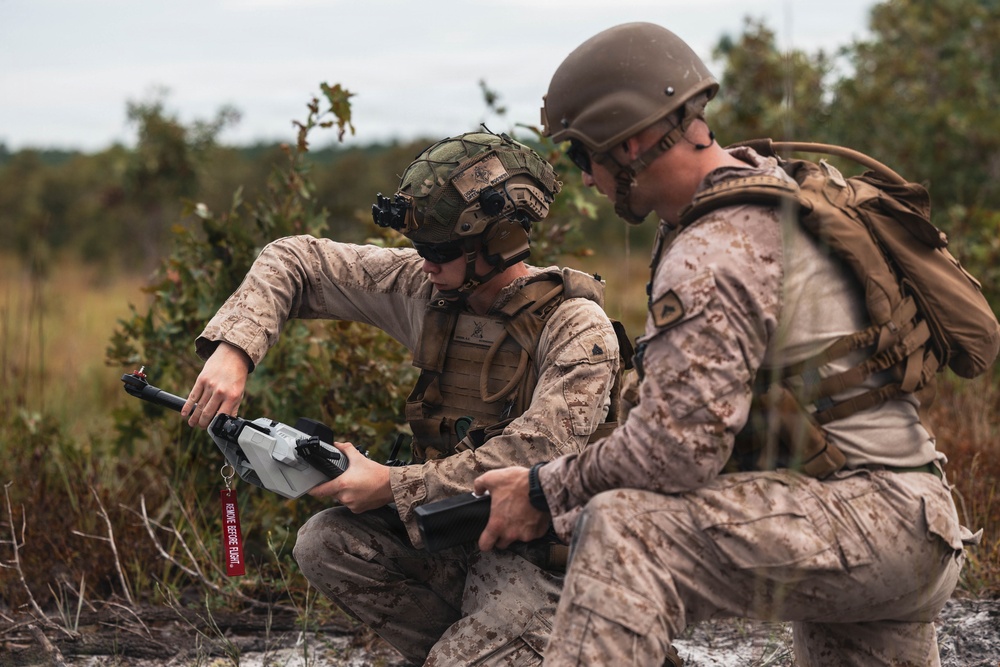
Photo By Sgt. Jorge Borjas | U.S. Marine Corps Cpl. Aidan Greene, left, a vehicle commander with Battalion Landing...... read more read more
 Subscribe
Marine Corps Develops Plan to Grow Force by More Than 6,500
As directed by the Secretary of War in an effort to rebuild the Nation’s military, the Marine Corps developed an executable and adaptable growth implementation plan for the next five years to advance the service’s “First to Fight” capstone concept.
This growth plan sustains modernization momentum and enables the Corps to continue fielding a globally responsive, lethal, and resilient naval expeditionary force in support of fleet maneuver and joint campaigns.
The Marine Corps spent the last several years executing an intense modernization campaign of learning, experimentation, and fielding. That effort gives the Corps a clear blueprint to outpace peer competitors, accelerate modernization, and meet one of the most complex and dangerous threat environments in our 250-year history.
The Force Structure Review turns that blueprint into an executable trajectory. By aligning trained Marines with modernized capabilities, the Marine Corps ensures prior and future investments in robotics, precision fires, counter-UAS, artificial intelligence, and autonomous systems produce warfighting advantages.
The Marine Corps developed a fiscally responsible and executable plan for a 4 percent end-strength growth by 2031 and assessed an additional 1 percent growth the following year to add operational depth across the total force. This growth includes the implementation of more than 6,500 billets across 64 initiatives, realizing modernization investments and generating the trained Marines required to operate, integrate, and sustain modernized capabilities.
This growth accelerates four critical advantages:
Ultimately, this end strength increase delivers a more modern, lethal, resilient, and ready force capable of supporting fleet maneuver, strengthening deterrence, and providing credible options to the Joint Force.
The following are some of the initiatives approved during the Force Structure Review:
Initiative Title
Initiative Background
FUTURE INFANTRY BATTALION
Adds personnel to 19 Infantry Battalions and 2 Littoral Combat Teams to formalize crew-served weapons resiliency, establish heavy guns platoons, and expand precision fires and ISR.
I AND II MEF DIRECT SUPPORT RESTORATION
Restructures units at the Direct Support (DS) and General Support (GS) levels, creating units that can better support an infantry regiment across dispersed sites.
INSTALLATION C-SUAS
Adds structure to installations to establish a dedicated defensive capability that protects Marine Corps installations, personnel, and critical assets from the threat of adversary drones.
ASSURED COMMAND AND CONTROL NETWORK AND SECURITY OPERATIONS CENTER
Establishes regional Network and Security Operations Centers to unify and standardize Command and Control, operations, and security across the Marine Corps Cyberspace Environment.
MARINE CORPS INSTALLATIONS PACIFIC BASE RESILIENCY
Improves forward posture and enables force generation from various installations in the Pacific.
ORGANIC INTELLIGENCE, SURVEILLANCE, AND RECONNAISSANCE INITIATIVE
Activates one Robotics and Autonomous Systems (RAS) Company within each MEF as part of the MIG to meet sensing demands of MAGTF units.
BREACHING AND BRIDGING CAPABILITY
Adds organic breaching and bridging capability to existing formations, aligning structure to the fielding of Stand-off Countermine Systems and Expeditionary Bridging.
MARINE MEDIUM TILTROTOR SQUADRON MAINTENANCE MANDATE
Provides necessary maintenance personnel to 16 Active Component and 2 Reserve Component VMM squadrons to enhance maintenance.
III MEF LCE
Adds capacity across 3d MLG HQ, 3d DSB, and CLB 4, enhancing mission success for III MEF.
STAND-IN FORCE COMMAND AND CONTROL
Provides III MEF the capacity to transition from competition to crisis and conduct EABO, enabling units to fight from local bases and deploy two MEFs.
TARGETING ANALYSIS AND EXPLOITATION
Adds billets to support multi-intelligence analysis cells at the MEFs.
SECTOR AIR DEFENSE COMMANDER, MULTIFUNCTIONAL AIR OPERATIONS CENTER, AND TACTICAL AIR COMMAND CENTER MODERNIZATION
Adds capacity to meet MASS, LAAB and TAOC company within the Marine Air Control Squadron to execute enduring and distributed C2.
DIGITAL OPERATIONS PMOS 0673 CREATION
Creates a permanent digital operations workforce by transitioning the necessary MOS 0673 to a Primary MOS for skills in software engineering, data science, and AI.
SENSE MAKING INTELLIGENCE ENTERPRISE OPTIMIZATION
Expands the Marine Corps intelligence enterprise structure to holistically increase staff capacity and training pipelines across multiple intelligence disciplines.
MARINE CORPS RECRUITING COMMAND REINFORCEMENT
Provides reinforcement to MCRC to meet directed end strength growth and enables sustained accession increases across both enlisted and officer populations.
MARITIME DISTRIBUTION PLATOON AND AIR COORDINATION CENTER
Establishes Air Unmanned Systems Centers of Excellence, Maritime Distribution Platoons, and Air Unmanned Systems Distribution Sections within all three MLGs.
II MEF GENERAL SUPPORT FOOD SERVICE, C2, CALIBRATIONS AND MAINTENANCE
Adds II MEF logistics capacity by adding food service, C2, calibrations and maintenance Marines.
PACIFIC COMMAND AND CONTROL
Provides additional capacity required to support operational requirements to U.S. Pacific Command (PACOM) and U.S. Pacific Fleet (PACFLT).
ALL DOMAIN TARGETING
Builds an All-Domain Targeting capability within MARSOC by integrating specialized intelligence, signals intelligence, infantry, and fires/targeting personnel directly into Marine Raider units.
MARINE FORCES RESERVE INITIATIVES
Encompasses 5 initiatives: Detachment, 6th ANGLICO; Infantry Modernization (Reserve); MACG 48 Reorganization; RC TACAIR Transition and Growth; and MAG 46 Activation.
59XX GROWTH, MEDIUM RANGE AIR DEFENSE RADAR
Adds billets to MASS, LAAB, and MCCESS to enhance the Medium Range Air Defense Radar, a Future Naval Capability initiative.
SMALL UNMANNED AIRCRAFT SYSTEM AND COUNTER-SUAS CENTRAL HUB
Establishes a permanent SUAS and C-sUAS training enterprise to standardize Total Force training, facilitate technology fielding, and ensure MAGTF overmatch.
MOBILE/MARITIME RECONNAISSANCE ENABLERS
Sets conditions for the modernization of Light Armored Reconnaissance Battalions to future mobile/maritime reconnaissance formations, applying structure to EWTG and Supporting Establishments.
SMALL UNMANNED AIRCRAFT SYSTEM SCHOOLHOUSE
Establishes a second Small Unmanned Aircraft System Schoolhouse at School of Infantry - West to increase training throughput of PMOS 7316.
0315 SCOUT PRIMARY MILITARY OCCUPATIONAL SPECIALTY
Establishes a 0315 Scout PMOS for infantry and light armored reconnaissance (LAR) battalions to standardize training and provide a sustainable capability.
| Date Taken: | 09.01.2026 |
| Date Posted: | 09.01.2026 13:09 |
| Story ID: | 573681 |
| Location: | US |
| Web Views: | 83 |
| Downloads: | 0 |

This work, Marine Corps Develops Plan to Grow Force by More Than 6,500, by LTC Eric Flanagan, identified by DVIDS, must comply with the restrictions shown on https://www.dvidshub.net/about/copyright.

No keywords found.




