
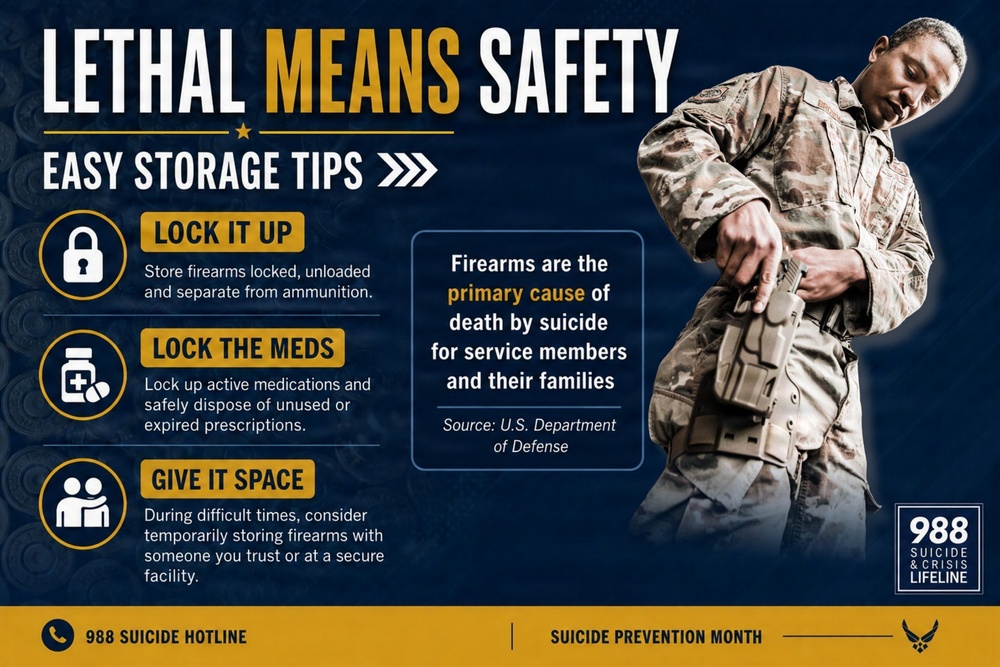
Photo By Jazmine Gutter-Robbins | Graphic outlining easy storage tips for firearms. (U.S. Air Force graphic by Jazmine...... read more read more
As we observe Suicide Prevention Month, the statistics surrounding military suicides remain a sobering call to action. Suicide is a public health issue impacting our military community leaving lasting harmful effects on individuals, families, communities and military readiness.
Through my lens as the Air Force Director of Psychological Health and a mental health provider for over 20 years, sitting across from service members in crisis, a singular, powerful truth consistently emerges: We cannot always predict a suicidal crisis, but we can profoundly impact its outcome by controlling the environment.
Firearms are the primary method of suicide death for service members and family members. Research supports that putting time and distance between an at-risk individual and a lethal means of suicide is an effective way to prevent death by suicide.
The concept of lethal means safety is about creating a critical buffer of time and distance that saves lives for at risk individuals. Research shows a 91% reduction in suicides from initiatives that focus on limiting access to firearms, medications and other potentially dangerous items.
Based on research from the Department of Defense Suicide Prevention Office, the Department of Veterans Affairs, and the National Action Alliance for Suicide Prevention, here is what every Airman, Guardian, supervisor, and leader needs to understand about lethal means safety.
The science of the "pause"
Mental health research clearly indicates suicidal crises are often intensely acute and terrifyingly brief. The period between making the decision to attempt suicide and acting on it can sometimes be measured in minutes.
If a highly lethal method, such as a loaded, unsecured firearm or a stockpile of prescription medications is immediately available during this brief window, the risk of a tragic outcome skyrockets. Putting time and distance between a person in crisis and a lethal method allows the impulse to pass and creates an opportunity for intervention.
We train for every other physical threat. Lethal means safety is the equivalent of tactical defense against an internal adversary.
Actionable defense for every warfighter
For individual Airmen and Guardians, practicing lethal means safety is a standard component of overall readiness and responsible ownership.
Concepts for leaders and supervisors Leaders are the center of gravity for shifting the culture around mental health and lethal means. Policy alone does not save lives; engaged leadership does.
Suicide prevention is complex and lethal means safety offers a straightforward, evidence-based solution. By securely storing firearms, managing medications responsibly, and fostering a command climate where checking on an Airman or Guardian’s environment is standard practice, we buy the most precious resource a person in crisis needs: Time.
Time for the crisis to subside. Time for a wingman to intervene. Time for a life to be saved.
Every second counts in suicide prevention. Educating our service members on lethal means safety practices, asking the hard questions when you notice someone struggling, and leaders being proactive in offering support can give someone an extra moment to change their mind about suicide.
Courtesy article by Col. Elisha P. Pippin, Air Force Director of Psychological Health
| Date Taken: | 09.02.2026 |
| Date Posted: | 09.02.2026 06:59 |
| Story ID: | 573663 |
| Location: | FALLS CHURCH, VIRGINIA, US |
| Web Views: | 14 |
| Downloads: | 0 |

This work, Time, distance, the wingman concept: Why lethal means safety is our strongest defense, must comply with the restrictions shown on https://www.dvidshub.net/about/copyright.


No keywords found.





