
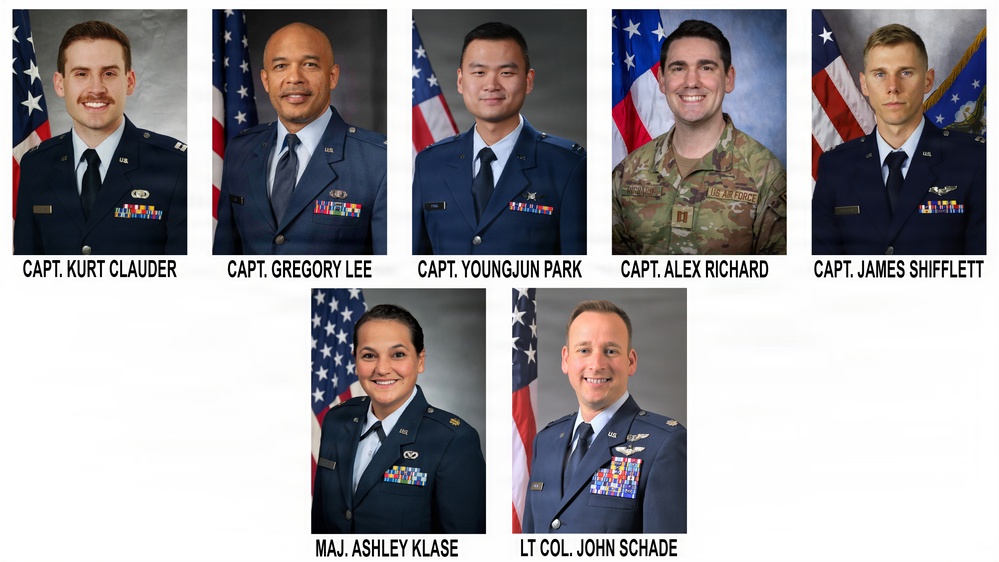
Photo By Staff Sgt. Mikayla Cardona | Air University researchers earned three of the Department of War's four recognitions...... read more read more
 Subscribe
MAXWELL AIR FORCE BASE, Ala. - Air University researchers took on three very different problems facing the joint force: deterring an amphibious attack in the Indo-Pacific, building expeditionary airfields faster and keeping information moving when communications fail. Their work earned Air University three of the Department of War's four recognitions in the 2025-26 Academic Research Challenge.
The three recognized papers came from different parts of the university. Squadron Officer School's Air University Advanced Research program produced the first-place paper, Air Force Global College produced the second-place paper, and Air War College produced the honorable mention. Air Command and Staff College and the School of Advanced Air and Space Studies also submitted research.
The deputy secretary of war and the vice chairman of the Joint Chiefs of Staff co-sponsor the Academic Research Challenge, administered by the Joint Staff J-7. Each year, students and faculty at professional military education institutions develop research on strategic and operational issues.
For Margaret Sankey, Air University director of research and electives, the results start with the students willing to take on the work. "The exceptional quality of Air University research stems directly from the intellectual curiosity of our students," Sankey said. "When you have company grade officers volunteering to take on additional, intensive research during a fast-paced, five-week Squadron Officer School course, it shows a relentless dedication to solving the most complex and pressing challenges facing our military."
Five officers in Squadron Officer School's Air University Advanced Research program authored the first-place paper. Air Force Capts. Kurt Clauder, Greg Lee, Youngjun Park, Alex Richard and James Shifflett studied commercially available autonomous technologies and deterrence in the Indo-Pacific. They proposed pairing low-cost loitering munitions with artificial intelligence-enabled target recognition to identify and engage high-value amphibious transport assets during a potential Taiwan contingency. The concept was designed to keep operating through communications disruptions and electronic warfare.
Air Force Maj. Ashley Klase of Air Force Global College earned second place for research on speeding up Agile Combat Employment by changing how expeditionary airfields are built. Her research considered modular infrastructure, additive manufacturing, robotics, deployable microgrids and advanced soil stabilization, with the goal of cutting construction timelines from several weeks to 24 to 72 hours while reducing the logistics needed for dispersed air operations.
Air Force Lt. Col. John Schade of Air War College turned to lessons from Ukraine for the paper that received an honorable mention. He studied how Taiwan could use citizen reporting, crowdsourced intelligence and commercial cloud computing to build a distributed information network. The approach could help maintain situational awareness and battlefield transparency when communications and electronic systems are degraded.
The projects aligned with Joint Staff priorities such as contested logistics, integrated deterrence, artificial intelligence and emerging technologies. The first- and second-place researchers briefed the vice chairman of the Joint Chiefs of Staff and senior Joint Staff leaders during a May 2026 virtual briefing. Schade's paper has also been selected for a future Pentagon briefing.
"Our students are capturing true operational relevance that directly informs warfighting and lethality by bringing their real-world experiences to the table," Sankey said.
| Date Taken: | 08.31.2026 |
| Date Posted: | 08.31.2026 16:33 |
| Story ID: | 573619 |
| Location: | MAXWELL AIR FORCE BASE, ALABAMA, US |
| Web Views: | 18 |
| Downloads: | 0 |

This work, Air University earns 3 of 4 DoW honors in Academic Research Challenge, by SSgt Mikayla Cardona, identified by DVIDS, must comply with the restrictions shown on https://www.dvidshub.net/about/copyright.

No keywords found.




