
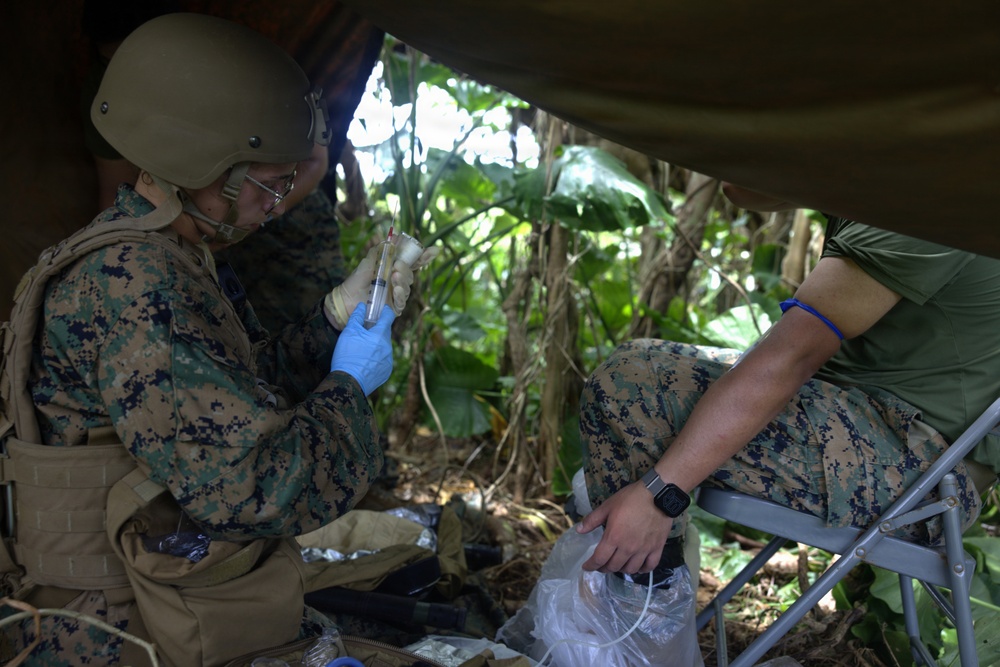
Photo By Lance Cpl. Haley Munoz | U.S. Navy Petty Officer 2nd Class Raegan Walter, a dental technician with 12th...... read more read more
 Subscribe
CAMP COURTNEY, OKINAWA, Japan — On the sandy beaches and in the dense jungles of Okinawa, U.S. service members, from commands throughout the region, conducted a combat trauma management course at Camp Courtney, Okinawa, Japan. The CTMC is a three-week program designed to develop service members into adaptable and operationally capable medical providers who can sustain prolonged medical care to patients in the challenging Pacific region.
“These service members are coming from different commands across the island,” said Petty Officer 2nd Class Thomas King, the lead instructor of the course. “The course challenges students beyond typical combat medic courses. They are expected to hike with their med bag attached to their ruck or conduct autologous blood transfusions, giving the providers the skills and knowledge necessary to extend care from a one-hour timeline to up to 24 hours.”
To achieve this level of proficiency, the training is built around the realities of littoral and jungle operations. Conducted under intense physical and mental stress, the course prepares providers to treat, sustain, and evacuate casualties in realistic, austere conditions for prolonged periods. The environment is specifically designed to replicate the uncertainty, discomfort, and physical demands of operational environments.
Specifically, service members participate in a series of realistic scenarios that can begin with ruck marches, buddy drags and repeatedly submerging in the ocean and sand to create wet, friction-filled conditions. From there, students construct their own field treatment centers to care for simulated casualties while conducting live blood transfusions. Under these demanding conditions, students must quickly assess casualties, identify immediate life-threatening injuries, and develop viable evacuation strategies.
“The course addressed a fundamental concern, which is sustaining a casualty for a prolonged period of time when an evacuation is not immediately available,” said Petty Officer 3rd Class Matthew Sanchez, a student in the CTMC. “It taught us to think about every aspect of prolonged patient care, from brushing their teeth to blood transfusions, reinforcing the need to stay adaptable and teaching us how to continue the fight even after sustaining casualties.”
During these scenarios, students are expected to manage critical airway problems, stop hemorrhaging, and resolve respiratory issues, all while successfully performing blood resuscitations in the field.
"These threshold blood transfusions are what will save lives and make a difference when you are resuscitating patients in the jungle or on the decks of ships where you don't have the same established medical assets that you do in your classic role 2 or role 3 facilities," said Lt. Cmdr. Matt Christianson, an emergency medicine doctor with 3rd Medical Battalion. "The most important learning objectives for this course are how to screen donors, safely obtain a unit of blood, and safely deliver that blood. The students must do all of this while recognizing hemorrhagic shock and understanding how to fit blood resuscitation into tactical combat casualty care."
While the course is rooted in combat tactics, the ability to quickly assess and intervene during life-threatening trauma is highly transferable to non-combat environments. The Indo-Pacific region is highly prone to severe natural disasters, including typhoons, earthquakes, and tsunamis. When these disasters strike, the prolonged field care skills taught in the CTMC become vital. Whether treating service members or assisting local populations during humanitarian aid and disaster relief missions, these providers can establish field-expedient treatment centers and perform critical blood transfusions. The capacity to sustain life for up to 24 hours without immediate evacuation ensures that these service members can act as a crucial bridge to survival for both military personnel and civilians in crisis zones.
The training provided in the course ensures that medical professionals are prepared for the worst-case scenario. The CTMC will continue to educate service members throughout the region, providing them with the knowledge, confidence, and practical experience necessary to treat casualties in demanding environments and reinforcing medical readiness throughout the Pacific.
| Date Taken: | 08.27.2026 |
| Date Posted: | 08.31.2026 04:07 |
| Story ID: | 573552 |
| Location: | JP |
| Web Views: | 25 |
| Downloads: | 0 |

This work, U.S. Service Members Conduct a Combat Trauma Management Course, by 1LT Joshua Figueredo, identified by DVIDS, must comply with the restrictions shown on https://www.dvidshub.net/about/copyright.


No keywords found.




