
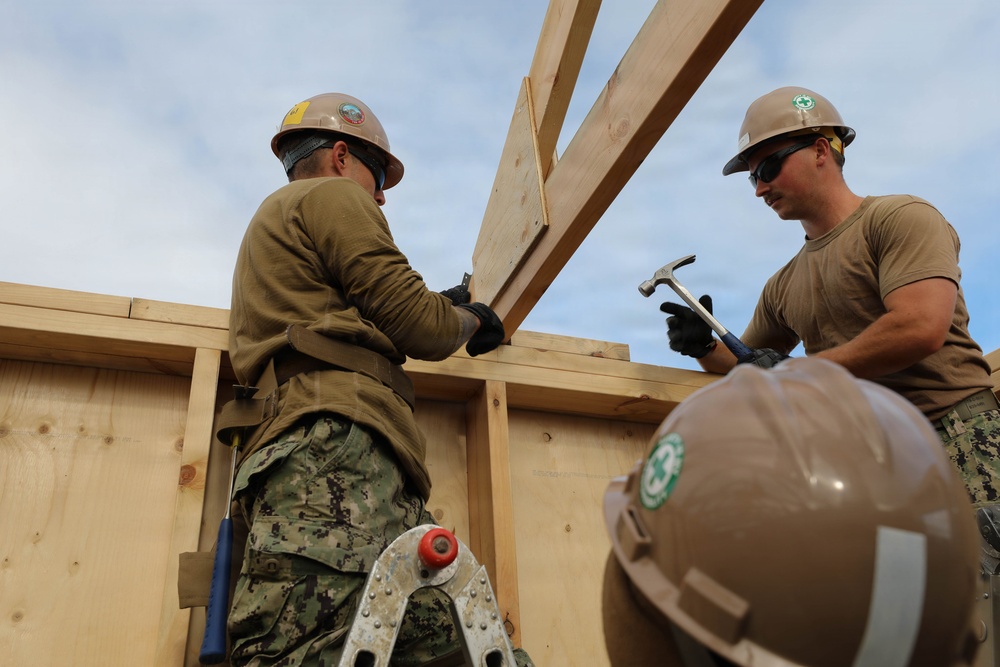
Photo By Petty Officer 1st Class Jasmine Suarez | Construction Mechanic 2nd Class Zac Muller, left, and Construction Mechanic 2nd Class...... read more read more
U.S. Navy Seabees participating in exercise Northern Viking 2026 are helping refine a familiar piece of expeditionary infrastructure for a different operating environment, constructing the third prototype of an Arctic Bee Hut at Keflavik Air Base.
The Arctic Bee Hut builds on generations of rapidly constructed wooden shelters used by the Naval Construction Force (NCF) to provide expeditionary living and working spaces.
While the Southwest Asia hut, commonly referred to as a SWA hut, became a familiar structure during operations in hot, arid environments, the Arctic version adapts that concept for colder climates.
“The environment matters when we build expeditionary structures,” said U.S. Navy Lt. Arthur Hines, 22nd Naval Construction Regiment future operations officer. “What works in one location may need to be adapted somewhere else.”
Compared with a traditional SWA hut, the Arctic Bee Hut incorporates additional insulation and structural changes intended to make the shelter better suited for freezing temperatures, wind and snow.
Seabees assigned to Naval Construction Battalion (NCB) 27 are putting those changes into practice during Northern Viking, positioning precast concrete footers, constructing the floor and walls and installing insulation as the structure takes shape.
“The basic construction skills are the same, but there are some significant differences in the design,” said U.S. Navy Senior Chief Jon Murray, NCB 27 Arctic Bee Hut project lead. “We’re dealing with heavier framing, a steeper roof pitch, and extreme insulation measures for cold prevention. The crew has to understand not only how to build it, but why those differences matter.”
The NCF is developing the Arctic Bee Hut in partnership with the U.S. Army Engineer Research and Development Center (ERDC), located in Vicksburg, Mississippi. Feedback from the Seabees constructing the prototypes is being incorporated into the design, which will ultimately be available to the joint engineer community through the Joint Construction Management System.
“We have partnered with the U.S. Army ERDC, which took our input and are actively designing the Arctic Bee Hut,” said U.S. Navy Chief Warrant Officer 5 Christopher Vollmer, 22nd NCR future operations chief. “This new design will be available to the entire joint engineer community through the Joint Construction Management System.”
The Keflavik build provides another opportunity to evaluate both the design and the construction process.
Lessons from the build will be returned to ERDC, while the completed structure will remain in Iceland for use as a storage building and provide an opportunity to observe how the design performs over future winters.
“Because this is still a prototype, we’re not just building it and walking away from it,” said Murray. “We’re looking at locational requirement differences where the crew runs into challenges and what could be done better the next time. What we learn here can help improve the design for the next crew that has to build one.”
The Northern Viking project follows another Arctic Bee Hut build earlier this summer during Baltic Operations 2026, when NCB 14 Seabees constructed a prototype in Skrunda, Latvia. Lessons from previous builds have already contributed to adjustments in areas such as floor insulation and structural details.
The Northern Viking build gives the NCF another opportunity to evaluate the design in the environment it is intended to support.
“This new design is part of the NCF’s larger effort to be more ready for a conflict in the high northern regions of Europe or North America,” said Vollmer.
Operating in Iceland also exposes Seabees to considerations that cannot be replicated by reviewing construction plans alone.
“Material, logistics, permitting, environmental and host-nation distinctions can only be learned on the ground,” said Vollmer. “With the establishment of the U.S. Navy Cooperative Security Location Keflavik, it is vital Seabees can seamlessly perform in Iceland whenever required.”
For NCB 27, the project provides both an immediate training opportunity and a chance to contribute lessons that could shape how joint engineers construct expeditionary infrastructure in cold-weather environments in the future.
Northern Viking 26 is a U.S. European Command-directed, U.S. Naval Forces Europe-led exercise executed by U.S. Sixth Fleet. The exercise brings together U.S. and Allied forces to strengthen interoperability and readiness in the defense of Iceland and the strategic lines of communication across the North Atlantic.
| Date Taken: | 08.26.2026 |
| Date Posted: | 08.29.2026 09:09 |
| Story ID: | 573520 |
| Location: | IS |
| Web Views: | 20 |
| Downloads: | 0 |

This work, Built for the Cold: Seabees Adapt Expeditionary Infrastructure During Northern Viking 26, by CPO Justin Stumberg, identified by DVIDS, must comply with the restrictions shown on https://www.dvidshub.net/about/copyright.


No keywords found.





