
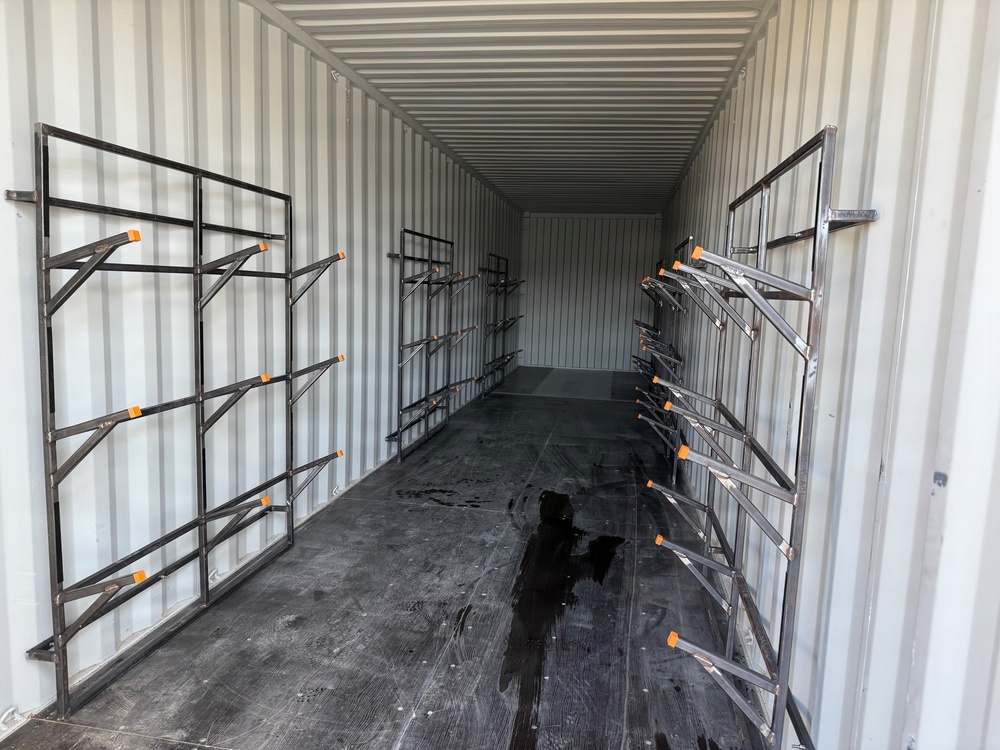
Courtesy Photo | Electronic warfare pod racks developed by the 53rd Test Support Squadron sit inside a...... read more read more
TYNDALL AIR FORCE BASE, Fla. — Two hundred pounds can take many forms.
On a weight bench? “Ain’t nothin’ but a peanut,” as bodybuilding legend Ronnie Coleman would say.
In an electronic warfare work center, though, where every pound of it costs roughly $1,000, asking for an extra set of hands—or several—might be the best course of action.
Or, if you’re a member of the 53rd Test Support Squadron at Tyndall Air Force Base, Florida, you could bring the rack.
A newly developed electronic warfare pod rack from the squadron’s Advanced Threat Replication flight is turning what once required a two-person carry into something personnel can more easily move, store and maintain.
The solution may never leave the shop, but the equipment it holds helps create the threat environments Air Force aircraft and weapons are tested against, said 1st Lt. Maxine Bresnaider, 53rd TSS lead engineer of special devices.
“Moving that equipment in a way that safely secures them and allows for testing without additional alterations to the electronic warfare pods is highly desired,” Bresnaider said.
Moving the weight, though, was only part of the problem.
EW payloads contain sensitive equipment that requires proper handling and storage. Any solution therefore had to do more than get a pod from one side of the shop to another. It also had to keep it secure once it got there. For equipment this sensitive—and potentially expensive—that support is crucial.
“If a part or asset were to fall off during storage or maintenance, it could break critical assets or cause up to hundreds of thousands of dollars in damage,” said Senior Airman Daniel Dehart, 53rd TSS metals technology journeyman.
Unlike equipment designed for flight, however, the pod rack doesn’t have to satisfy aircraft airworthiness requirements.
It never leaves the shop.
Instead, engineers focused on making sure the materials and structure could support the loads placed on them during storage and maintenance.
The simplicity is intentional.
By making the pods easier to access, maintain and move, the rack reduces handling required between storage and use while allowing the flight to accommodate additional payloads.
That can translate into less time preparing the equipment and more time having it ready to support the mission. “This capability allows the flight to store additional pods in a way that provides easy calibration and assembly to get them out the door quicker,” Bresnaider said. “The ease of movement is an additional capability that allows our flight to operate more efficiently.”
The rack itself won’t replicate an adversary’s electronic signature. It won’t fly. It won’t even leave the shop.
But when the equipment sitting on it is needed for the next test, the rack helps make sure hundreds of pounds of sensitive electronics are ready to go with it.
| Date Taken: | 08.28.2026 |
| Date Posted: | 08.28.2026 14:36 |
| Story ID: | 573479 |
| Location: | TYNDALL AIR FORCE BASE, FLORIDA, US |
| Web Views: | 16 |
| Downloads: | 0 |

This work, Lightweight, baby!: 53rd TSS rack supports electronic warfare testing, by SSgt Christian Conrad, identified by DVIDS, must comply with the restrictions shown on https://www.dvidshub.net/about/copyright.

No keywords found.





