
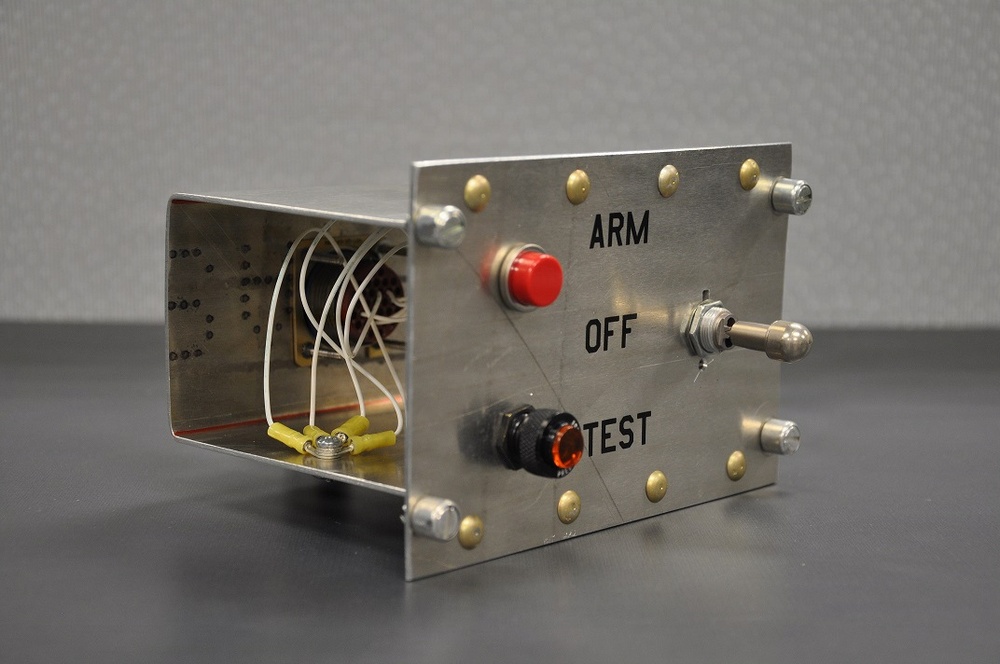
Courtesy Photo | A NULLO panel sits on display at Tyndall Air Force Base, Florida. The approximately...... read more read more
TYNDALL AIR FORCE BASE, Fla. — It costs roughly $60.
A handful of wires. A switch. A panel small enough to disappear among the thousands of components packed inside an F-16.
But when that F-16 takes off without a pilot in the cockpit, the small assembly carries a much larger responsibility. If something goes wrong, it helps ensure the aircraft doesn’t.
Known as a NULLO panel, the component is installed aboard QF-16 Full-Scale Aerial Targets operated by the 82nd Aerial Targets Squadron. NULLO, short for “Not Under Live Local Operator,” refers to QF-16 missions flown remotely with no pilot aboard.
The modified fighters provide the Department of War with a threat-representative, full-scale target against which aircraft and weapons can be tested in conditions approaching those they could encounter in combat.
That realism, though, harbors inherent risk.
“The NULLO panels are a switch installed in the QF-16s which is armed on the ground when they are flown remotely,” said Senior Airman Kianna Kielb, 53rd Test Support Squadron avionics journeyman and avionics lead for the project. “This allows the pilots to remotely detonate the aircraft in the event that something goes wrong in flight to ensure the drone does not cause any damage to property.”
That capability is especially important along the Gulf Coast, where the aircraft operate in test airspace surrounded by civilian communities and government infrastructure.
“The ability to terminate a drone flight is critical to risk-management processes and decision-making,” Kielb said. “It allows evaluators to simulate more threat-realistic environments and advance munitions testing without compromising the safety of those who inhabit areas that surround the Gulf Test and Training Range.”
Good news, he continued, considering the QF-16 is more than a purpose-built drone.
Each began life as an operational F-16 Fighting Falcon before being modified into an optionally piloted Full-Scale Aerial Target. The aircraft retain the performance characteristics that made the F-16 an effective fighter, including supersonic speed and nine-G maneuverability.
Those capabilities permit test teams to pit modern aircraft and weapons against something much closer to the fighter-sized threats they may encounter in combat.
They also mean engineers are integrating new equipment into an airframe designed decades ago.
“Integrating the wiring from our assembly into a 50-year-old retrofitted aircraft is not an easy task,” said Senior Airman Jonathan Rath, 53rd TSS aircraft structural maintenance craftsman.
The challenge goes beyond finding somewhere to put a switch.
“There are a lot of processes and requirements in place when modifying any military aircraft,” he continued. “Every component that will be used in flight must pass a number of flight-worthiness inspections before it is cleared to fly.”
The current panel also represents an effort to find a simpler solution to an expensive problem.
In 2016, the shop was tasked with redesigning an industry-produced version of the panel as a cost-saving measure. According to Rath, the original panels cost thousands of dollars each.
The redesigned version costs approximately $60.
Its consequences, however, aren’t cheap.
“This is also a project that, if not executed correctly, could cost lives,” said Tech. Sgt. Kory Kusmierczyk, 53rd TSS aircraft structural maintenance journeyman. “It is important to understand the risk when engineering something that has the potential to seriously injure or kill someone if it malfunctions.”
That engineering helps enable a mission the Air Force cannot easily reproduce elsewhere.
The 82nd ATRS operates the Department of War’s full-scale aerial target capability, using QF-16s to support developmental and operational testing and live-fire weapons evaluations. The aircraft can fly with a pilot aboard or remotely as a NULLO, allowing weapons to be tested against a maneuvering, fighter-sized target without placing an aircrew member in the cockpit.
The result is a paradox at the heart of weapons testing: creating increasingly realistic combat conditions while controlling the risks that realism introduces.
For the NULLO panel, accomplishing that mission comes down to a few wires, a switch and roughly $60 worth of hardware.
Small enough to overlook.
Too important to fail.
| Date Taken: | 08.28.2026 |
| Date Posted: | 08.28.2026 14:36 |
| Story ID: | 573476 |
| Location: | TYNDALL AIR FORCE BASE, FLORIDA, US |
| Web Views: | 14 |
| Downloads: | 0 |

This work, $60 NULLO panel helps safeguard QF-16 weapons testing, by SSgt Christian Conrad, identified by DVIDS, must comply with the restrictions shown on https://www.dvidshub.net/about/copyright.

No keywords found.





