
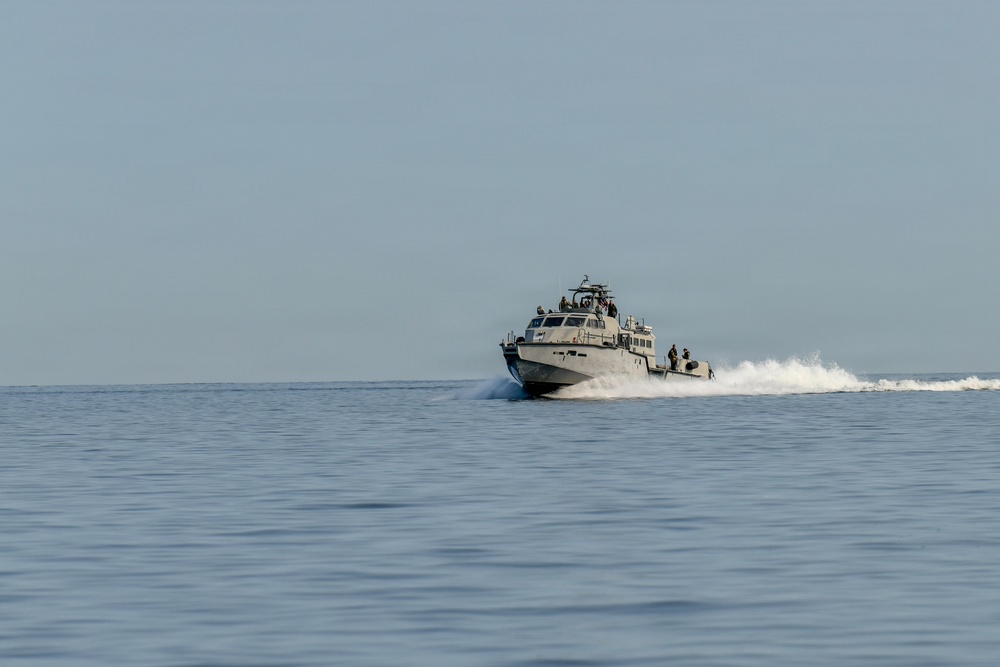
Photo By Tech. Sgt. Tristan Viglianco | The Michigan National Guard’s Mark VI patrol boat evades pursuit during Exercise...... read more read more
 Subscribe
Off the coast of Lake Huron, the Michigan National Guard has been testing visiting aviation units’ ability to operate in the littoral and maritime domains. Through the deliberate acquisition of various watercraft, including the recently added Mark VI patrol boat, Michigan’s maritime capabilities challenge visiting units to conduct complex air operations.
“Our maritime program allows us to do training in support of air operations in maritime surface warfare (AOMSW),” said Cmdr. Curtis Webster, U.S. Navy (Ret.), Michigan Air National Guard (MIANG) strategic and maritime planner. “For example, we interact with combat air forces and rotary-wing aircraft, allowing them to conduct sea surveillance and targeting of vessels of interest in the maritime domain.”
After recently acquiring the Mark VI from the Defense Logistics Agency, Northern Strike 26-2 marked the first time the former U.S. Navy vessel was utilized by the National Guard to support visiting training units.
“Our brand-new platform, the Mark VI, has a lot of utility," said Webster. “It gives us the ability to do a high-speed run out to the restricted zone in Lake Huron and conduct live-fire support out there.”
One particular focus of this year’s exercise was enabling visiting fighter aircraft and rotary-wing assets to conduct the joint targeting process against maritime surface vessels.
“The Mark VI and other vessels were helpful in replicating small, fast-attack craft, like those found in the U.S. Central Command and U.S. Pacific Command geographic areas of responsibility,” said U.S. Air Force Lt. Col. Shannon Vickers, the MIANG’s 127th Operations Group commander and A-10 Thunderbolt II pilot. “The boat and crews seemed to be aware of a pending attack and maneuvered realistically, presenting an aware bandit which made us work to achieve a kill.”
This training is made possible by the expansive 17,000-square-mile airspace complex located within Northern Michigan’s National All-Domain Warfighting Center (NADWC).
“It’s rare to have a chance at finding and attacking a fast-attack boat,” said U.S. Air Force Maj. William Wurtzer, the Indiana Air National Guard’s 163rd Fighter Squadron chief of standards and evaluation and F-16 Fighting Falcon pilot. “The large airspace, mixed with water and land while also being able to operate down to the surface and up to 50,000 feet, provides the ability for the F-16 to execute all of our tactics.”
In addition to AOMSW, Michigan’s layered airspace meets the real-world pilot and aircrew training requirements for the identification and interception of unmanned aircraft systems (UAS) and cruise missile threats over Lake Huron. This was made possible through the implementation of microjets and other small air platforms as dynamic targets.
“Both the counter-UAS and AOMSV missions allowed us to realistically train to the threat faced downrange by the 107th Fighter Squadron today,” said Vickers. “This mimics the threat presentation of CENTCOM well. It gave us a complicated air and surface fight that benefits our team’s readiness.”
The air-to-water range is unique among Air National Guard training facilities and gives visiting units maritime and littoral experience, paying dividends to the joint force. Acquiring the Mark VI was a long-term initiative to further enhance the training value provided by the Alpena Combat Readiness Training Center and the NADWC.
“Northern Strike showed that the NADWC can deliver joint all-domain training with a real military maritime target,” said U.S. Air Force Lt. Col. Brian Wyrzykowski, Michigan National Guard Joint Forces Headquarters deputy director of future capabilities and strategic integration. “The Mark VI demonstrated that we're not just talking about all-domain concepts. We are expanding counter-maritime training opportunities for the joint force.”
The Mark VI was also used to facilitate UAV landings, unmanned surface vessel support, littoral medical resupply and evacuation, friendly surface vessel escort, and remote command and control operations.
“Not only is the Mark VI a unique training platform; it's a foundation,” said Wyrzykowski. “We're using it to build out a realistic, multi-domain training environment that is scalable and adjusts to an adversary’s ever-changing tactics. It's not just a boat; it's an integrated joint battlespace enabler.”
| Date Taken: | 08.28.2026 |
| Date Posted: | 08.28.2026 14:26 |
| Story ID: | 573454 |
| Location: | ALPENA, MICHIGAN, US |
| Web Views: | 29 |
| Downloads: | 0 |

This work, Hunting over Huron: Michigan Creates Mission-Ready Pilots in Maritime Domain, by TSgt Tristan Viglianco, identified by DVIDS, must comply with the restrictions shown on https://www.dvidshub.net/about/copyright.


No keywords found.




