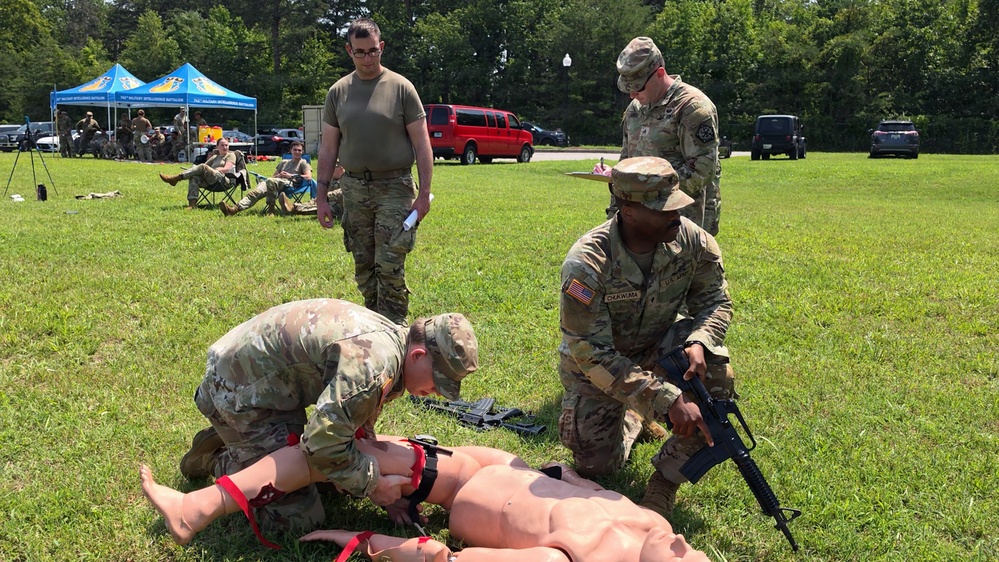
FORT GEORGE G. MEADE, Md. — Although their primary mission is rooted in signals intelligence, Soldiers assigned to Alpha Company, 742nd Military Intelligence Battalion, know that does not exempt them from the fundamental battlefield skills every Soldier is expected to master.
Soldiers from Alpha Company conducted Tactical Combat Casualty Care training Aug. 13 with assistance from the Military District of Washington Fort A.P. Hill Regional Training Support Center (RTSC) (North). The training gave Soldiers an opportunity to strengthen essential medical skills while preparing for the Expert Soldier Badge.
The Expert Soldier Badge is an Army special skills badge awarded to Soldiers outside infantry, Special Forces and combat medic military occupational specialties who demonstrate proficiency in warrior tasks, land navigation and physical fitness.
The hands-on training also demonstrated how the RTSC can help Fort Meade units overcome the challenges of an installation with limited training space.
The training began several weeks earlier, when Staff Sgt. Hilton Epps and Sgt. Felicia Burgett contacted the RTSC to discuss training requirements, said Robert R. “Red” Howard, D.D., Training Support Branch lead, Military District of Washington Fort A.P. Hill Regional Training Support Center (RTSC) (North).
“They had planned this entire event from scratch and asked us to provide the right training enablers to support their mission-essential task list training goals,” Howard said.
Rather than simply providing equipment, RTSC personnel worked with the Soldiers to determine which training aids could best support the company’s objectives. Epps and Burgett then incorporated those resources into their training plan, creating an immersive medical training environment.
The RTSC provides a range of training aids, devices, simulators and simulations to support unit training requirements. Its Fort Meade site is a subsite of the Fort A.P. Hill Regional Training Support Center and supports units throughout the surrounding Maryland area.
For Epps, the value of the training went beyond preparing Soldiers for a badge.
“Every Soldier needs to know these skills — how to shoot, move, communicate, medicate,” Epps said. “The better we’re able to do these tactical skills, the better we’re able to provide support to any other unit, wherever we may be.”
That philosophy is particularly important for a military intelligence unit. While many intelligence Soldiers spend much of their time working in office or technical environments, they remain Soldiers first and must maintain proficiency in Armywide tasks.
“Although we are here and our job is mostly in the office, we are still in the Army,” Burgett said. “We like to emphasize proficiency in Army tasks and drills.”
Burgett said TCCC is a skill level 1 task all Soldiers should be able to perform. Maintaining proficiency also prepares Soldiers for future assignments, where their ability to respond to a casualty could be critical.
“Not all of the Soldiers will stay with our units,” she said. “We will transition at some point, and we cannot predict the future of where our Soldiers will go. At that point, it’s best to maintain a variety of skills.”
For the training, the RTSC supplied a variety of equipment, including litters, Rescue Randy manikins and injury simulation kits that allowed Soldiers to practice responding to battlefield injuries.
The RTSC also helped connect the company with the brigade physician assistant’s office, expanding the resources available to the training team, Epps said.
“RTSC has been probably the biggest help that we’ve gotten,” Epps said.
RTSC personnel provided the Soldiers with a worksheet detailing available equipment, led them through the facility and explained different training options. Burgett said the staff also discussed additional simulators, weapons and sound effects that could have been incorporated into the event had the company had more preparation time.
“It was actually a really pleasant experience, very helpful,” Burgett said. “Any questions I had, they knew what they would be before I even had them.”
The resulting training was a team effort. Epps said about eight trainers participated, including Combat Lifesaver-qualified noncommissioned officers who led individual training groups. Junior enlisted Soldiers worked alongside them, gaining experience not only as participants but also as trainers.
That approach gave the company an additional training objective: developing leaders who understand how to plan and execute training.
“We have CLS-qualified NCOs that are in charge of their training groups,” Epps said. “And we have junior enlisted Soldiers under them as well to get both that leadership experience and what it looks like to actually run a training and be a part of that process.”
Howard said that type of collaboration is central to the RTSC’s mission.
The center works with Army, joint and interagency forces to provide flexible and relevant training enablers while helping units determine how best to employ those resources in the environments available to them.
“We understand the unique training challenges at Fort Meade, particularly the lack of physical training areas available to operate our enablers,” Howard said. “Because of this, we work diligently with units to brainstorm creative training ideas and select the absolute best enablers for whatever environment they choose to train in.”
When units require larger scale collective training, Howard said the Fort A.P. Hill Regional Collective Training Center in Virginia provides more than 76,000 acres of training space where units can employ training enablers alongside their weapons, vehicles and equipment.
For Fort Meade’s intelligence Soldiers, however, readiness starts with mastering the fundamentals wherever they can train.
The Aug. 13 TCCC event showed that even a unit whose daily mission centers on intelligence can build combat readiness through creative planning, hands-on training and close coordination with installation training support professionals.
For Burgett, the ultimate goal is simple: ensure Soldiers leave the unit better prepared for whatever comes next.
“We just kind of want to make sure we’re setting everyone up for success, even if it’s not with our unit,” she said.
| Date Taken: |
08.27.2026 |
| Date Posted: |
08.27.2026 14:33 |
| Story ID: |
573370 |
| Location: |
FORT GEORGE G. MEADE, MARYLAND, US |
| Web Views: |
19 |
| Downloads: |
0 |
PUBLIC DOMAIN

This work, TSC helps MI Soldiers sharpen combat lifesaving skills, by Bryan Spann, identified by DVIDS, must comply with the restrictions shown on https://www.dvidshub.net/about/copyright.