
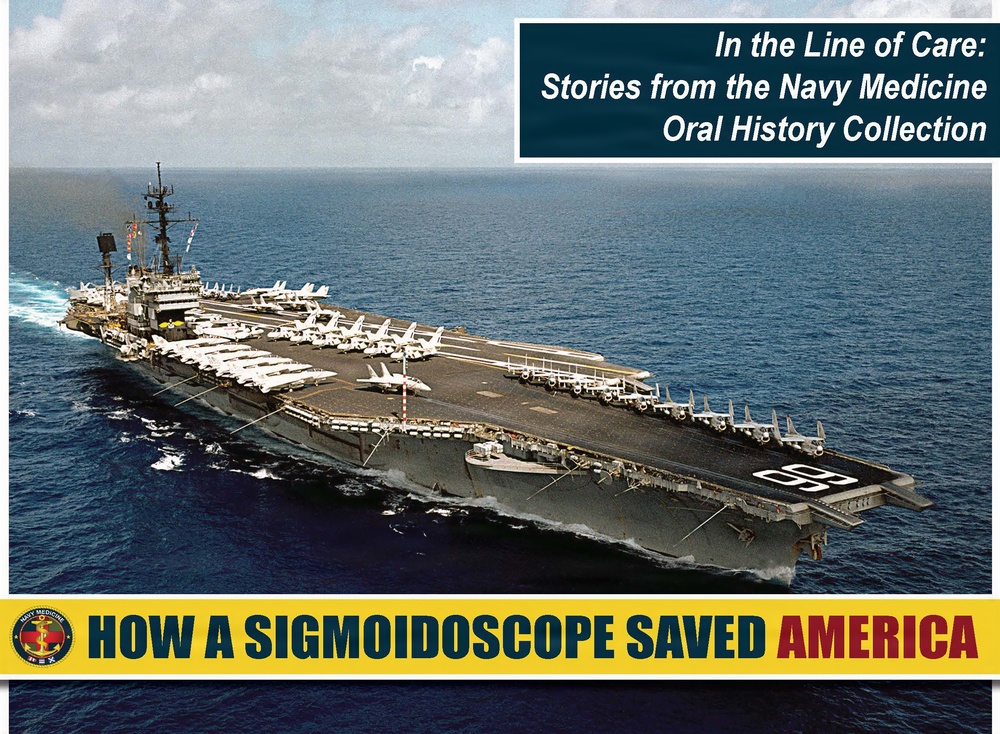
Courtesy Photo | A photo illustration composed of view of Kitty Hawk-class carrier USS America (CV 66)...... read more read more
 Subscribe
It is 1976. You are aboard the Kitty Hawk-class aircraft carrier USS America (CV 66), slicing through the Mediterranean during high-stakes fleet exercises, when disaster strikes: a heavy wrench falls deep into the ship's massive turbine, completely disabling the vessel.
Who do you call in this instance? Naturally, the ship's general surgeon.
Retired Lt. Cmdr. Tom Minehan, a U.S. Navy Medical Corps officer and general surgeon, was stationed aboard the America during the 1970s when he found himself facing one of the most unexpected crises of his career. Tasked with helping extricate the foreign object from the turbine, Minehan had to rely on “unconventional tools” to save the day.
The following is an excerpt from an oral history from 2015 in which Dr. Minehan details the curious yet true story of how a medical sigmoidoscope (an instrument used to examine the colon) was ingeniously repurposed to rescue a disabled warship.
***
“It was a pretty standard day. We were in the Mediterranean, as I recall, and had just gotten there within a week, and we were still in the Western Med. There were three carriers: one spent some of the year in Norfolk being refitted; another one went across and went to the Eastern Med immediately; the one in the Eastern Med came back and spent the second half of the tour in the Western Med, and then when that tour ended they went back to Norfolk and the ship at Norfolk came over and went into the Eastern Med. And as I recall we had just gotten through Gibraltar and really hadn’t gotten very far in when my senior medical officer came to me some time in the afternoon and had this wide-eyed worried look on his face.
He said, ‘We have a problem.’
I’m thinking, okay, somebody just crash landed a plane somewhere and I’m going to get 25 people injured onboard in a few minutes, and I’m worried about that.
And he says, ‘It’s a little strange.’
I said, ‘Alright, I’m listening.’
He said, ‘Somebody dropped a wrench into the inside of one of the steam turbines on the ship.’
There are four of these engines and each of them are about 25,000 horsepower; they are huge engines, and without them we would not be operational. We couldn’t run the engine with this piece of foreign body in there because if it got up into the turbine it could ruin the whole engine and maybe make it explode. Who knows what sort of terrible problem it would be, so the engine was finished at that point.
He said, ‘Do you think you can get it out?’
I’m thinking, ‘What am I going to do? How am I going to do this?’
He said, ‘Come on down and we’ll take a look and I’ll show you what’s going on.”’
So, we went down to the engine room and this steam turbine was a formidable presence; it really was an amazing thing. We went down to the bottom of it and there was a fairly high crawl space that you could get in and crawl under on your back and look up at the bottom of the turbine. They had drilled a hole in the bottom of the turbine that was about two inches in diameter and the casing around the turbine was about two or three inches thick.
I’m on my back and I’m looking up into this hole that goes up into this huge engine, and the bottom of the casing was a little like a funnel. It was wide at the upper part of it and then narrowed as you got down to where that hole was, and the hole looked like it was at the bottom point of the funnel arrangement. I looked at it and I put a finger up in there, and I could just barely get the tip of my finger over the inside edge, and I felt around and I couldn’t feel anything in there, and I got a flashlight and looked around.
They had been trying to get this wrench out of the engine for two days at this point. I got the light and I looked up in there and couldn’t really see anything in there. So, I’m thinking to myself, maybe I could scratch around with a coat hanger or something and see if I could do anything like that. But I thought, well, I don’t know quite what’s up in there; I better not be doing that.
Suddenly, I wondered if I could get a sigmoidoscope up into that thing.
At that time, flexible colonoscopy devices were just barely getting started, and so we were all pretty used to using rigid sigmoidoscopes, which are about a foot long, and they have a light on them so you can see where you are. I went up and got a sigmoidoscope and grabbed some surgical clamps of various descriptions-some with curves and some straight, and came back down and put the sigmoidoscope in. I’m looking around as best I can.
You couldn’t get a great angle off to the side, but you could get a little bit of an angle to see off to the side, and I was astonished to see this wrench just sitting there not quite straight up, but at an angle. And there it was. I initially tried to get some sort of surgical tool up through the sigmoidoscope, but I couldn’t get it over far enough to get around it or get at the thing. So, I took the sigmoidoscope out and knew the angle where this thing was sitting, and took a rounded forceps and passed that up in so that would loop over the top and could get up into the corners. I kind of felt around with that a little bit. And I could feel it touching the wrench. After five or ten minutes of fussing around and manipulating and getting my bearings, I just opened this thing up and I could feel it kind of slide over the wrench, so I closed it and I felt like I had the wrench. I gave it a little bit of a tug to bring it toward the hole and it just fell out on my chest.
As I was working they kept asking, ‘How are we you doing? How you doing?’
I said, ‘Well, I’m making some progress I think.’
And then I pulled myself out from under the turbine and I handed them the wrench. They couldn’t believe it. I couldn’t believe it either. There was a lot of dumb luck involved in having that thing fall out, but I got the wrench around it and skidded it over a to the hole and plunk, it just fell right through the hole. The whole thing took about two hours, after they had worked on it for two days.
I suspect that I’m the only person in the Navy that’s ever sigmoidoscoped a steam turbine. The rest of the story is that the ship was basically headed back to Norfolk. If I couldn’t get the thing out, they were going to have to cut a very large hole in the flight deck on down through to the engine room to pull this steam turbine out and replace it with a new unit. We’re talking maybe half a year the ship being out of service before they could get it back in and going again.
The other part of that story is that my time onboard at sea would have been shortened a lot if I thought about not getting the thing out because we would have been right back at Norfolk. But I would have tried anyway.
I did get a commendation from the captain which I still have. As I was leaving the ship when my tour was up, I got handed a package. Inside was a plaque with the wrench on one side and on the other side was the clamp that I’d used to get it. So yes, I do still have the wrench and I have the forceps that I used those many years ago.”
***
The Navy Medicine Oral History Project was started in the 1980s as a means of capturing the stories and important experiences of the men and women of Navy Medicine, both past and present. Future installments of the “In the Line of Care” series will feature some of these stories captured over the years.
SOURCE: Minehan, Tom. (Oral history conducted by A.B. Sobocinski, July 23, 2015) . BUMED Oral History Collection.
| Date Taken: | 08.27.2026 |
| Date Posted: | 08.27.2026 13:15 |
| Story ID: | 573359 |
| Location: | FALLS CHURCH, VIRGINIA, US |
| Web Views: | 81 |
| Downloads: | 0 |

This work, In the Line of Care: Stories from the Navy Medical Oral History Collection -- How a Sigmoidoscope Saved America, by André B. Sobocinski, Historian, identified by DVIDS, must comply with the restrictions shown on https://www.dvidshub.net/about/copyright.


No keywords found.




