
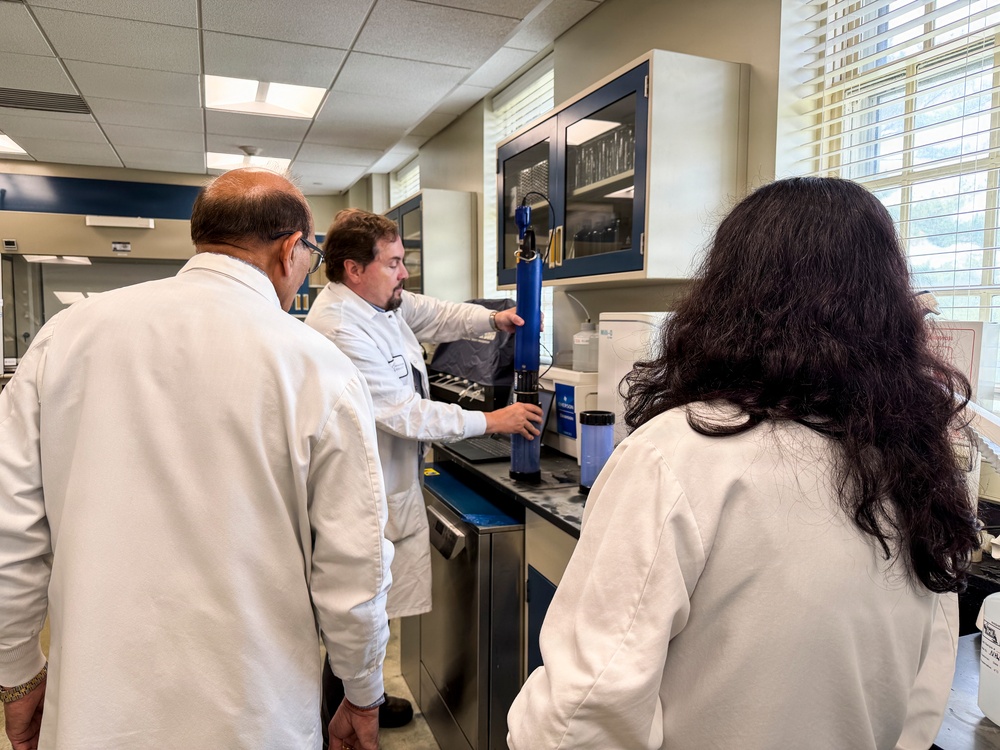
Photo By Julius Delos Reyes | The Washington Aqueduct's Laboratory team calibrates a new data sonde to ensure the...... read more read more
 Subscribe
WASHINGTON, D.C. – In a continuous effort to safeguard the region’s drinking water, the Washington Aqueduct has recently upgraded its state-of-the-art data sonde at the Great Falls intake.
Originally placed into service in February this year, this advanced continuous monitoring system has now been expanded to serve a dual purpose: providing early warnings for both seasonal algal blooms and potential sewage spills.
The primary goal for installing the data sonde was to ensure the Aqueduct is fully prepared to detect and manage algae events in the Potomac River before they can impact the treatment process. Algae blooms can challenge water treatment facilities, making early detection a critical component of water quality management.
The system’s original configuration was designed to track total algae, conductivity, temperature, pH, dissolved oxygen, and turbidity. Crucially, the total algae sensor allows for the continuous monitoring of both green algae (Chlorophyll a) and blue-green algae (phycocyanin). This capability gives the Aqueduct the critical early warning needed to adjust treatment protocols proactively, ensuring the facility is always prepared to handle changing river conditions.
The upgrade is strategically timed to coincide with upcoming Potomac Interceptor rehabilitation project. Recognizing the potential theoretical risks associated with this infrastructure rehabilitation, the Aqueduct proactively purchased and integrated a new sensor into the data sonde.
“Our top priority is the safety of the drinking water we provide to approximately one million people in the National Capital Region,” said Robert Hoffa, Washington Aqueduct Laboratory chief. “This addition allows us to monitor the river in real-time. If a significant unreported spill were to occur during the Potomac Interceptor project, then the data sonde unit stationed at the Great Falls intake would immediately detect it upon arrival and we could activate our rapid response protocols to safeguard our drinking water.”
This new addition allows for continuous ammonium and ammonia monitoring. Under normal conditions, ammonia is only detected at trace-level concentrations in the Potomac River. However, it is present in significant concentrations in raw sewage. A sudden increase in measured ammonia at the Great Falls intake would probably indicate a sewage spill, acting as a rapid-response alarm.
By upgrading this critical piece of technology, the Aqueduct ensures it has the real-time environmental data necessary to protect the treatment facilities and guarantee the safety of the drinking water provided to approximately one million citizens int the District of Columbia, Arlington County, and Fairfax County.
| Date Taken: | 08.27.2026 |
| Date Posted: | 09.09.2026 14:03 |
| Story ID: | 573318 |
| Location: | WASHINGTON, DISTRICT OF COLUMBIA, US |
| Web Views: | 14 |
| Downloads: | 0 |

This work, Washington Aqueduct enhances water quality monitoring to safeguard drinking water, by Julius Delos Reyes, identified by DVIDS, must comply with the restrictions shown on https://www.dvidshub.net/about/copyright.


No keywords found.




