
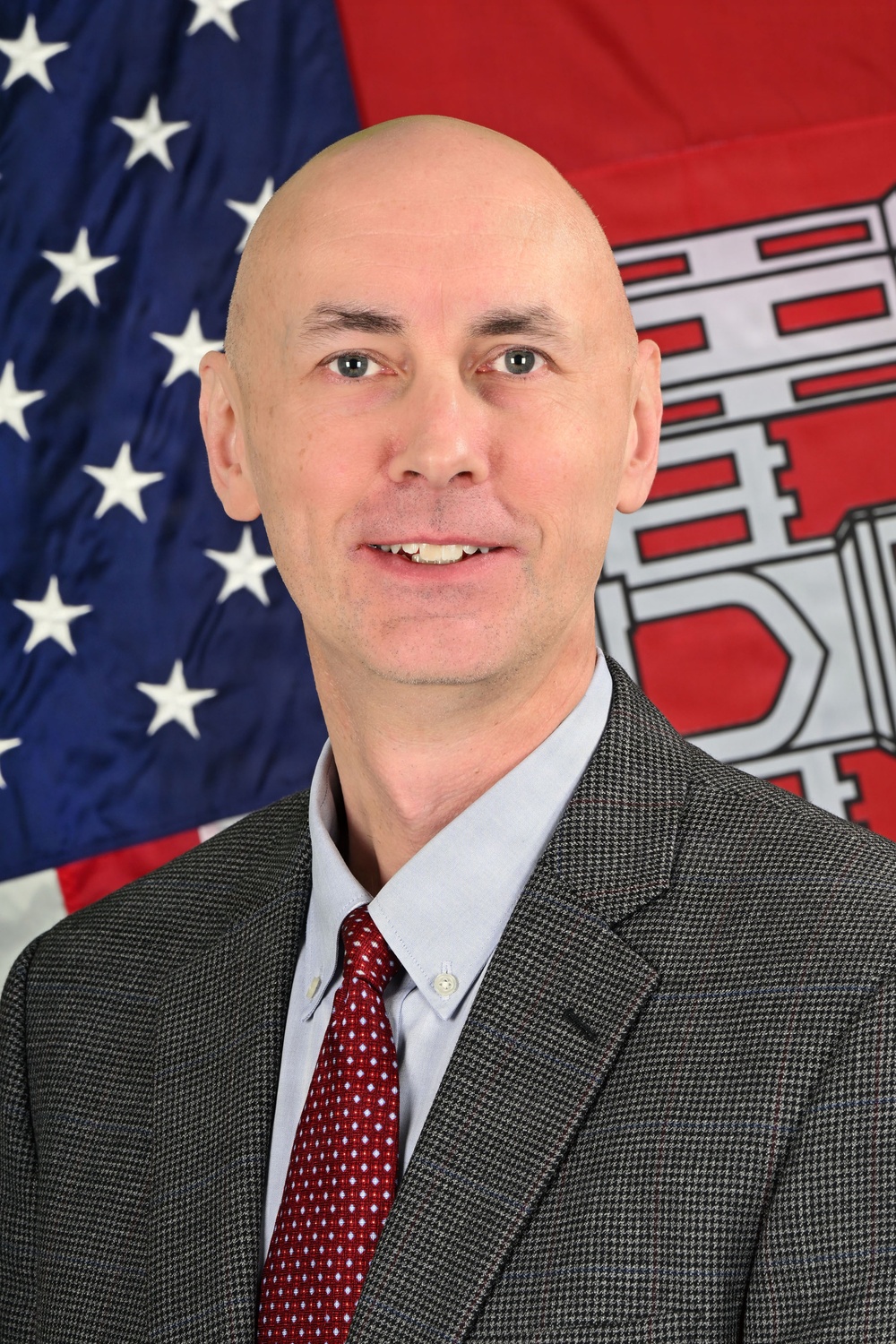
Photo By Kaylee Wendt | Marty Wargo, chief of the Regulatory Division for the U.S. Army Corps of Engineers,...... read more read more
BUFFALO, N.Y. — As workloads continue to grow across modern workplaces, U.S. Army Corps of Engineers Buffalo District Regulatory Division Chief Marty Wargo says the key to effective leadership is learning how to balance focus with flexibility.
Wargo’s approach, inspired by the 2001 book ”Men Are Like Waffles, Women Are Like Spaghetti,” centers on managing overwhelming responsibilities by breaking them into smaller, more manageable parts while still recognizing how tasks and people remain connected. It’s a philosophy that has helped guide him through nearly three decades of public service and complex environmental projects.
“You can’t make a 25-hour day,” said Wargo. “So how do we use the limited number of hours with the ever-expanding number of things we have to do in those hours?”
Wargo explained the “waffle” mindset represents compartmentalization, separating problems into individual sections and focusing on one task at a time. “Spaghetti” thinking reflects the interconnected nature of people, priorities and decisions. A challenge in one area can quickly affect another, requiring leaders to consider relationships, communication and long-term consequences before making decisions.
The philosophy has shaped Wargo’s leadership style throughout his career with the U.S. Army Corps of Engineers, where he began working in 1997 as a biological sciences technician while still attending college. After earning a master’s degree through a cooperative agreement with the State University of New York’s College of Environmental Science and Forestry in Syracuse, New York, he returned to the Corps of Engineers full time and advanced through a series of leadership roles.
Today, Wargo oversees regulatory operations while drawing on years of experience managing environmental programs and large-scale regional initiatives.
One of the most significant projects in his career was the Great Lakes Mississippi River Interbasin Study. The study focused on preventing aquatic invasive species like invasive carp, northern snakehead and alewife from spreading between the Mississippi River Basin and the Great Lakes. It required coordination among federal agencies, state governments, researchers and multiple Corps of Engineers districts to evaluate possible invasion pathways like floating, hitchhiking or swimming and conducting risk assessments to measure the likelihood and impact of species migration across connected waterways.
For Wargo, projects of that scale reinforced the importance of balancing detailed problem-solving with a broader awareness of ecology and the human environment.
“Not to sound overly cliché, butif we have to climb a mountain, it seems overwhelming when we’re standing at the base,” Wargo said. “But it becomes less overwhelming when we break it apart and handle things one at a time.”
His approach reflects a leadership challenge many employees face across government and professional workplaces: managing competing priorities without losing sight of the larger mission.
Wargo said understanding both the waffles and spaghetti perspectives strengthens teamwork and organizational effectiveness. Leaders who focus only on compartmentalization may lose sight of how decisions affect people and long-term goals. On the other hand, leaders who see every issue as deeply interconnected can struggle to make progress when problems become too overwhelming.
The lesson, Wargo said, is knowing when to narrow focus and when to step back and see the bigger picture.
“That is also where other people can help you, sinceyou willneveralways have that perfectly balanced,” said Wargo. “AnysuccessI have hadis rooted in surrounding myself with great people.”
The message carries particular relevance for organizations like the Corps of Engineers that rely on collaboration, technical expertise and public service. As agencies and businesses continue facing increasing and complex responsibilities, Wargo’s philosophy offers a practical framework for maintaining productivity and efficiency while supporting teams and mission success.
Rather than trying to eliminate complexity, Wargo believes effective leaders learn how to navigate it.
By breaking large challenges into manageable steps while staying aware of how people, projects and priorities connect, leaders can make progress without losing sight of the broader mission.
The Buffalo District delivers world class engineering solutions to the Great Lakes Region, the Army and the Nation to ensure national security, environmental sustainability, water resource management, and emergency assistance during peace and war. Learn more at www.lrd.usace.army.mil/buffalo.
| Date Taken: | 08.27.2026 |
| Date Posted: | 08.27.2026 07:48 |
| Story ID: | 573314 |
| Location: | BUFFALO, NEW YORK, US |
| Web Views: | 21 |
| Downloads: | 0 |

This work, Corps of Engineers Leader Shares “Waffles and Spaghetti” Approach to Manage Workplace Complexity, by Kaylee Wendt, identified by DVIDS, must comply with the restrictions shown on https://www.dvidshub.net/about/copyright.

No keywords found.





