
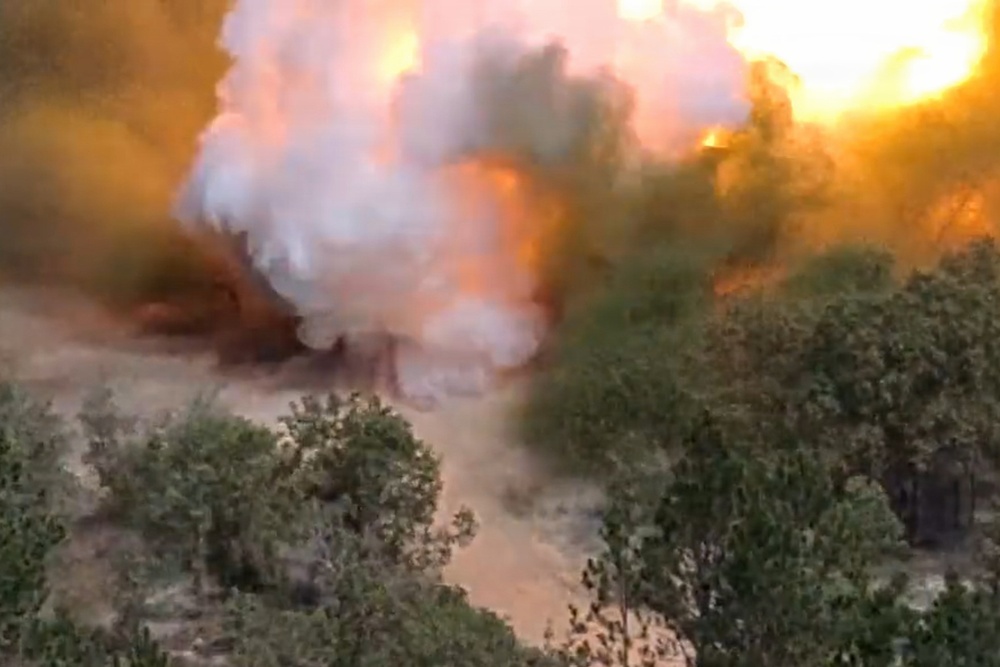
Courtesy Photo | A Safe Pro AI Black Widow drone captures the detonation of a Slurry Line Charge...... read more read more
 Subscribe
FORT BRAGG, N.C. —Soldiers and industry developers worked side by side from Aug. 17-28, 2026, during Project Sandhills to test the fielding of autonomous and attritable mass in realistic conditions. Managed by the 20th Engineer Brigade, the exercise demonstrated how the Army can scale operations and bend the economics of war using low-cost robotic systems.
During the exercise, Soldiers and industry partners deployed autonomous breaching payloads and tactical robotics to validate a human-machine teaming concept. This effort demonstrated how attritable robotic mass could reduce Soldier risk, speed up obstacle clearance, and ensure the continuous momentum of an attack. At the center of the exercise were autonomous trucks, robotic breaching payloads, drone swarms, mine-detection systems and counter-drone tools working together on the same operational problem.
“These systems give combat engineers a wider set of tools: unmanned breaching, drone swarms, mine detection and autonomous counter-UAS to increase tempo and reduce risk to Soldiers,” said Capt. Denny Drummey, Sandhills Project operations officer.
Throughout the exercise, Soldiers and industry developers worked together to refine autonomous tools that expand what Soldiers can do on the battlefield. On a breaching lane, Soldiers built digital routes and dispatched autonomous trucks to execute the breach. The successful clearing of these obstacles demonstrated how unmanned platforms can assume some of the most high-risk engineer tasks, accelerating tactical momentum without risking human lives.
Another lane highlighted drone integration by rapidly establishing aerial coverage without exposing Soldiers’ locations. On this lane, a counter-UAS truck locked onto and shot down drones within seconds, while a platform equipped with a breaching payload supported the breach with a rocket-assisted line charge. Together, these lanes demonstrated how emerging autonomous and semi-autonomous systems strengthen combat engineer formations and enhance adaptability on the modern battlefield.
Drummey said Sandhills 2.0 provides the Army with an attritable autonomous mass capability built around large numbers of low-cost, semi-autonomous systems that can be risked, replaced and rapidly iterated without putting Soldiers in harm’s way.
“Instead of relying solely on high-value, crewed assets, we can field semi-autonomous F-250s, sUAS swarms and autonomous c-UAS systems that are adaptable, scalable and resilient,” Drummey said. “It’s a ‘fight-tonight’ capability.”
Project Sandhills 2.0 marks a step forward in how the Army integrates autonomy into operations, giving formations scalable tools that can reduce risk, increase tempo and adapt quickly to the demands of the modern battlefield.
| Date Taken: | 08.26.2026 |
| Date Posted: | 08.26.2026 19:58 |
| Story ID: | 573299 |
| Location: | FORT BRAGG, NORTH CAROLINA, US |
| Web Views: | 28 |
| Downloads: | 0 |

This work, XVIII Airborne Corps Tests Emerging Autonomous Attritable Systems for Today’s Battlefield, by SSG Davon Allums, identified by DVIDS, must comply with the restrictions shown on https://www.dvidshub.net/about/copyright.


No keywords found.




