
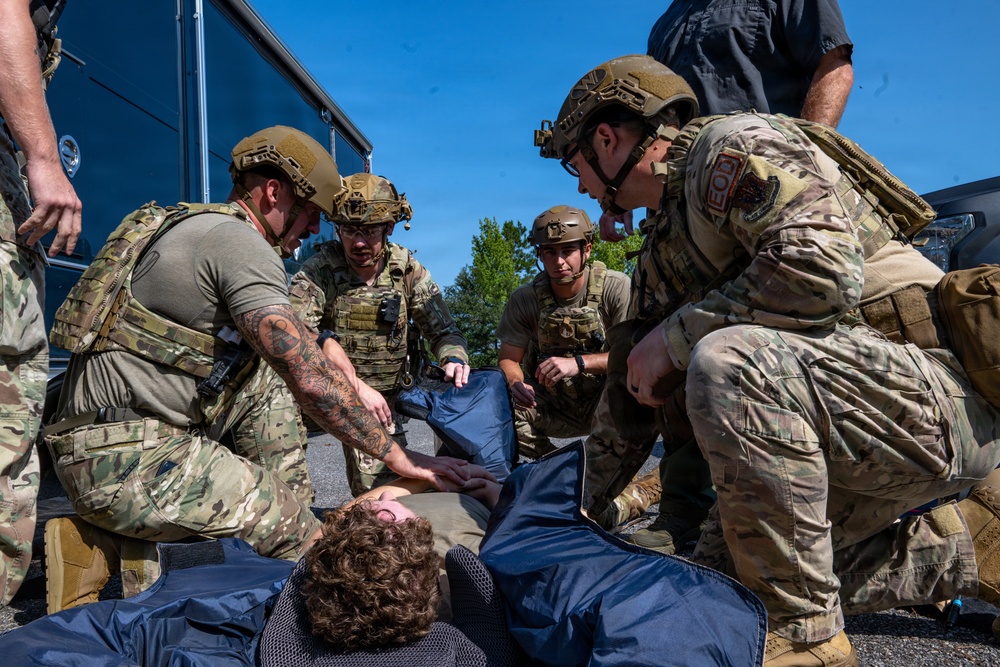
Photo By Airman 1st Class Noah Noonan | U.S. Air Force Airmen assigned to the 23d Civil Engineer Squadron Explosive Ordnance...... read more read more
 Subscribe
MOODY AIR FORCE BASE, Ga –23d Civil Engineer Squadron Explosive Ordnance Disposal (EOD) technicians trained in tactical combat casualty care (TCCC) to strengthen their ability to provide immediate lifesaving care during emergencies at Moody Air Force Base, Georgia, Aug. 17-21, 2026.
TCCC prepares Airmen to assess and treat life-threatening injuries in high-risk environments, using the MARCH approach to prioritize immediate treatment of massive hemorrhage, airway, respiration, circulation and hypothermia.
For EOD technicians, that capability is critical. Their mission requires them to operate around explosive hazards where injuries can occur with little warning, making the ability to provide immediate care an essential part of their readiness.
“Historically, EOD techs were the first responders after an improvised explosive device detonated,” said Tech. Sgt. John Sturges, 23d Civil Engineer Squadron EOD team leader. “We were always the first ones on scene, so we could start rendering aid to that casualty.”
Rather than waiting for medical personnel to arrive, TCCC gives EOD Airmen the knowledge and skills to immediately assess a teammate, identify life-threatening injuries and begin lifesaving interventions.
The training included several scenarios designed to test the team’s ability to respond to injuries in high-risk situations, including a simulated drone attack, heat exhaustion and a simulated car crash. During one scenario, EOD members responded to a simulated enemy attack that left two members wounded, with one sustaining a simulated gunshot wound to the leg and the other to the shoulder. The team moved the simulated casualties to cover before providing TCCC, assessing each casualty for massive hemorrhage, airway, respiration, circulation and hypothermia. Once stabilized, the casualties were moved to a designated evacuation zone for further care.
Beyond individual medical skills, the scenarios reinforced the importance of teamwork and communication during an emergency. By training to the same standard, EOD Airmen can communicate effectively, understand their roles and know what to expect from one another when responding to a casualty.
“We’re all trained to the same standard, so we all know what each other is doing at the moment,” Sturges said. “That team doesn’t have to rely on anybody to render aid. We can do it ourselves.”
For Airmen new to the EOD career field, the training provides an opportunity to build both medical skills, while building trust within the team.
“There’s not always going to be a medic there,” said Airman 1st Class Samuel Bennett, 23d CES EOD technician. “For somebody to know how to at least stabilize somebody who’s been injured, I feel like it’s pretty important.”
That ability to act immediately can make a difference when seconds matter. For EOD Airmen, being ready to provide care is another way they preparing to protect the force, accomplishing the mission and taking care of the people beside them.
TCCC training ultimately gives EOD Airmen another capability to rely on in high-risk environments: the ability to respond when their teammates need them most, giving injured Airmen the best chance of making it home and returning to the fight.
| Date Taken: | 08.21.2026 |
| Date Posted: | 08.26.2026 16:18 |
| Story ID: | 573289 |
| Location: | MOODY AIR FORCE BASE, GEORGIA, US |
| Web Views: | 24 |
| Downloads: | 1 |

This work, EOD sharpens lifesaving skills through TCCC training, by A1C Noah Noonan, identified by DVIDS, must comply with the restrictions shown on https://www.dvidshub.net/about/copyright.


No keywords found.




