
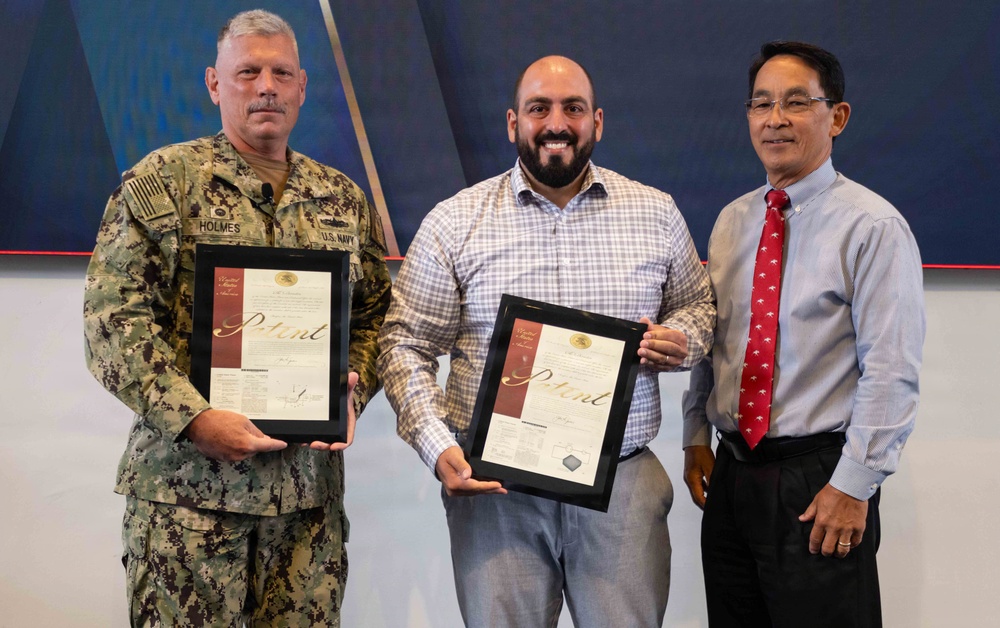
Photo By Jhon Parsons | From left: Naval Surface Warfare Center, Port Hueneme Division then-Commanding Officer...... read more read more
 Subscribe
Armen Kvryan, Naval Surface Warfare Center, Port Hueneme Division’s (NSWC PHD) corrosion and additive manufacturing lead, is considered an excellent example of how an idea can become an official patent that ultimately could benefit the U.S. Navy and the warfighter.
Kvryan was issued two patents in June from the United States Patent and Trademark Office (USPTO) for ideas that matured into realized product concepts in February 2021 and April 2022, he explained. The patent application approval process can take a few years, so he was surprised when the two recent patents were issued just a week apart from each other, he added.
The patent issued June 2 and the one issued June 9 tackled different problems but used the same family of materials as a part of a potential solution.
The first patent, titled Apparatus and Methods for Sensing Mass Accumulation Degradation, held a bit of nostalgia for Kvryan as it related to the subject of his doctoral dissertation regarding corrosion of bearing systems in naval jets.
He explained that one of the ways an aircraft’s bearing system is assessed is if the bearing housing experiences irregular vibrations. While the aircraft is not operating, the liquid inside the bearing chamber is tested for metal content. If the test results show more metal is present than acceptable, the bearing chamber needs to be assessed, repaired or most likely replaced, he said.
The patent specifically laid out a design for a corrosion, degradation and wear-detection system that would affix inside the bearing chamber. The device that Kvryan developed combines a highly customizable material, such as aerogel, with a force-sensing device, such as a piezoelectric sensor. As particles or material are shed from the spinning bearing chamber rings, they are captured by the aerogel, causing a measurable change in force on the sensor that results in a signal being sent that there has been a change.
“It acts like a scale,” Kvryan said. “The aerogel’s porosity can be adjusted to control how big or small the ‘pores’ are. The system not only weighs the loose particles but traps them so they aren’t causing further damage through friction as they circulate around in the fluid.”
The resulting sensor output is used to quantify material loss and degradation as it occurs, providing a direct, continuous indication of the bearing chamber’s health. The technology can be used to detect material degradation in other naval and Department of War systems as well.
Personal protection
The other patent awarded last month also uses a familiar product. It details a protective mask or mask insert that includes one or more layers of an air-permeable aerogel.
“The idea came about during the COVID-19 pandemic, when even the N95 protective masks were hard to come by,” Kvryan said.
The number 95 refers to the advanced filtration technology in the mask that can block at least 95% of airborne particles that measure around 0.3 microns in diameter. These particles can include dust, bacteria and viruses. Using electron microscopy, the COVID-19 virus particles measure between 0.06 and 0.14 microns.
A Centers for Disease Control and Prevention (CDC) study conducted in California, which tracked real-world mask use in indoor public settings during 2021, found surgical masks reduced the odds of COVID-19 infection by about 66%, while cloth masks offered a non-statistically significant 56% reduction. N95 respirators came in at 83%, which put them in the highest demand.
Kvryan said his wife, who is a registered nurse, saw firsthand how that shortage of N95 respirators affected hospitals and other healthcare institutions as well as first responders.
“We were 3D-printing masks for Sailors when they came to NSWC PHD for Combat Systems Assessment Team (CSAT) events and for our own CSAT personnel and ship riders,” Kvryan said.
Theeffortwas part of a commandinitiativein early 2020 between NSWC PHD’s Office of Technology and two command labs touse additive manufacturing to3D-print respirator masks, faceshieldsand face coveringsto supplement a shortage of masks. The labs usedapproved designs from the National Institutes of Health as well as guidance from theNavy and the CDC.
The command initiative spurred Kvryan into thinking about what types of material would be most effective against the microscopic particles of the COVID-19 virus or other potential viruses where the N95 masks would not work as well.
Since he was already working on a project with aerogel, he naturally turned to the versatile substance. “With aerogel, you can control the porosity to where it can be adjusted to capture even the smallest particulates,” Kvryan said.
Shooting for the broadest applications, Kvryan’s patent includes designs for a full aerogel mask, one that incorporates the substance just over the mouth and nose, and one comprised of a full-mask insert that can be slipped between two standard woven cotton layers.
His design also includes an optional power source, such as a small battery, to electrify the filter interface to kill any particulates captured by the mask prior to disposal.
A helping hand
With three patents under his belt and a half dozen still in the pipeline, Kvryan said he is always willing to share his advice and experience with those thinking about pursuing a patent.
“What I think I do very well is piece things together from different technologies and different experiences in life,” said Kvryan, who spent some time with commercial spacecraft and rocketry company SpaceX and NASA before coming to NSWC PHD in February 2019. “I was exposed to a lot of different technologies, ideas and ways of innovating.”
Kvryan isn’t the only one at the command who can assist with the patent process. Patricia Guese, NSWC PHD technology transfer and intellectual property (IP) program manager, also offers guidance and helps with patent applications.
“As far as filling out the mandatory documentation to file a patent application, I’m 100% there to guide the inventor every step of the way to make it as easy as possible for them,” she said.
The timeframe for receiving a patent depends upon the USPTO examiner’s review, Guese said, adding that, on average, it can take two to three years to receive a patent.
While NSWC PHD workforce members’ patent applications are filed on behalf of an individual or team of inventors, Guese noted that the right, title and interest are assigned and transferred to the United States as represented by the Secretary of the Navy.
The fees for filing and maintaining a patent are paid for by the command’s Office of Technology.
For this fiscal year, a total of six patent applications have been filed from personnel with the command, according to Guese. For the time period of fiscal 2012 to fiscal 2026, NSWC PHD has paid nearly $62,650 from the command’s awards budget in financial incentives to inventors.
And down the road, the inventor — and NSWC PHD — could see additional income if a Patent Licensing Agreement (PLA) is signed between the command and a commercial company that hopes to ultimately produce the product for sale, whether directly to the Navy or industries that could make use of it.
Guese said the command has two active PLAs, one of which is related to Kvryan’s first patent, Corrosion Detection Systems and Methods, issued in October 2022.
Kvryan said that for him, money is not the motivating factor. He said he loves helping the warfighters and is grateful the command and its Office of Technology support and encourage his efforts.
“Applying my scientific knowledge to help the men and women who serve this country is incredibly rewarding,” Kvryan said. “When I see a need, I see an opportunity to bridge the gap between innovation and the people who need it most.”
| Date Taken: | 08.26.2026 |
| Date Posted: | 08.26.2026 16:26 |
| Story ID: | 573255 |
| Location: | PORT HUENEME, CALIFORNIA, US |
| Web Views: | 30 |
| Downloads: | 0 |

This work, With Three Patents Under His Belt, Kvryan Is Ready to Share His Expertise on the Process, by Teri Carnicelli, identified by DVIDS, must comply with the restrictions shown on https://www.dvidshub.net/about/copyright.

No keywords found.




