
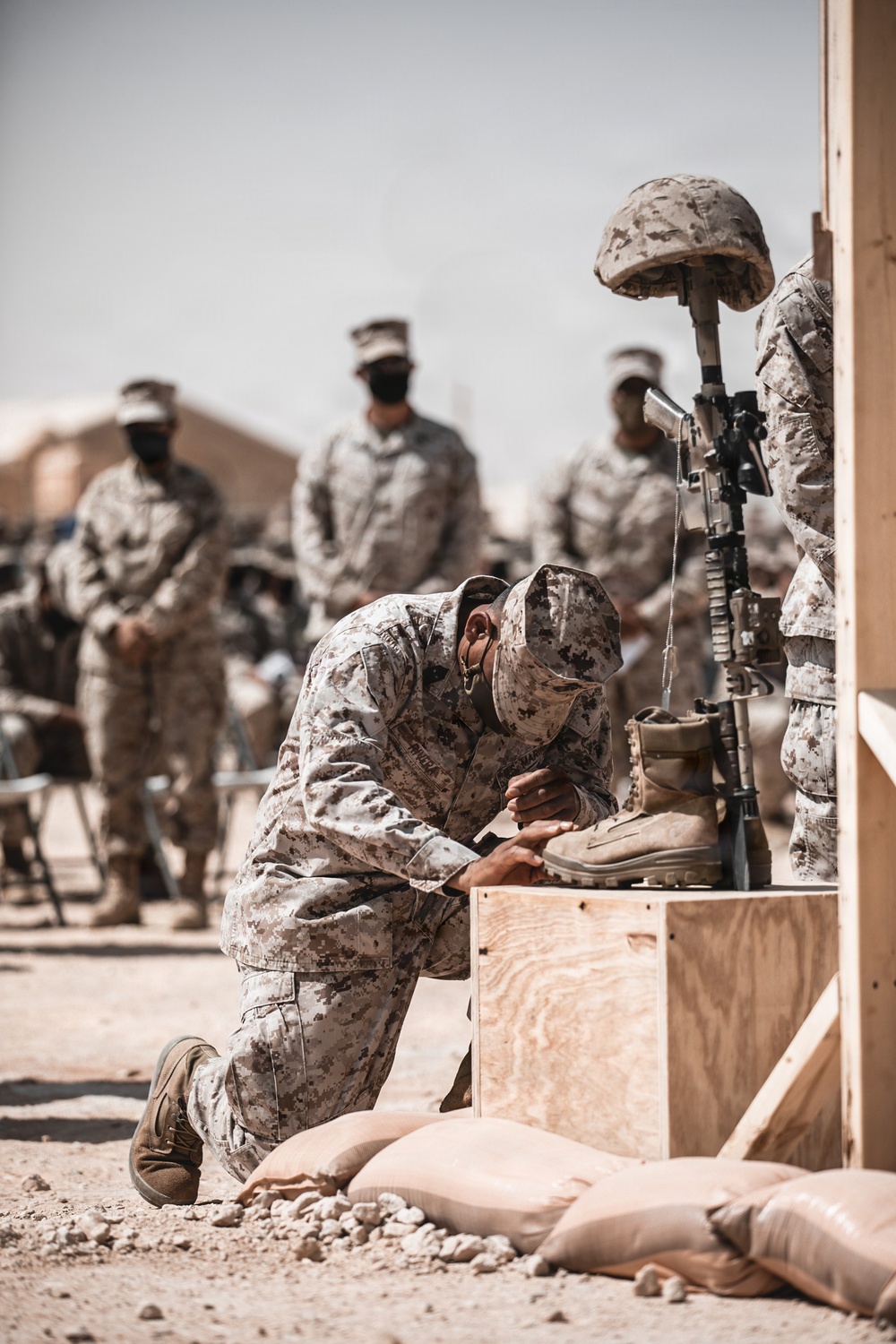
Photo By 1st Sgt. Melissa Marnell | U.S Marine Corps Sergeant Major Hector Rivera, the command senior enlisted leader of...... read more read more
 Subscribe
"We landed under the cover of night, stepping into the exact nightmare we had just watched on television,” said U.S. Marine Corps Sergeant Major Hector Rivera, reflecting on his unit’s arrival at Hamid Karzai International Airport in Kabul, Afghanistan, during his time as the senior enlisted leader of 2nd Battalion, 1st Marine Regiment, 1st Marine Division. “But piercing through that darkness, one sight cut straight to the bone: a young Afghan boy standing amidst the panic, holding a steadfast salute. He refused to lower his hand until all 300 Marines had stepped off our aircraft and marched into the darkness to hold the line.”
To Rivera, that young boy he saw on Aug. 14, 2021, embodied those 20 years of partnership and served as a lasting reminder that the sacrifices made by Marines and their Afghan partners would not be forgotten. In the days that followed, and in the years since, that moment would serve as a core reminder of the mission they had been sent to accomplish.
Five years later, the legacy of 2nd Bn., 1st Marines deployment, in support of Operation Allies Refuge, is defined by the courage of the Marines who stood the watch at Hamid Karzai International Airport, and by the enduring memory of the 13 U.S. service members who made the ultimate sacrifice during the attack at Abbey Gate. 2nd Bn., 1st Marines was first notified that they would be deploying as a part of the Special Purpose Marine Air-Ground Task Force – Crisis Response – Central Command, in March of 2020, where they would be conducting security operations and participating in bilateral training and combat readiness programs. In Nov. 2020, the deployment was put on pause, it was uncertain if they would ever get the approval to proceed with the deployment. It was not until January of 2021 that it was confirmed they would be deploying.
For Rivera, the deployment began with what seemed like an ordinary day. On Jan. 30, 2021, 2nd Bn., 1st Marines, was conducting a routine unit physical training event. As Rivera conducted roll call for PT that morning, he recalled a moment with Staff Sgt. Darin Taylor Hoover, who was an infantry unit leader with 2nd Bn., 1st Marines, and who would later be present at Abbey Gate. He raised his hand during the roll call to let him know his name had not been called.
“I told him he didn’t need to be there, and he just smiled and said, 'I finished my work early, SgtMaj, so I have to PT with you guys.' I loved his motivation so much I penned his name onto the roster myself,” said Rivera. “Looking back, it haunts me. If I had known what was waiting for him at Abbey Gate, I wouldn't have written his name down. I would have hugged him and told him I loved him. That memory breaks my heart every single time I think about it.”
When the battalion arrived in theater in Apr. 2021, they were dispersed across various strategic locations in the U.S. Central Command area of responsibility in support of Operation Inherent Resolve. During this time, Rivera and the commanding officer travelled across the region to visit the Marines of 2nd Bn., 1st Marines. Rivera recalls visiting one of the unit’s positions in Jordan, where he had an interaction with a Marine, Cpl. Daegon Page, who would later be present at Abbey Gate.
“He was deeply loved by his company, and he was unapologetically 'by the book,'” said Rivera. “The Company Commander intentionally put Page on guard duty because he knew Page wouldn't take a chance with security. Sure enough, when our vehicle rolled up, Page looked right at the command deck [personnel] and said, 'Gentlemen, please exit the car. I have to inspect it entirely.' He made the highest-ranking men in the battalion get out and wait while he did his job.”
Rivera said this interaction reinforced the confidence Page’s leaders had in him. His unwavering commitment to doing the right thing, regardless of rank or circumstance, reflected the integrity that defined both his character and his leadership. His determination to protect those around him remains a lasting part of his legacy and continues to serve as an example for Marines who may one day be called upon to lead in war.
As the Marines were fulfilling the mission as a standard crisis-response posture, a new mission was formed. Following the announcement of Operation Allies Refuge, the battalion was rapidly re-deployed to Hamid Karzai International Airport in Kabul, Afghanistan, to support the non-combatant evacuation operation.
On Aug. 14, 2021, 2nd Bn., 1st Marines, arrived in Kabul. Their mission was to secure Hamid Karzai International Airport and provide safe passage for American citizens and Afghan allies. It was the mission they had spent months preparing for through intensive training focused on worst-case scenarios and tactical readiness.
“We were told to prepare for night combat upon landing. I had no idea what to expect,” said HM2 Jasper Kung, a corpsman attached to the unit, whose role was to care for casualties while assisting the Marines with directing refugees through the airport. “Our first 72 hours were spent clearing the airfield and pushing all the civilians that had overrun the airfield back to the airport terminal.”
The unit immediately began operations, rotating through shifts lasting 24 to 36 hours with little sleep. Despite exhaustion and deteriorating conditions, the Marines continued carrying out the mission.
“For the first 96 hours we got about three hours of sleep. Most of the time was spent escorting abandoned children to the hospital and treating injuries, including broken bones, general pain, and numerous heat casualties,” said HM2 David Hollingsworth, another corpsman attached to the unit. They remained focused on evacuating thousands of civilians while maintaining security in an increasingly volatile environment.
“When you strip away the resources and the sleep, what is left is the raw character of the warrior,” Rivera said. “They didn’t just display honor, courage, and commitment. They proved what those words cost. They showed honor by refusing to abandon their friends, courage by stepping into the terror of the unknown, and an unbreakable commitment to the thousands of innocent lives depending on them to hold the line.”
As the days wore on, the crowds outside the gates only intensified, and the desperation became increasingly apparent. By Aug. 26, the evacuation effort had reached its final stages, with Abbey Gate serving as the primary entry point for the remaining American citizens and Afghan allies awaiting evacuation.
“It felt like another day,” said Hollingsworth. “We were informed that we were going to stop processing and retrograde to start leaving the airport.”
Hollingsworth recalled standing near Abbey Gate alongside HM3 Maxton Soviak, a fellow line-corpsman, doing security screenings and pulling people from the crowd to tend to casualties. Hollingsworth and Soviak both tended to different casualties but kept close to each other as they were working.
“Last thing I told him was, 'I’ll be right here if you need me.' Minutes later the suicide bomber detonated,” recounted Hollingsworth, remembering the moments right before the explosion. “I fell on my back, eyes closed, seeing stars. I opened my eyes looking at the blue sky. I felt nothing. I heard nothing. I kept telling myself in my head that something had just happened, but I was unable to move. I thought I was dead.”
Hollingsworth says he remembers someone coming to his aid and dragging him away from the scene of the attack. He described the chaos of the environment around him, people running by, and seeing his own feet dragging through the dirt as he was pulled away, tasting blood. He was pulled to a secure area and began receiving aid for severe facial injuries sustained during the attack before he was transported to the hospital.
“We arrived at the hospital, and I’m in a giant room full of casualties, my Marines. I walk around to check on the Marines to make sure they’re okay but was escorted back to my bed because I’m a casualty too,” said Hollingsworth. “I asked where Soviak is. And they shook their heads.”
Soviak, Hoover, and Page were among the 13 U.S. service members killed in the attack. Fellow service members also killed were: U.S. Marine Corps Sgt. Johanny Rosario Pichardo, Sgt. Nicole L. Gee, Cpl. Hunter Lopez, Cpl. Humberto A. Sanchez, Lance Cpl. David L. Espinoza, Lance Cpl. Jared M. Schmitz, Lance Cpl. Rylee J. McCollum, Lance Cpl. Dylan R. Merola, Lance Cpl. Kareem M. Nikoui and U.S. Army Staff Sgt. Ryan C. Knauss.
Following the attack, Abbey Gate was closed. As the final aircraft departed Afghanistan, Operations Allies Refuge concluded after evacuating approximately 130,000 people.
“To safely extract 130,000 desperate people from a collapsing nation in under two weeks defies every logistical limit," Rivera said. “We didn’t just execute an evacuation; we salvaged generations of families. That is an enormous achievement that will echo long after our uniforms are put away.”
The 13 service members were awarded the Congressional Gold Medal and posthumously awarded Purple Hearts. Their legacy is defined by their selfless service, devotion to duty and commitment to protecting others.
“They had a call to duty, a call to go and perform something that is bigger than oneself,” Kung said. “The politics of the world never mattered. They saw the people as they were; scared and desperate, and in response they extended their hands to help.”
“I remember the smiles, the laughter, the conversations, the camaraderie,” recounted Hollingsworth. “I remember the good times, like when Lance Cpl. Espinoza had a laugh attack when there was a boxing match at Camp Titin in Jordan against the British.”
Their legacy lives on not only through the memories of family, friends, and fellow service members, but also through the Marines and Sailors they continue to influence. Hollingsworth and Kung now teach casualty care courses, passing on lessons learned in Kabul to prepare future generations for the realities of combat. Rivera says he sees the Marines lost at Abbey Gate reflected in every young Marine he now leads.
“Every single time I look at a young Marine, I see the faces of the warriors I lost at Abbey Gate. That tragedy permanently changed how I view my responsibility to them,” explained Rivera. “I realized my duty as a leader is twofold: I have to love them more, and I have to train them harder.” And to Rivera, loving his Marines means ensuring they are prepared for the worst day of their lives. It means enforcing discipline, not just because it is required, but because it gives them the greatest chance to survive, accomplish the mission, and return home.
“My mission now is to ensure those lessons are never forgotten. I carry a solemn responsibility to pass this raw experience down to the next generation of warriors,” said Rivera. “I want the future generations to understand that courage, resiliency, and devotion to duty are not just words on a whiteboard, they are the bedrock of our survival.”
At Abbey Gate, those values carried a tangible cost. Courage meant stepping out into a hostile crowd despite the danger. Resiliency meant enduring heat, exhaustion, and uncertainty without losing focus for weeks. Devotion to duty meant remaining on the wall to protect complete strangers.
“If the next generation of Marines carry that exact fire,” stated Rivera. “Our nation will always be secure.”
| Date Taken: | 08.26.2026 |
| Date Posted: | 08.26.2026 11:27 |
| Story ID: | 573253 |
| Location: | CAMP PENDLETON, CALIFORNIA, US |
| Web Views: | 89 |
| Downloads: | 0 |

This work, 5 years later; fallen service members, events of Kabul Evacuation remembered, by Sgt Calah Thompson, identified by DVIDS, must comply with the restrictions shown on https://www.dvidshub.net/about/copyright.


No keywords found.




