
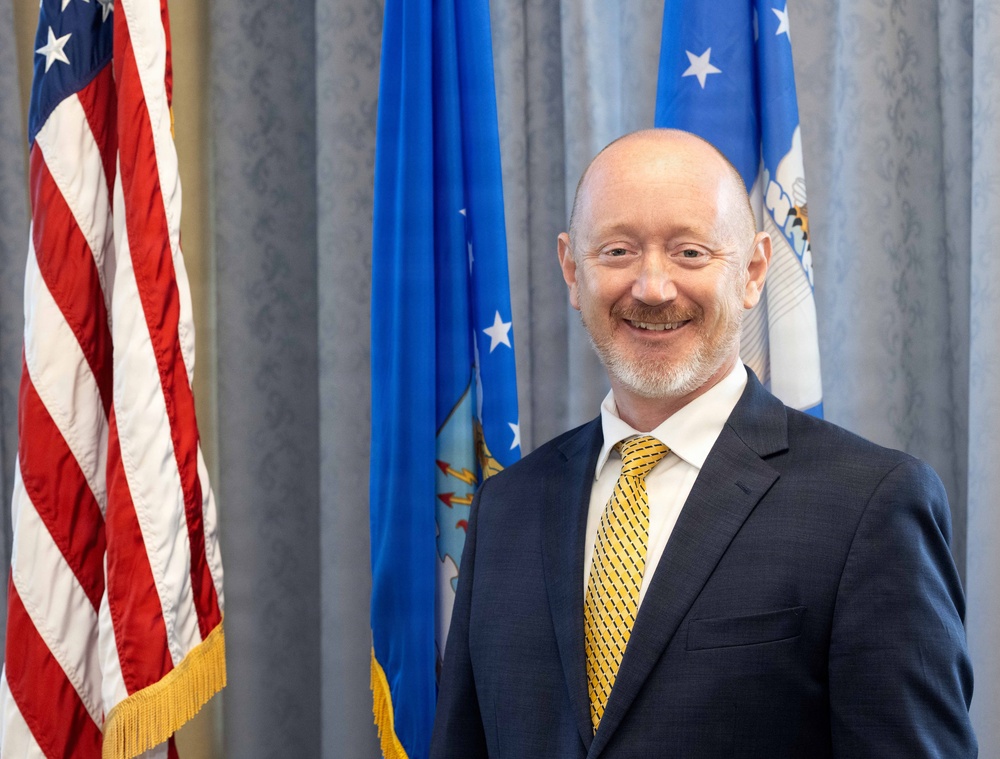
Photo By Brian Dietrick | Daniel Watson’s career with the U.S. Air Force has taken him from enlisted Airman to...... read more read more
 Subscribe
Thirty-two years ago, Daniel Watson was an Airman checking identification cards at the gates of Wright-Patterson Air Force Base.
Today, he sits on the same installation as a member of the Senior Executive Service, serving as the command counsel for Headquarters Air Force Materiel Command and the senior legal adviser to the AFMC commander and staff.
For Watson, the distance between those two points isn't measured by rank or titles. It is measured by a mindset built on hard work, optimism, adaptability and an unwillingness to let circumstances dictate his future.
“I look at the world optimistically,” Watson said. “There’s no magical formula other than having a positive attitude, treating people like you want to be treated, and putting in the work.”
Watson enlisted in the Air Force in 1993 and served as a Security Forces military working dog handler before separating in 1997. He returned to active duty in 2004 as a Judge Advocate and spent the next two decades serving in legal and leadership positions before retiring with the rank of colonel in 2024. Following his uniformed retirement, he joined the Senior Executive Service, ultimately assuming his current position in September 2025.
His path from Airman Basic to senior executive was anything but predictable. But Watson believes that is precisely the point.
Building momentum
Watson doesn't look back on his younger years as an obvious launch point for a successful career.
“My high school career was unremarkable,” he said.
Joining the Air Force changed the trajectory. As a young Security Forces Airman, Watson volunteered to become a military working dog handler. He was assigned Arco, a dog who would remain his partner throughout his time at Wright-Patterson AFB.
The job gave Watson opportunities to develop confidence and experience well beyond his years. He worked patrols, responded to incidents and interacted with people across the installation.
He also began collecting small victories. Watson earned Airman of the Quarter and Airman of the Year recognition, accomplishments that helped him realize that success could build upon itself.
“You start getting some wins and then you build confidence…next thing you know, you accomplish this goal, and then you accomplish the next thing,” he said.
For Watson, that became a lesson in momentum. Success wasn't something that suddenly appeared later in his career. It started with showing up, doing the job and discovering that one accomplishment could provide the confidence to pursue another.
“The decision to join and enlist is that foundational platform upon which all my future success was built,” he said.
Letting the path evolve
Watson's career also illustrates that having goals doesn't mean knowing exactly where they will lead. While serving as a Security Forces Airman, Watson became interested in the legal profession after interacting with military attorneys during law enforcement duties.
He eventually separated from the Air Force, attended Cleveland State University and Cleveland-Marshall College of Law, and began pursuing the goal of becoming an attorney.
The attacks of Sept. 11, 2001, changed his perspective once again.
“I felt my sense of purpose and calling, taking whatever talents I had and putting them back on the team,” Watson said.
He returned to the Air Force as a judge advocate general in 2004. His legal career took him through assignments involving military justice, defense work and, eventually, acquisition and contract law. Not every assignment was one he had planned for.
When Watson arrived at Cannon Air Force Base, he expected to focus on criminal military justice. Instead, almost immediately, he was told the installation's contracts attorney was deploying, and he would take over their position.
His response and reaction was familiar.
“You just stay calm and tackle it,” Watson said.
That willingness to accept unfamiliar challenges eventually helped lead Watson into acquisition law, where he advised senior leaders, program managers and contracting officers on complex issues involving some of the Air Force's most critical acquisition priorities.
His career ultimately brought him back to Wright-Patterson AFB, where he found a natural connection between his legal expertise, his Ohio roots and AFMC's acquisition mission.
“Ohio’s the center of all that, the heart of it all, the heartbeat of Air Force acquisition,” he said. “So it kind of married up for both myself, my family and the JAG Corps.”
Leadership requires courage
As Watson moved into senior leadership positions, his approach evolved. The discipline he learned as an enlisted Airman remained, but he added something else: the confidence to speak up.
During a deployment to Iraq around 2013, Watson found himself advising senior Army and Air Force leaders, all of whom were general officers and SES personnel.
Watson recognized that his responsibility was to provide honest advice, regardless of who was sitting across the table.
“This is not the time for a wallflower,” Watson said. “To be a good adviser to a commander, you need to provide them the unvarnished truth on things where there are lines, risk or legal impediments.”
For Watson, confidence isn't about pretending to have all the answers. It comes from preparation.
“You need to know what you don’t know,” Watson said. “No one expects you to have all the answers, but you need to do your homework and have solid support for the answer you’re planning to give or decisions you make.”
That philosophy remains central to his role as command counsel. Watson sees his legal team not as an obstacle to the mission, but as a partner helping leaders find a way forward.
“If we’re doing our jobs correctly, we help enable the mission,” he said. “And the AFMC mission is extremely important; our priority is getting war-winning capabilities into the hands of our warfighters.”
Rather than simply telling a commander what cannot be done, Watson wants his team involved early enough to help identify options.
“Tell us what you’re trying to do, how you want to get there, and then if we can get there in a straight line, great,” he said. “But if there’s a law or regulation that prevents us from doing it, maybe there’s a way to get relief or maybe we can do it another way.”
Never forget where you started
Perhaps the most significant leadership lesson Watson carried with him from his enlisted days is perspective. He remembers what it was like to be an Airman Basic with no rank, experience or credibility.
“You’re very vulnerable,” Watson said. “You’ve thrown yourself into the fray.”
That experience shaped how he treats people today. Watson believes the person speaking to an Airman Basic and the person speaking to a general officer should fundamentally be the same person.
“I always believe, whether I’m talking to the commander or the lowest-ranking Airman on this base, whoever that may be, they’re going to get the same interaction,” Watson said. “They’re going to get the same person every time.” His rank may change the formality of the conversation, but it shouldn't change respect for the person.
“I don’t think there should be a bit of difference in how you treat people,” he said.
That perspective also influences how Watson leads his own team. He doesn't believe senior leaders need to have every answer. Instead, they need to know when to listen, when to trust their people and when to admit they don't know something.
“I don’t come at this job with any level of arrogance or anything where I think that, as an SES, suddenly I know it all,” he said. “That’s a very dangerous approach to have.”
Watson said he is comfortable telling people, “I don’t know, but I will find out and get back to you.”
His approach is rooted in credibility and that trust is critical.
“I’d rather take a moment to do some reflection and research, but also rely on my teammates,” Watson said. “When you’re in a leadership position, they either make you look good or not. You’ve got to rely on people to do their jobs and trust them.”
The mission and the people
Watson said he pursued the opportunity to become an SES because, over time, he discovered his passion was increasingly centered on leadership.
“My passion is in leading more than it is in just being an attorney,” Watson said.
He enjoys being part of the decision-making process, helping shape organizational direction and having an opportunity to positively influence the people around him.
“I try to keep my motivations and intentions to do what I can to help people,” he said. “If I felt like I couldn’t help the mission or help people, I wouldn’t do it. I would find something else to do.”
That philosophy comes down to two things, the mission and the people. Watson sees the two as inseparable. “My overall philosophy is to take care of the mission and take care of people,” he said. “Both feed into each other.”
That same belief has kept Watson connected to the Airmen he served with decades ago.
He has organized squadron reunions with former enlisted teammates, maintaining relationships that have stretched across careers, assignments and generations of military service.
To Watson, those connections aren't simply about remembering the past. They're about taking care of people.
“You don’t know what people are going through and if you can help them out in any way, do it,” he said. “Sometimes it’s just talking or listening.”
That sense of shared experience is one of the things that has kept him serving.
“The people you were with and the shared struggle — that, to me, is what keeps me in the game,” he said.
Keep your eyes downfield
For a young Airman looking at Watson's career, the distance between Airman Basic and SES might seem almost impossible to comprehend.
Watson sees it differently.
He doesn't believe success comes from having the perfect plan. He believes it comes from continuing to move. “Set short-term, medium-term and long-term goals,” he said. “Draw out a picture for yourself of where you want to be in five to 10 years but think of the things you’ll need to do — the steps you’ll need to take to get there.”
The destination can change. The important thing is forward momentum.
“You might end up somewhere different than you imagined, but I think if you have that mindset of, ‘I need to get to objective B. I need to get to objective C. I need to keep advancing forward,’ you can change your circumstances.”
For Watson, the ultimate measure of success isn't a promotion, a title or a position. It's the impact a person has on others.
“When you want to be remembered for something, it’s not like, ‘Oh, there’s one legal opinion or there’s one traffic stop or something that I had an impact on,’” he said. “It’s how that person made you feel. What was it like to be around that person?”
Watson's remarkable journey was built on an optimistic outlook, hard work, and the courage to thrive in unfamiliar circumstances. Imagine what that mindset can do for young, impressionable Airmen.
“Thirty years ago, I was checking ID cards at the gates at Wright-Patt,” Watson said. “Now I’m sitting here.”
| Date Taken: | 08.26.2026 |
| Date Posted: | 08.26.2026 11:19 |
| Story ID: | 573251 |
| Location: | WRIGHT-PATTERSON AIR FORCE BASE, OHIO, US |
| Hometown: | MENTOR, OHIO, US |
| Web Views: | 16 |
| Downloads: | 0 |

This work, From enlisted Airman to SES: A journey built on mindset, grit and service, by Brian Dietrick, identified by DVIDS, must comply with the restrictions shown on https://www.dvidshub.net/about/copyright.

No keywords found.




