
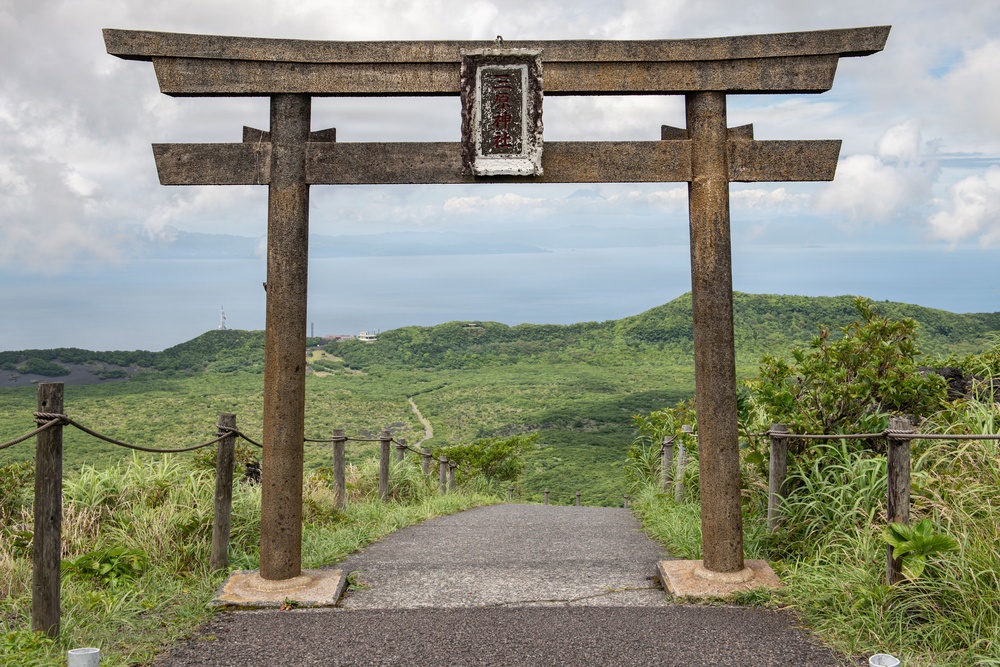
Photo By Taylor Ardito | IZU OSHIMA, Japan (Aug. 19, 2026) – A Torii stands at the entrance of Mihara Shrine,...... read more read more
 Subscribe
IZU OSHIMA, Japan (Aug. 18, 2026) – In the early morning I boarded a high-speed ferry that was docked at Takeshiba Passenger Terminal. The ship set sail, departing the inlet surrounded by the Tokyo skyline, and sailing south down Tokyo Bay and out of the megalopolis.
Nearly two hours later, the ship completed the 55-mile journey and docked at Motomachi Port. I stepped ashore onto the small volcanic island-and found myself still in Tokyo.
There were no skyscrapers, large train stations or bustling streets. Instead, there was a small coastal community that sits in the shadow of Mt. Mihara, a 2,500-foot-tall active volcano that rises from the center of Izu Oshima Island. I thought of the Oshima advertisement poster I saw when departing the Takeshiba Passenger Terminal and finally understood why it said, "One city. Two worlds."
To learn more about the lesser-known side of Tokyo, I decided to travel to Izu Oshima Island and hike to the summit of Mt. Mihara. To get to the trailhead, I rented an electric-assist bicycle from a small shop. The shopkeeper asked me where I was going and warned me of the steep ride I had ahead.
I rode uphill on a rural road through the dense subtropical vegetation. The sound of birds and insects filled the thick, humid air. Besides the occasional vehicle that passed, I was alone. After almost 7 miles and gaining 1,900 feet in elevation I arrived at a clearing where the forest ended and the volcanic rock began.
Leaving the bike behind, I finished the climb on foot to the top of the volcano. From the trail I could see Shizuoka and Kanagawa prefectures off in the distance, but little resembled the Tokyo I thought I knew. My legs ached from the nearly 2,500-foot total climb as I stumbled up the trail of volcanic rock, and I began to miss the flat Kanto Plain.
Along the trail lies Mihara Shrine, a shrine dedicated to the guardian of Oshima Island. Large rock formations from previous lava flows surround the shrine. Evidence of previous eruptions and lava flows can be seen throughout the trail, the most significant being the large, 200-meter-deep, pit crater.
After finishing the loop around the pit crater I began the descent back down the mountain. With the physical challenge behind me I coasted down the mountain toward Motomachi. After returning the bicycle I went to one of the nearby restaurants in search of something local.
The small izakaya was crowded with people eating lunch, and a warming atmosphere after spending the day traveling alone. Looking for one last taste of the island before leaving, I ordered bekko, a local dish made with fresh fish with a spicy soy sauce.
After lunch I made the short walk back to Motomachi Port. Only a few hours had passed since I first stepped off the ferry, but in that time, I had cycled through dense forests, climbed an active volcano, walked across hardened lava, and ate locally caught fish in a small island restaurant.
As the ferry pulled away from Oshima, the island slowly disappeared behind me and the familiar skyline of mainland Tokyo returned. In one day, I truly experienced one city and two completely different worlds.
For those on duty in Japan, Tokyo can be easy to define with the typical stereotypes of a modern urban metropolis. But a short ferry ride away from the heart of the city center reveals a very different side of the prefecture, one of small island communities and volcanic landscapes.
Naval Air Facility (NAF) Atsugi supports the combat readiness of Commander, Fleet Air Western Pacific, Commander, Carrier Air Wing (CVW) 5, Helicopter Maritime Strike Squadron (HSM) 51 and 23 other tenant commands, and provides logistic support, coordination, and services to units assigned to the Western Pacific.
| Date Taken: | 08.17.2026 |
| Date Posted: | 08.25.2026 20:00 |
| Story ID: | 573219 |
| Location: | TOKYO, JP |
| Web Views: | 30 |
| Downloads: | 0 |

This work, Duty in Japan: The Other Side of Tokyo, by Taylor Ardito, identified by DVIDS, must comply with the restrictions shown on https://www.dvidshub.net/about/copyright.

No keywords found.




