
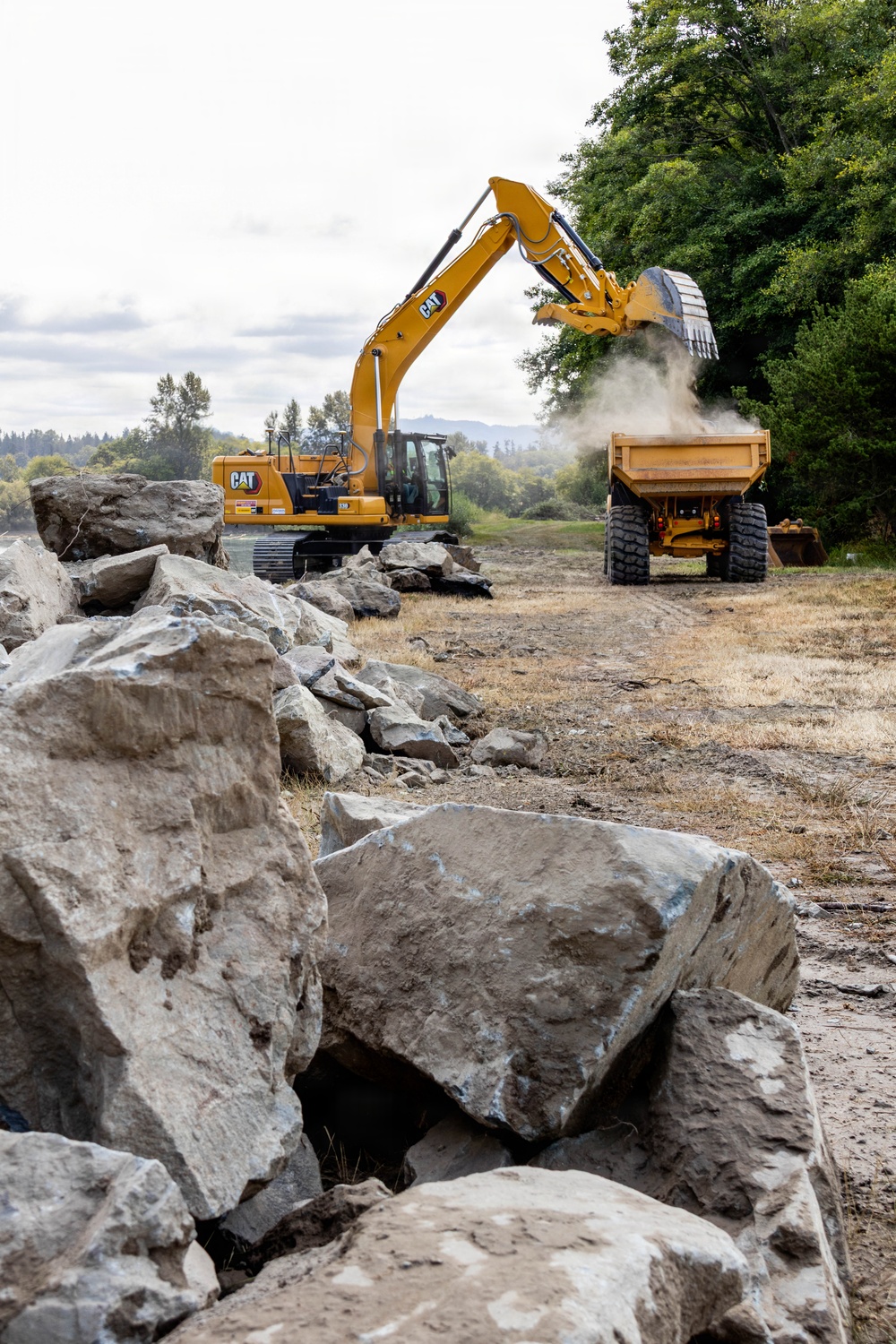
Photo By Abigail Chipps | U.S. Army Corps of Engineers' (USACE) Seattle District staff conduct a site visit to a...... read more read more
In early December 2025, a series of powerful atmospheric rivers brought historic rainfall to the Pacific Northwest, triggering catastrophic flooding, landslides and widespread infrastructure damage across Washington, Montana and Idaho.
In western Washington, some areas received more than 10 inches of rain as already saturated soils absorbed wave after wave of precipitation. Major rivers, including the Nooksack, Skagit, Cedar, Green and White, rose rapidly, flooding communities and threatening levees and other critical infrastructure.
The severity of the event prompted a 24-hour emergency response by the U.S. Army Corps of Engineers (USACE), Seattle District. But while the immediate flood threat eventually subsided, the district's mission did not end when the water receded.
Today, Seattle District continues the work that began during the December flood fight, helping communities restore damaged flood protection infrastructure and prepare for the next flood season.
From Emergency Response to Recovery
The December flood fight was only the first phase of the district's response. As floodwaters receded, attention turned to damaged infrastructure and restoring communities' ability to withstand future flooding.
Under Public Law 84-99 the Seattle District’s Emergency Management team worked with local and city partners conduct post-flood assessments and understand rehabilitation needs.
“PL 84-99authorizes repair and restoration of levees, such as those in Skagit County, active in the program and ensures their continued function,” said Lt. Col. Brandon Nall, Seattle District’s levee rehabilitation task force lead. “The program is designed to return damaged flood protection systems to their pre-flood level of protection as quickly and accurately as possible, with the goal of completing rehabilitation before the next flood season.” The 2026 rehabilitation effort currently includes 14 projects at various stages of operations.
One project has already had its level of protection restored: Skagit River Diking District 1, near Mount Vernon, Washington.
“The Skagit County Diking District 1 repair was completed last week and was the first of the PL 84-99 post-flood restoration projects,” said Seattle District’s Chief of Emergency Management Krystle Walker. “Three additional projects are currently under construction: Skagit Diking District 12, Skagit Diking District 22 and the Cedar River Left Bank project in King County. Another 10 projects are in the acquisition phase, representing the next group of projects moving through the process toward construction.”
“Together, these projects demonstrate the transition from the immediate emergency response to the longer-term effort to restore flood protection across communities affected by the December event,” said Walker.
The 2026 repair effort at Skagit Diking District 1 included restoring the protective levee by placing large armor rock to re-establish the levee prism and provide erosion protection.
“We went in and cleared the vegetation on the levee slope, to confirm the full extent of the damage caused in December,” said Sam Rosling, a Seattle District quality assurance representative. “We then laid new rock, including some rock chips or fragments also known as spalls, followed by larger rocks and stone, and crushed rock on top of that. Finally, we placed topsoil and willows to re-start vegetation growth.” “With the work completed, the level of flood protection has been restored at Diking District 1,” said Nall. “The restoration is significant for the Skagit Delta, where flood protection infrastructure helps protect homes, agricultural lands and other property from the effects of high-water events.”
The rehabilitation program illustrates how USACE's emergency management mission extends beyond the immediate response to a disaster.
“During an active flood fight, the priority is protecting lives and reducing immediate threats to critical infrastructure,” said Walker. “Once conditions stabilize, the focus shifts toward assessing damage, repairing eligible infrastructure and helping communities prepare for future events.”
"The work we do after a flood is just as important as the work we do during the flood," said Walker. "Our goal is to help communities recover from the immediate impacts while restoring the infrastructure they rely on to reduce risk from future flooding."
Building Infrastructure, Not Paperwork
The levee rehabilitation effort is also an example of how the Army Civil Works "Building Infrastructure, Not Paperwork" initiative is intended to accelerate delivery of critical infrastructure projects.
The initiative enables USACE to deliver projects and programs, including PL 84-99 rehabilitation work, more efficiently and sooner.
For flood-prone communities, faster project delivery can have significant consequences. Restoring damaged flood protection infrastructure before the next major flood event provides communities with greater protection and reduces the likelihood that previously damaged systems will become points of failure during another flood event.
Preparing for the Next Flood
Although the Pacific Northwest has moved beyond the immediate emergency conditions of December 2025, the lessons from the event remain fresh.
The flooding demonstrated how quickly conditions can deteriorate when successive storms saturate the region and rivers rise across multiple watersheds.
Seattle District continues to monitor weather conditions, river levels and reservoir operations while supporting communities through recovery and infrastructure rehabilitation.
The district's Emergency Management team provides response services for national and natural disasters, helping minimize damage and support recovery efforts.
The PL 84-99 Levee Rehabilitation Program also allows USACE to assist tribal, state and local authorities with flood-fighting activities when requested.Private residents and businesses seeking flood assistance should work through their local government organizations.
A Continuing Commitment
The December 2025 flood event tested communities, infrastructure and emergency response organizations throughout the Pacific Northwest. Seattle District responded by operating around the clock, managing reservoirs, providing technical expertise, delivering critical flood-fighting supplies and coordinating directly with government partners.
But the response did not end when the floodwaters receded.
That work represents the next phase of the flood response, moving from emergency action to infrastructure recovery and ultimately, to greater resilience.
Walker said, “From the first weather forecast to the final construction project, the mission remains the same: reduce risk to people and property, restore critical flood protection infrastructure and help communities prepare for the next emergency.”
| Date Taken: | 08.25.2026 |
| Date Posted: | 08.25.2026 18:03 |
| Story ID: | 573217 |
| Location: | SEATTLE, WASHINGTON, US |
| Web Views: | 26 |
| Downloads: | 0 |

This work, From flood fight to recovery: Seattle District continues restoring flood protection across the Pacific Northwest, by Shelia Fourman, identified by DVIDS, must comply with the restrictions shown on https://www.dvidshub.net/about/copyright.


No keywords found.





