
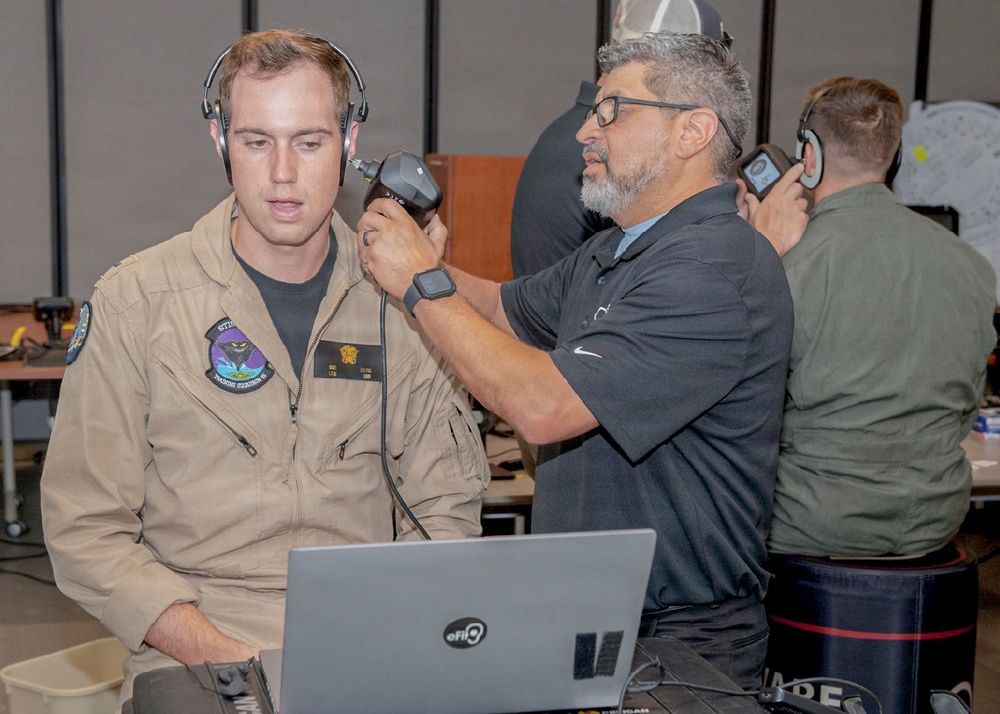
Photo By Ensign Geoffrey Gumport | Lt. j.g. Richard Irving, a student naval aviator assigned to the “Stingrays” of...... read more read more
 Subscribe
__Naval Air Training Command Implements 3D Digital Ear-Scanning Fleetwide __
Corpus Christi, Texas – More than 1,000 Chief of Naval Air Training (CNATRA) personnel are one step closer to receiving custom hearing protection thanks to the coordinated efforts of CNATRA and Naval Air Training Command’s (NATRACOM) Aerospace Medical Safety Officers (AMSO).
Working alongside Commander, Naval Air Forces (CNAF) and the Aircrew Systems Program Office (PMA-202), CNATRA AMSOs organized large-scale ear-scanning events during July and August in Corpus Christi, Texas, Kingsville, Texas and Pensacola, Fla. that will provide Student Naval Aviators (SNA), Instructor Pilots (IP), and aircrew assigned to NATRACOM with custom communication earplugs designed to improve hearing protection and in-flight communications. The initiative marks the first time CNATRA has participated in a mass digital ear-scanning effort, following successful proof-of-concept events conducted at Naval Test Wing Atlantic.
For decades, Naval Aviation has used custom-fitted hearing protection to help mitigate the effects of hazardous aircraft noise. Traditionally, creating custom earpieces required placing silicone material into an aircrew member’s ear canal to form a physical impression. The impression was then mailed to a manufacturer, where it was used to create a cast and ultimately the custom earpiece.
The process introduced opportunities for error, including physical impressions becoming distorted during shipping, which could result in uncomfortable or poorly fitting hearing protection. Digital scanning removes the need for a physical ear impression by creating an electronic three-dimensional model of an individual's ear that can be sent directly to the manufacturer.
This past month, nearly 500 personnel assigned to Training Air Wing (TW) 2 and Training Air Wing (TW) 4 volunteered to participate in the three-dimensional digital ear scanning. Training Wing (TW) 5 and Training Wing (TW) 6 are expected to have over 700 volunteers participate during August. The resulting digital models are used to manufacture communication earpieces custom-fitted to each aircrew member’s unique ear anatomy.
Lt. Destiny Attewell, TW-4 AMSO, emphasized the importance of providing naval aviation’s newest aviators with hearing protection early in their careers.
“Every flight hour exposes our aviators to hazardous noise levels, making hearing conservation a critical part of readiness,” said Attewell. “Seeing nearly 500 aviators from Training Wing 2 and Training Wing 4 receive custom-fit hearing protection through CNAF priority and 3D scanning innovation demonstrates our commitment to protecting the warfighter today while preserving their hearing for the future.”
Because TW- 2,4,5 and 6 are located in areas with larger concentrations of naval aviation personnel, PMA-202 funded the mass-scanning events for those wings. At Training Air Wing (TW) 1, located at Naval Air Station Meridian, Mississippi, Lt. Amos Meyers, TW-1 AMSO, has been conducting digital ear scans for aircrew at the wing himself.
“Naval Air Station Meridian is a relative island in terms of Navy locations,” said Lt. Amos Meyers, TW-1 AMSO. “Having the ability and equipment to scan in-house incurred an up-front cost, but long-term has developed a sustainable process to get custom hearing protection into the hands, or ears, of our aircrew early in their careers. Hearing is one of those senses that doesn’t recover once damaged so early intervention is key.”
Earlier this year, all NATRACOM AMSOs completed specialized training on the digital scanning equipment and returned to their respective training wings with certified scanning devices and the ability to conduct the scans themselves. While the mass-scanning events accelerated the initial rollout, the AMSOs will continue sustaining the program by scanning newly reporting aircrew as they arrive at their commands.
The effort is being carried out across CNATRA by Lt. Amos Meyers at TW-1; Lt. Natalia Karvelis at TW-2; Lt. Destiny Attewell at TW-4; Lt. Andy Cosgrove at TW-5; and Lt. Will McMillen at TW-6.
Cmdr. Amanda Lippert, CNATRA aerospace medical safety officer, who helped coordinate the initiative between CNAF, PMA-202 and NATRACOM’s training wing AMSOs, stressed the critical role the AMSO played in the execution of the program.
“We are especially thankful for our Aerospace Medical Safety Officers at each of our training wings,” said Lippert. “Their hard work to facilitate these mass scan events ensured that over 1,000 personnel assigned to CNATRA had their ears scanned and received custom earpieces to protect their hearing and better facilitate communications while flying. I am immensely proud of their initiative.”
Headquartered at Naval Air Station Corpus Christi, Texas, the Chief of Naval Air Training (CNATRA) oversees five training air wings and 17 training squadrons across Florida, Mississippi, and Texas. These squadrons conduct primary, intermediate, and advanced flight training for student naval aviators, naval flight officers, and air vehicle pilots. CNATRA remains steadfast in its mission to train, mentor, and deliver the highest quality naval aviators prepared to win in competition, crisis, and conflict.
| Date Taken: | 08.25.2026 |
| Date Posted: | 08.25.2026 16:56 |
| Story ID: | 573213 |
| Location: | CORPUS CHRISTI, TEXAS, US |
| Web Views: | 22 |
| Downloads: | 0 |

This work, Naval Air Training Command Implements 3D Digital Ear-Scanning Fleetwide, must comply with the restrictions shown on https://www.dvidshub.net/about/copyright.


No keywords found.




