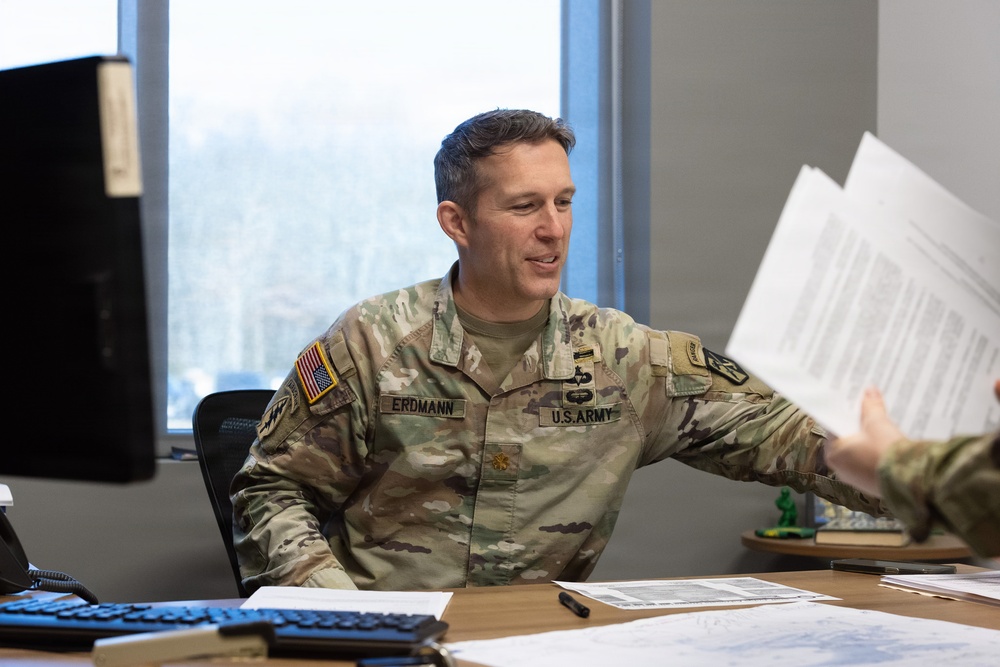
Photo By Sgt. 1st Class Terry Rajsombath | Major Tyson Erdmann, Judge Advocate General, Rhode Island Army National Guard, reviews legal documents with a fellow Soldier, Dec. 11, 2025. Erdmann uses his background as a former infantryman and 75th Ranger Regiment veteran to bring an operational perspective to his role as a legal advisor and build rapport with the Soldiers and commanders he supports.
(U.S. Army National Guard photo by Sgt. 1st Class Terry Rajsombath) see less
| View Image Page
Fighting for rapport in and out of the courtroom with one of the most interesting JAGs in the Army
“We’re all taking fire. The assault element is taking fire. The support element is taking fire. We were shooting hundreds of rounds,” said Maj. Tyson Erdmann, General Counsel for the Rhode Island National Guard. “It lasted for six hours or so and we ended up calling for an air-strike.”
When many people think of a Judge Advocate General (JAG) officer, they picture a Soldier behind a desk, drafting legal briefs or arguing in a courtroom. They don’t picture one taking cover from sniper fire, advising Special Forces commanders on kinetic strikes, or blowing up IED factories in Afghanistan.
But Maj. Tyson Erdmann is that JAG officer.
Erdmann’s Army journey began in 1996, straight out of high school. With a Ranger Regiment contract in hand, he enlisted as an infantryman and pushed through One Station Unit Training (OSUT), airborne school, and Ranger selection. He served over four years in the 75th Ranger Regiment, cutting his teeth in one of the Army’s toughest units before transitioning to the Massachusetts National Guard.
In 2003, Erdmann deployed with his unit to Guantanamo Bay, where his infantry squad rotated through security, patrol, and quick reaction force missions at the height of detainee operations.
After completing his eight-year enlistment with the Guard, Erdmann set aside his uniform for nearly a decade. He worked as a private detective, ran an international security consulting business with missions in Mexico, Sudan, Kenya, and the Philippines, and pursued a degree in law.
Then he felt the pull back to service.
Erdmann said, “After finishing law school, I started thinking I may want to serve again, and it just so happened that because I had my law degree, I could direct commission as a legal advisor.”
That decision didn’t just bring him back to the Army; it reconnected him with the world he once belonged to. Many of the Soldiers he served with were now senior leaders in the 75th Ranger Regiment. Close friends went on to become leaders in Delta Force. An early mentor in the Ranger Regiment became the Command Sergeant Major for the 10th Mountain Division and was the first to welcome Erdmann to his initial JAG assignment at that Division.
Those relationships gave him a foundation of trust to stand on, but it was his own experience that carried him forward. As a former Ranger turned attorney, he understood life outside the wire, which bridged the world between combat and counsel.
“It was a shift for sure,” said Erdmann. “But my background in tactical operations gave me additional perspective as a JAG officer. I wasn’t just advising on the law; I understood the practical, operational side of things, which helped me build rapport with commanders and teams.”
On his first deployment as a legal advisor, he led a rule of law team to train and collaborate with Afghan prosecutors, judges, and police in their own villages and cities, spanning from the mountains of Kunar to Kabul. His objective: to aid in criminalizing the insurgency.
Erdmann also served as a foreign claims officer, joining combat patrols into remote villages to compensate Afghans whose homes or lives had been damaged in combat.
“It was sort of the existing SOP (standard operating procedure) that those claimants had to come to the FOB (Forward Operating Base) to file a claim,” said Erdmann. “To file a claim, they had to have x, y, and z, which meant they often had to travel back and forth. It baffled me because we were in the middle of a war and many of those people didn’t have a car.”
Rather than forcing civilians to make dangerous trips repeatedly, he brought the process to them. By sharing the same risks instead of remaining in the safety of an office, he earned the trust of both the local population and his own team; ultimately giving commanders greater credibility with the people they were there to support.
Later, with the 10th Mountain Division, Erdmann served as the legal advisor for the targeting team for Regional Command East, Afghanistan. Led by a former Delta Force commander, his team worked alongside Navy SEALs and Green Berets, advising strike cells on high-value insurgents. That experience set him up for a 2017 deployment with 7th Special Forces Group, where he became the principal legal advisor for the Special Operations Task Force (SOTF) Alpha Commander in Afghanistan.
He didn’t spend that entire deployment behind a desk. Upon the early arrival of his successor, and with his commander’s blessing, Erdmann attached to a Special Forces team in Nangarhar Province as they fought the Islamic State Khorasan (ISIS-K).
“My commander at the time was a prior enlisted Ranger,” said Erdmann. “We had a mutual understanding of our background, which allowed for the situation in which I joined up with the ODA (Operational Detachment Alpha) as an extra gun on a push preventing ISIS from re-taking Pekka Valley from their position in Pakistan.”
Every day brought troops in contacts (TICs). Erdmann manned a M240 machine gun during a six-hour battle to clear a bazaar riddled with enemy fighters. He helped demolish an IED factory with C-4 explosives, taking the same risks as the operators he advised.
Looking back, Erdmann believes his unusual path, Ranger, detective, contractor, lawyer, JAG, wasn’t about collecting titles. It was about building credibility and service in every role.
“Everyone has something unique they bring to the team,” said Erdmann. Not every JAG has to get on combat patrols, but the idea is that they be willing to sacrifice and do the tough training with their units, never miss an Annual Training, a JRTC rotation, or an opportunity to deploy with the units they advise. That’s how you earn trust. That’s how your voice matters.”
Erdmann shares his knowledge and lessons learned with the legal team of the RI Army National Guard and while teaching as an adjunct professor at the Naval Justice School, and the U.S. Naval War College, Law of Armed Conflict Course (ILE and SSC), two of the Department of War’s premier institutions for developing military legal professionals and strategic thinkers.
Erdmann still maintains strong ties with former teammates in the Special Operations community. In his spare time, he enjoys traveling and practicing jiu-jitsu.