
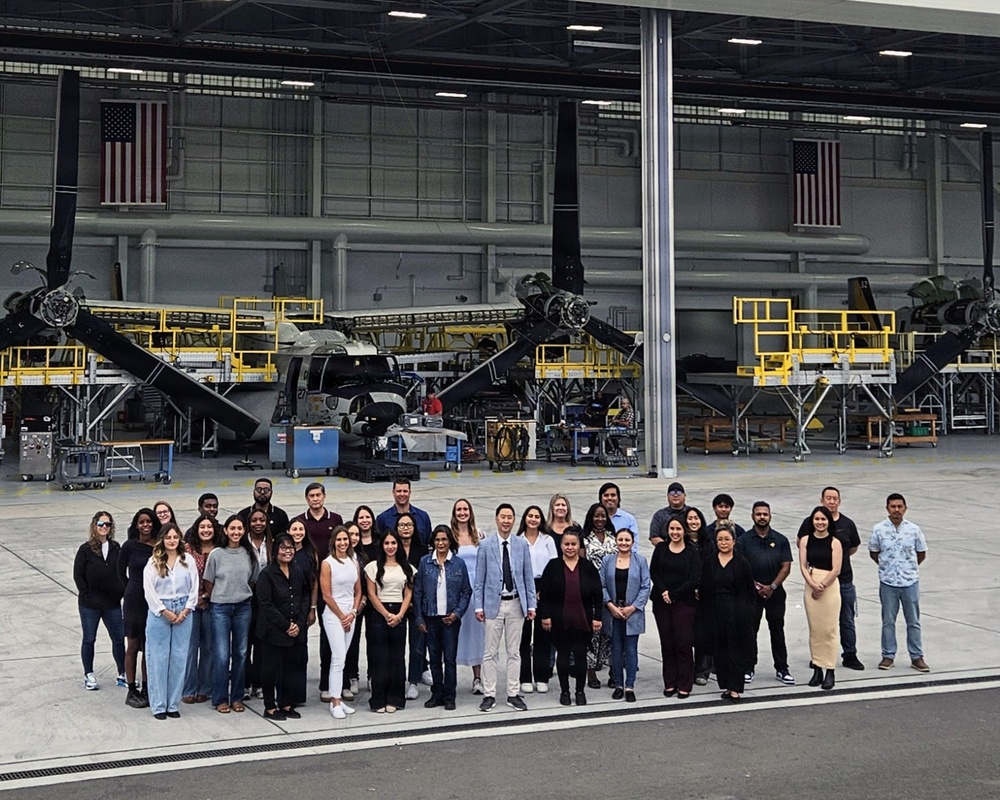
Photo By Michael A Furlano | For Ji Kim, FRCSW’s Comptroller, that connection has driven a years long effort to...... read more read more
Financial management may start behind a desk, but at Fleet Readiness Center Southwest (FRCSW), its impact can be felt on the flightline.
For Ji Kim, FRCSW’s Comptroller, that connection has driven a years long effort to change how the command approaches money, data, technology and accountability.
His leadership was recently recognized with the Contribution to End to End Business Environment Optimization award, an award recognizing individual and team excellence in modernizing business operations, but Kim is quick to point out that the recognition belongs to far more than one person.
“It’s the team,” Kim said.
The heart of the operation is the entire FRCSW Comptroller workforce, a dynamic team of Budget, Accounting, and Business Financial Management specialists.Their expertise and collaboration are empowered by a strong core leadership team, including Deputy Comptroller Caroline Thomas,Business Financial Management Division DirectorEd Reyes,Budget OfficerChristina Bartram andAccounting OfficerGrazyna Waters. Together, they helped transform a department once heavily reliant on spreadsheets and manual processes into a datadriven organization focused on providing leaders with timely information to make better decisions.More importantly, they helped change the culture of financial management across the command.
When Kim and his team began their financial recovery effort, FRCSW faced a daunting challenge: a large, accumulated deficit that needed to be reduced. Through what became known as the “Get Well Plan,” the team eliminated the deficit and restored financial stability.
Balancing the books was only the beginning. “The deficit was the lynchpin,” Kim said. “But the real success wasn’t overcoming that number. It was changing the culture at the command.”
That meant changing the mindset from financial management being the Comptroller’s responsibility to understanding that every employee has a role in responsible stewardship of public funds.
FRCSW operates as a Navy Working Capital Fund activity. Unlike a mission funded organization that receives a set amount of money to accomplish its mission, FRCSW generates revenue by providing aviation maintenance and repair services to other military commands. That makes financial stability directly connected to the command’s ability to execute its mission.
Klim’s team stabilized the Net Operating Result (NOR) and rates, the costs FRCSW charges other military commands for its work, and maintained its NOR targets for five consecutive years following the Get Well Plan.
The result is more than a healthy balance sheet, it gives leaders greater predictability, allowing FRCSW to plan, execute its workload and return aircraft and components to the fleet.
In the end, financial readiness supports flightline readiness.
One of the most visible changes has been the Comptroller team’s embrace of technology. They have moved beyond traditional spreadsheet heavy processes and now use tools such as Microsoft Power BI, Qlik Sense, Microsoft Power Apps and other data capabilities to automate work and provide leaders with real time information.
The team has deployed more than 50 Qlik applications alone that are used in daily operations.
One conversation showed Mr. Kim just how deeply the transformation had taken hold. When he asked a junior employee how Qlik was being used, the employee responded: “Mr. Kim, we cannot do our jobs properly without Qlik anymore.”
For Kim, that was a powerful moment.
“When I first arrived at the command, we were very Excel heavy,” he said. “Now we are working with real time data.”
That shift allows employees to spend less time gathering and manipulating information and more time analyzing it, identifying problems and helping leaders make strategic decisions.
Technology alone did not create the transformation. People did.
Kim challenged his workforce to develop new skills and become more comfortable with data analytics. He helped develop financial analysts into data focused professionals through training in areas including SQL, Python and data visualization.
The team went on to identify a $10.2 million cost saving opportunity in its first year and develop dynamic applications that provide leaders with greater visibility into the command’s financial health.
Kim also believes leaders have to “walk the talk.”
Rather than simply asking his employees to learn new technology, he pursued his own education, earning a data analytics certificate through the Naval Postgraduate School.
The approach helps Kim understand the tools his employees use while demonstrating that professional development is not something leaders should expect from others without embracing it themselves. That philosophy extends beyond the Comptroller office.
FRCSW’s mission requires production, engineering, logistics, facilities, administration, finance and numerous other departments to work together. Every week, the command’s Tuesday Morning Exchange meeting brings those organizations together to discuss production and other issues affecting the command, including finances. The goal is to make the connection clear.
A financial decision can affect production, production affects aircraft availability, aircraft availability affects the fleet, and fleet readiness affects the warfighter. When employees understand that connection, financial management stops being someone else’s job. It becomes part of the mission.
Kim also works to ensure his Comptroller team understands that their mission does not exist behind a computer screen.
Team members have been given opportunities to see the operational side of naval aviation, including visiting an aircraft carrier and seeing firsthand the people and aircraft their work ultimately supports. For financial professionals, seeing that end result can change the perspective. The numbers become real, the mission becomes real.
When Vice Admiral John Dougherty IV (Commander Naval Air Systems Command), congratulated Kim on the award, he asked a question that may ultimately be more important than the recognition itself: “How can we export this culture to other commands?”
Kim’s answer is rooted in sharing.
FRCSW’s Comptroller team regularly communicates with its counterparts at the other Fleet Readiness Centers, sharing lessons learned, discussing challenges and looking for ways to improve together. The objective is not simply for FRCSW to succeed but for the entire enterprise to become stronger.
Sustaining this success comes down to three things: people, culture and technology. People must continue to learn, develop and bring new skills into the organization. Culture must continue to emphasize ownership, accountability and continuous improvement and technology must continue to evolve as new tools provide better ways to work.
At FRCSW, financial management is not just about dollars. It is about readiness, and readiness means providing the Navy and Marine Corps warfighter the aircraft, components and resources needed to fight and win whenever the nation calls.
FRCSW Employees are the Backbone of Military Readiness!
| Date Taken: | 08.14.2026 |
| Date Posted: | 08.25.2026 14:57 |
| Story ID: | 573198 |
| Location: | SAN DIEGO, CALIFORNIA, US |
| Web Views: | 26 |
| Downloads: | 0 |

This work, FRCSW Comptroller - Turning Dollars Into Readiness, by Michael A Furlano, identified by DVIDS, must comply with the restrictions shown on https://www.dvidshub.net/about/copyright.


No keywords found.





