
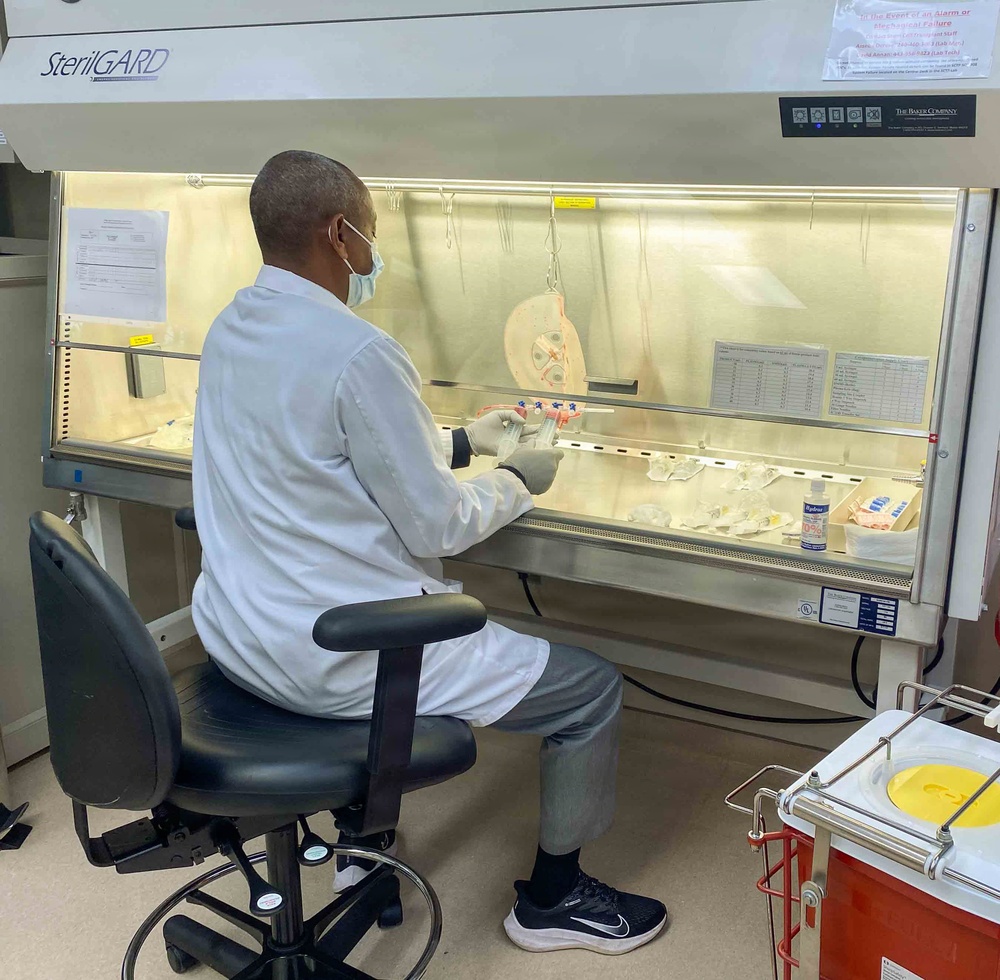
Courtesy Photo | A lab technician processes collected cells at Walter Reed National Military Medical...... read more read more
 Subscribe
Walter Reed National Military Medical Center’s Murtha Cancer Center was recently approved to deliver an advanced form of treatment for cancer. The therapy, known as Chimeric Antigen Receptor T-cell therapy (CAR-T), allows Walter Reed to treat patients with forms of non-Hodgkin’s lymphoma and acute lymphoblastic leukemia by reprogramming their own blood cells to hunt and destroy the cancer cells within them.
CAR-T therapy uses a technique called “apheresis,” which separates the lymphocytes, white blood cells that include T-cells, in a patient’s blood. The harvested T-cells are sent to a laboratory that genetically alters them, applying the chimeric antigen receptors that are designed to seek out the particular form of cancer cells they are intended to destroy.
During this process, patients typically undergo a low-dose round of chemotherapy to prepare their body for the new cells. Once the adapted cells are ready, they are re-introduced into the bloodstream and go about their work of attacking the cancer.
“Before this technology, if lymphoma patients didn’t respond to their initial treatment, or their disease came back, we would give them more chemotherapy and consider an autologous stem cell transplant,” said U.S. Army Maj. (Dr.) Arjun Kalra, staff physician in Walter Reed’s hematology-oncology clinic, and assistant professor of medicine at the Uniformed Services University of the Health Sciences (USU). “Unfortunately, that can only apply to a subset of patients. To perform an autologous stem cell transplant, the patient must be in good shape and overall good health, so we can be restricted on who we offer that therapy.”
According to Kalra, the CAR-T treatment offers an entirely new path forward for patients who have these types of cancers.
“CAR-T overcomes barriers in a lot of ways because many people who would not have been candidates for a stem cell transplant are going to be candidates for CAR-T,” Kalra said. “This offers a drastic improvement in treatments that can significantly improve patient outcomes.”
The primary advocate who brought CAR-T treatment to Walter Reed is U.S. Navy Cmdr. (Dr.) Daniel Bowers, director of Walter Reed’s cellular therapy program, staff physician and assistant professor at USU. Bowers followed the therapy's progress since 2014, when he heard its pioneer, immunologist and oncologist Dr.Carl June speak about the technique at Duke University.
June, a retired Navy captain, completed his internal medicine residency at the former National Naval Medical Center (now Walter Reed National Military Medical Center). He founded the Immune Cell Biology Program at the Naval Medical Research Institute and headed its immunology department from 1990 to 1995 before retiring from the Navy to join the University of Pennsylvania. The FDA first approved the therapy in 2017. Because of logistical challenges, only a limited number of facilities are authorized to administer the therapy. Within the Department of War (DOW), Walter Reed is the only facility approved to provide CAR-T therapy.
“This has been one of the biggest innovations in malignant hematology or bloodborne cancer therapy in the last 15 years,” Bowers said. “Especially for lymphomas, which are among the curable cancers that we treat. With active-duty patients, we treat them and return them to medically unrestricted duties. It’s one of the reasons we targeted the lymphoma products first. It has more military relevance.”
Potential CAR-T treatment patients must first be identified. Walter Reed’s CAR-T team assesses people with advanced lymphomas that have not responded well to their initial chemotherapy treatments. At that point, CAR-T treatment is often the last option possible for many patients.
The screenings for CAR-T therapy look for current or prior viral infections, and ensure patients aren’t suffering from any disqualifying medical problems, like heart or lung issues. Chosen patients are required to follow a regimen that prepares the body to receive the CAR-T cells, as infusion of the cells can have an immunosuppressive effect. During the infusion, patients may be susceptible to new infections or old infections resurfacing.
One major benefit of CAR-T therapy is that the treatment only requires one infusion. While there are many steps for qualifying and preparing the body to receive the CAR-T cells infusion, there is no requirement for future infusions.
“When it’s done, it’s done,” Kalra said. “Patients who respond positively won’t need anything else … no other cancer-directed therapies.”
Providing access to this advanced level of healthcare aligns perfectly with Walter Reed’s focus on bringing state-of-the-art medicine to the nation’s service members, retirees and their beneficiaries.
“We’re the Murtha Cancer Center, the sole Center of Excellence for cancer treatment in the DOW, so adding this capability is in line with keeping up with the high standards that we set for ourselves,” Kalra said. “Not only are we focused on treating our present patients with our current standard of care, but we’re also looking to remain on the cutting edge and staying ahead. By adding this capability, it opens doors for us to add clinical trials that will give us more access to CAR-T products, for different indications at different times, and another way we can offer this therapy to our patients.”
Bowers is excited to see how CAR-T therapy brings optimism to cancer patients who might be losing hope, not only for long-term remission but also for a potential cure.
“Historically, DOW hasn’t had this capability, and we don’t have a solid idea of what the actual need in the military community is,” Bowers said. “Patients are either not getting treated, or maybe they live somewhere where they have the means of receiving treatment at another facility. But I think there are enough patients out there dealing with these types of cancers for this to be an unmet need.”
Ultimately, addressing that unmet need means expanding access across the broader military healthcare network.
“I think it’s important that Walter Reed receiving this approval increases access to these curative treatments for our patients, and for military oncology at large,” Bowers said. “I think that’s the most important thing we can do. There are opportunities via sharing agreements to help our veterans at the VA and other patients that would benefit from having access to these treatments.”
For more information on the John P. Murtha Cancer Center, visit https://walterreed.tricare.mil/MurthaCancerCenter.
| Date Taken: | 08.25.2026 |
| Date Posted: | 08.25.2026 13:34 |
| Story ID: | 573184 |
| Location: | BETHESDA, MARYLAND, US |
| Web Views: | 39 |
| Downloads: | 0 |

This work, A new front on cancer: Walter Reed’s Murtha Cancer Center unleashes cutting-edge CAR-T therapy, by Christopher Smith, identified by DVIDS, must comply with the restrictions shown on https://www.dvidshub.net/about/copyright.


No keywords found.




