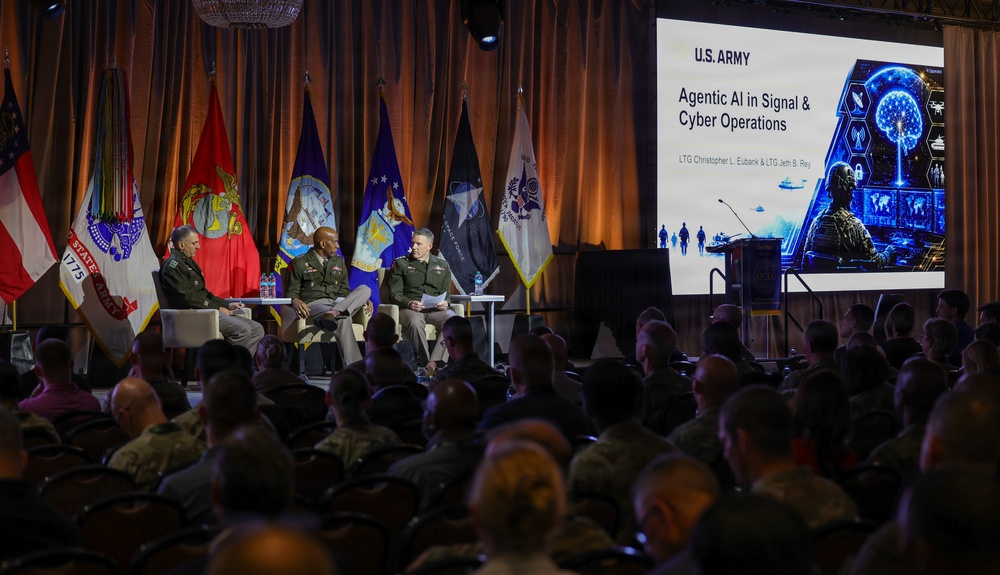
FORT GORDON, Ga.-- Lt. Gen. Christopher Eubank, commander of U.S. Army Cyber Command, joined Lt. Gen. Jeth Rey, the Army’s chief information officer/G-6, for a discussion focused on the Army’s evolving approach to artificial intelligence, network defense and human-machine teaming at TechNet Augusta 2026 on August 19, 2026.
Their conversation reflected one of the central purposes of TechNet Augusta: creating an environment where military leaders can engage directly with the technology industry to discuss operational challenges, exchange ideas and identify solutions.
For Eubank, that partnership is increasingly important as the Army faces a network environment that changes faster than traditional processes can keep pace.
“The defense today of this network is moving at machine speed,” Eubank said. “The network you see today will not be the network you see in 90 days.”
That pace creates a challenge for an enterprise spanning hundreds of installations, thousands of systems, and hundreds of thousands of users. Eubank said the Army cannot rely solely on human personnel to identify and respond to every potential vulnerability at the speed required.
Instead, Army Cyber Command is pursuing human-machine teaming, using AI-enabled agents to augment cyber professionals while maintaining human oversight.
That includes roles such as developers, engineers, host analysts, and exploitation analysts. The agents are trained to meet standards established for their respective work roles before being assigned to missions.
The process is designed to create a feedback loop. Agents operate under human supervision, produce results, and learn from mistakes, with their performance evaluated and incorporated into subsequent training.
For Eubank, that approach is critical to balancing the speed AI can provide with the risks associated with employing emerging technology in military operations.
“Speed without control creates risk,” he said.
Eubank described the Army’s challenge through the framework of speed, scale, information and integration. While the Army has demonstrated an ability to innovate and integrate capabilities across the force, he said achieving speed and scale while appropriately managing risk remains one of the most difficult challenges.
Rey emphasized the same need from the Army network perspective, noting that AI can help cyber professionals process the enormous volume of information generated by the enterprise and turn it into actionable insights.
Rather than replacing people, Rey said AI should help personnel move from manually processing information toward making faster, better-informed decisions.
The Army’s network, he said, is foundational to every aspect of military operations.
“We can’t fire rounds without it. We can’t move people without it. We can’t operate daily without it,” Rey said.
The discussion at TechNet Augusta underscored a broader shift in how the Army views artificial intelligence: not simply as an emerging technology, but as a capability that must be integrated into the way the force operates.
As adversaries continue to leverage technology to move faster, Army leaders say the ability to combine human expertise with machine speed will be increasingly important to maintaining an advantage.
The objective, Eubank said, is not to replace the people who defend the Army’s networks, but to give them the tools to operate at the speed modern warfare demands.
| Date Taken: |
08.21.2026 |
| Date Posted: |
08.25.2026 12:53 |
| Story ID: |
573182 |
| Location: |
AUGUSTA, GEORGIA, US |
| Web Views: |
32 |
| Downloads: |
0 |
PUBLIC DOMAIN

This work, Army Leaders highlight AI, human-machine teaming at TECHNET Augusta 2026, by SSG DeMarco Wills, identified by DVIDS, must comply with the restrictions shown on https://www.dvidshub.net/about/copyright.

 Subscribe






