
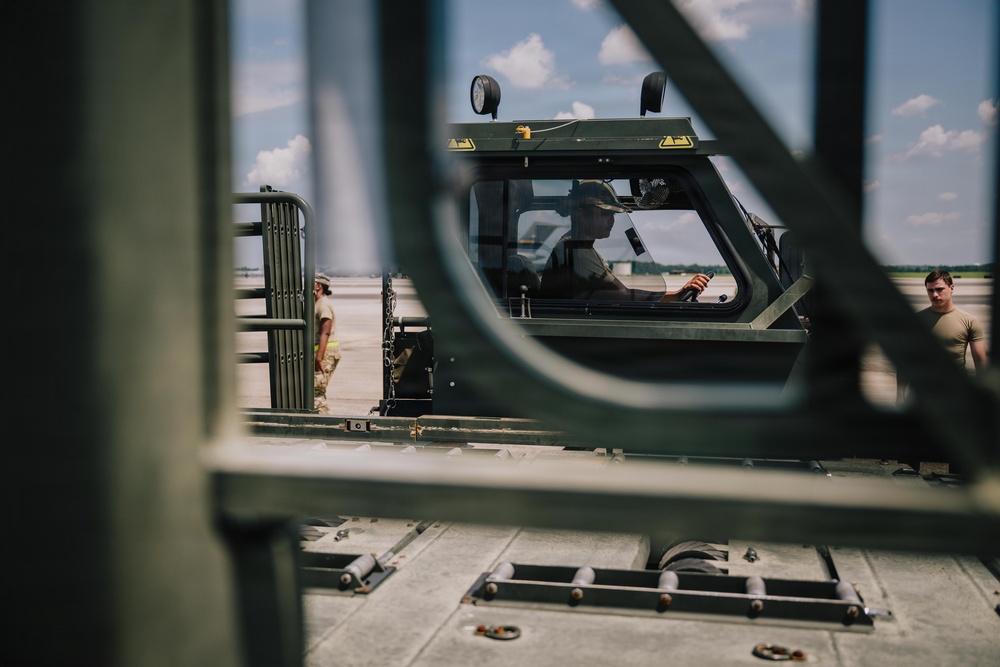
Photo By Maj. Marquel Coaxum | U.S. Air Force Airman 1st Class Diosa Abad, an air transportation specialist with the...... read more read more
Reserve and active duty Airmen trained side by side on 25K aircraft loaders at Joint Base Lindsey Graham, South Carolina, Aug. 21, sharpening readiness and building the shared skills Reserve Airmen need to integrate with active duty forces during deployed operations.
The initial qualification training put Airmen behind the controls of the 25K aircraft loader, commonly called a K-loader. The vehicle can carry up to 25,000 pounds of cargo and is used to move cargo and baggage pallets to aircraft. Master Sgt. Sean Judice of the 38th Aerial Port Squadron, here, served as the lead instructor.
“I need to make sure that our drivers are confident enough that when they come out here to go up to an actual aircraft, that they can do it safely and be able to follow the directions of spotters out there,” Judice said.
That confidence comes from more than learning the controls. Airmen must safely maneuver the loader around aircraft, communicate with spotters and understand their role in the larger cargo operation.
Training alongside active duty Airmen also gives reservists an opportunity to learn from personnel who operate the equipment routinely. Staff Sgt. Jacobe Putman, a cargo operations specialist with the 38th Aerial Port Squadron, said the difference in day-to-day operating time naturally creates a learning curve.
“Our active duty counterparts operate K-loaders multiple times a day, on an everyday basis, so there is a natural learning curve between reservists and active duty,” Putman said. “Fortunately, the curve is flattened because active duty helps reservists learn tips and tricks on making K-loader operations smoother.”
The benefit goes beyond qualification. Reserve and active duty Airmen who train together may later work alongside one another during deployments, where familiarity with each other’s procedures and communication can make integration easier.
“It is super important that Reserve and active duty work together before operational missions or deployments because both components are expected to operate as one team,” Putman said. “Training together beforehand builds cohesion, chemistry and communication that carry over when they’re working side by side.”
That integration also gives Reserve Airmen an opportunity to demonstrate the capability they bring to the Total Force. Putman said reservists stepping into roles previously filled by active duty Airmen can reinforce confidence in their training and their ability to carry the work forward.
“When a Reserve Airman fills the role previously filled by an active duty Airman, it shows active duty that reservists are just as capable and have received proficient training as active duty Airmen,” Putman said. “This also allows the Reserve Airman to separate themselves and active duty personnel to gain trust and comfort that the mission will be completed with excellence, just as if an active duty Airman was tasked to complete the mission.”
For Judice, that capability comes down to a common standard. When Reserve Airmen deploy, they are expected to arrive ready to perform alongside their active duty counterparts.
“As reservists, when we deploy, we’re expected to operate at the same level of competency that our active duty counterparts operate at,” Judice said.
That standard allows Reserve Airmen to enter an existing operation, work alongside active duty Airmen or assume responsibility for work already underway.
“When we come in and take over for an active duty aerial port that’s already out on the flightline, we can step in and take control,” Judice said. “We’re trained to deliver the same capability and keep the mission moving from the moment we arrive.”
Learn more: Follow the 315th Airlift Wing on https://www.facebook.com/315AW and https://www.instagram.com/315th_aw/ for the latest news, photos and stories highlighting our Airmen and mission.
| Date Taken: | 08.25.2026 |
| Date Posted: | 08.26.2026 14:01 |
| Story ID: | 573166 |
| Location: | JOINT BASE CHARLESTON, SOUTH CAROLINA, US |
| Web Views: | 23 |
| Downloads: | 0 |

This work, Joint K-loader training sharpens Reserve readiness, by Maj. Marquel Coaxum, identified by DVIDS, must comply with the restrictions shown on https://www.dvidshub.net/about/copyright.


No keywords found.





