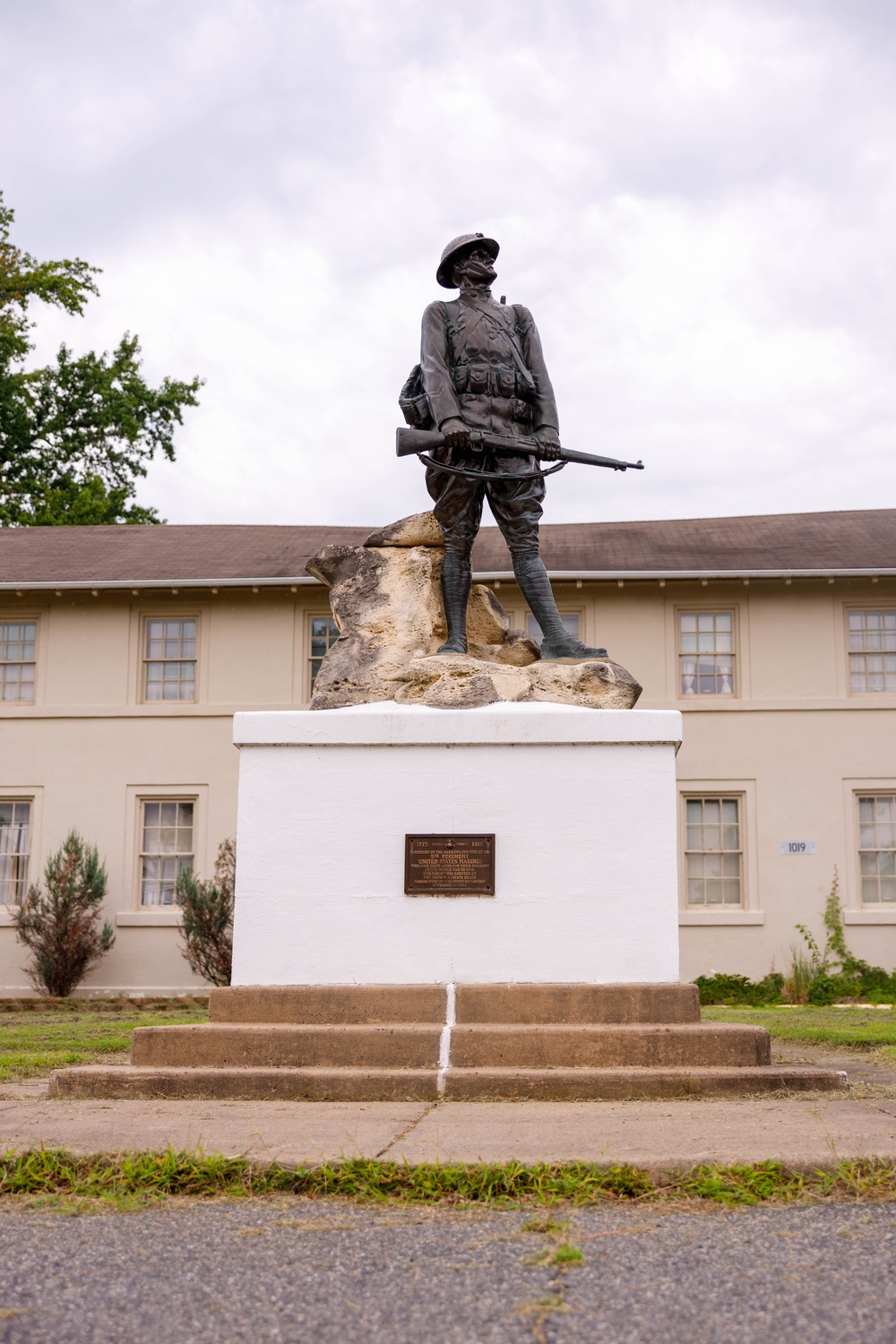
Photo By Lance Cpl. Lynsee Avila-Ramirez | The “Crusading for Right” statue, also known as “Iron Mike,” stands outside Butler Hall at Marine Corps Base Quantico, Virginia, Aug. 16, 2026. The bronze monument, created in 1918 by French sculptor Charles Raphael Peyre, depicts a World War I U.S. Marine holding an M1903 Springfield rifle. (U.S. Marine Corps photo by Lance Cpl. Lynsee Avila-Ramirez) see less
| View Image Page
Crusading for Right' or 'Iron Mike'? The true story of Quantico's iconic statue
MARINE CORPS BASE QUANTICO, Va. —In the quiet, dust motes of a Parisian sculptor’s studio in 1918, Charles Raphaël Peyre stood face-to-face with the raw reality of the Western Front. Before him stood Pvt. Carl J. Millard — a twice-wounded Marine from the 5th Regiment, sent directly from the hellscape of Chateau-Thierry. Still clad in his mud-caked combat gear and gripping his Springfield rifle, the exhausted private embodied the fierce defiance Peyre had only read about in the front-line dispatches. Peyre knew immediately that this was the stance he had to freeze in bronze.
“He was not a soldier on parade; he was the Crusader of the right, marching forward to deliver the world from tyranny," wrote Peyre in a 1920 letter.
Today, this statue that’s officially titled “Crusader of Right,” commands the entrance of Butler Hall on MCB Quantico. The iconic World War I statue, born from a battlefield of valor and artistic defiance, is one monument of many across the base’s 59,000 acres. Yet, none capture the raw grit of the trenches quite like “Iron Mike,” the common name used by Marines in reference to the statue of Millard.
Born in Paris in 1872, Peyre was a sculptor who studied under artists Antonin Mercie, Alexandre Falguiere and Theophile Barrau before establishing himself as a professional artist in the 1890s. He worked in bronze, marble, ivory and plaster, receiving multiple awards for his artwork.
When World War I began in 1914, the 42-year-old Peyre joined the French army. Following the Battle of Chateau-Thierry in the summer of 1918, he found inspiration for a new sculpture.
Peyre said in one of his letters, “In June 1918, immediately after the memorable and decisive battle of Château-Thierry, when the American soldier revealed to the world his invincible energy, I conceived the idea of immortalizing these heroes through a statue.”
Peyre wrote that the actions of the American troops who helped stop the German advance on Paris emotionally moved him. Since Peyre was a soldier at this time, he needed permission to begin working on the first model of his desired sculpture.
In June 1918, the governor agreed to Peyre’s request and provided him with a room at the Palais des Invalides to begin the sculpture. The governor also permitted Peyre to contact Brig. Gen. William W. Harts, the commanding general of the American District of Paris. Harts provided a selection of 150 American service members who had served on the battlefield.
Among these men was Marine Pvt. Carl J. Millard of the 5th Marine Regiment.
“Carl Millard of Chicago, a member of the Marine Corps who had been twice wounded at Chateau-Thierry was chosen by me,” Peyre said in his translated letter. “The next morning, this man presented himself at my studio in heavy marching order.”
Using Millard as his model, Peyre completed a 2-foot version of the statue by December 1918. The piece, which featured a Marine Corps insignia on the helmet, was placed on display in Harts’ Paris office. Marine Maj. Davis B. Wills saw the statue and recommended that the Commandant of the Marine Corps Maj. Gen. George Barnett commission a full-size version.
Approximately a week later, Sgt. George B. Robert of the Marine Corps paymaster’s office contacted Peyre to negotiate the creation of an 8-foot version. Peyre began work on the larger statue, incorporating Marine Corps buttons and collar insignias that were not on the original model.
He completed the 8-foot version, titled “Crusading for Right,” in April 1919 and displayed it in the Place des Champs-Élysées from May through June 1919.
Barnett selected the headquarters building at Quantico, now known as Butler Hall, located between Little Hall and the barracks buildings, as the site for the statue. Peyre and Marine Corps representatives officially dedicated “Crusading for Right” on Dec. 8, 1921.
The statue's base features three bronze memorial plaques commemorating the officers and men of the 6th Machine Gun Battalion, 5th Regiment and 6th Regiment.
The plaques, donated by the Thomas Roberts Reath Marine Post No. 186, American Legion, also have a dedication to the U.S. Marines "who gave their lives for their country in the World War in 1918."
More than a century after its dedication, “Crusading for Right” remains at Quantico to commemorate the Marines who served in WWI.
According to a document from the National Museum of the Marine Corps, “Crusading for Right” is mistakenly but commonly referred to as “Iron Mike,” since this term was used to label men who showed extreme bravery and courage during WWI. The real “Iron Mike” statue was sculpted by Robert Ingersoll Aitken, and it was erected at Marine Corps Recruit Depot Parris Island on July 25, 1924.
For more information on Marine Corps history, please visit the National Museum of the Marine Corps’ website: usmcmuseum.com.
-30-

 Subscribe






