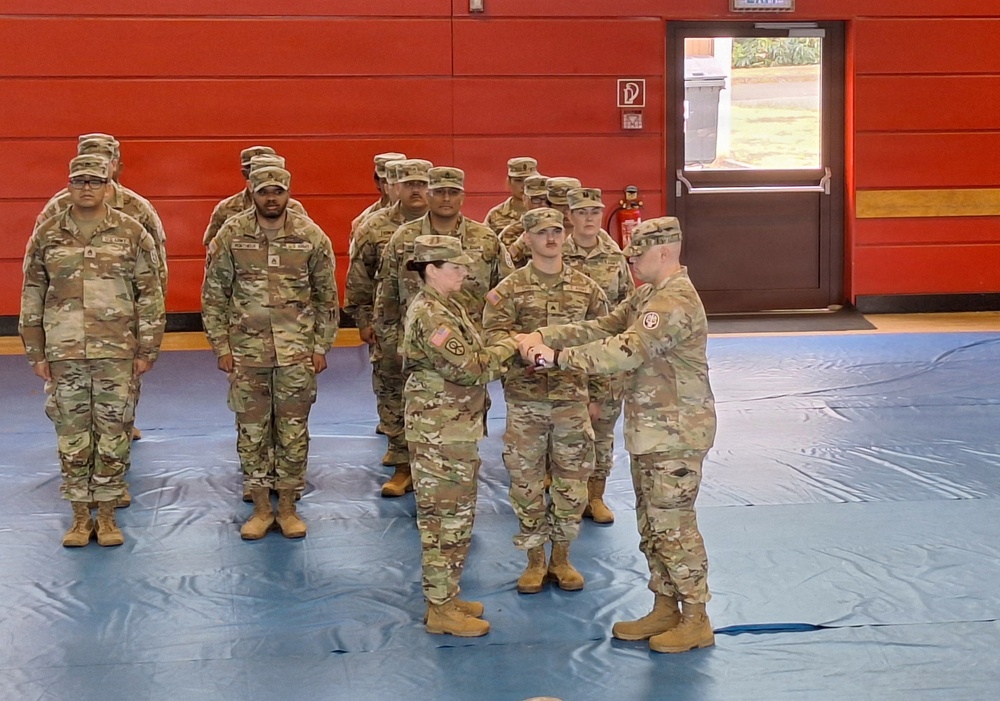
LANDSTUHL, Germany —Soldiers assigned to the 7452nd Forward Detachment 1 concluded a nearly 10-month deployment Aug. 24 as responsibility for the Deployed Warrior Medical Management Center (DWMMC) transferred to the 7457th Medical Forward Detachment 3 during a relief in place/transfer of authority ceremony at Landstuhl Regional Medical Center.
The ceremony, held in the LRMC gymnasium, marked the end of a 293-day mission for the outgoing detachment, whose Soldiers supported the tracking, coordination of care and movement of wounded, ill, and injured service members arriving from operational theaters.
Col. Warren Stewart, commander of LRMC, thanked the outgoing DWMMC Soldiers for their service and said their work reinforced Landstuhl’s role as the medical bridge between combat zones and definitive care in the United States.
“As we say goodbye to one of the best medical teams we’ve ever had, I want you know that you were the right team at the perfect time for this critical mission,” Stewart said. “Without the DWMMC, there is no ‘Regional’ in Landstuhl Regional Medical Center. DWMMC serves as that vital bridge home from the combat zone back to their families.”
That bridge is part of a larger continuum of care that begins at the point of injury and continues through battlefield treatment, evacuation, trauma care and eventual movement to follow-on medical facilities.
“The reality is your life is saved at the point of injury, by your battle buddy or whoever is the initial person providing lifesaving care,” Stewart said. “From the initial point of injury, through multiple levels of care and different teams of people, one thing has remained constant: They come through us and that’s our legacy.”
Stewart said the center’s impact extends beyond moving patients from one location to another. The mission gives wounded and injured service members the opportunity to recover, return to duty when possible and continue their lives after injury or illness.
“Our legacy is that those service members get to spend the rest of their lives being productive, raising families, and continuing to serve,” Stewart said. “We are all part of that legacy, but DWMMC is a critical part of making that happen.”
The outgoing team assumed the mission during a period of increased operational demand. Within weeks of its arrival, LRMC received combat causalities from Syria, including two Soldiers and a contractor.
During its deployment, the detachment coordinated care for more than 1,100 service members, supported hundreds of patient movement missions, and managed patients who arrived without an active or valid patient movement request.
“Between DWMMC and the Emergency Department, they figured out the problem and made sure no Soldier or Airman went without the medical care that they needed,” Stewart said. “I want to personality thank you for that.”
The team also managed 1,026 global telehealth consultations, opened 491 cases and closed 615 cases during the rotation. In addition, DWMMC personnel helped return 177 Soldiers to duty and volunteered 2,442 hours with the USO and other organizations across the Kaiserslautern Military Community.
“You have shown remarkable resilience during times of immense stress while treating an unprecedented number of combat casualties,” Stewart said. “Thank you for your hard work. I know your time here at LRMC was extended longer than expected, making you a vital part of Landstuhl’s historic legacy.”
Lt. Col. Pamela Fleming-Farmer, commander of the 7452nd Forward Detachment 1, said the unit’s core mission remained constant throughout the deployment: ensuring the accurate reception, tracking, accountability of patients while coordinating clinical care and determining their next destination.
“This mission has been one of the most rewarding and privileged experienced experiences of my career,” Fleming-Farmer said. “Every day, the DWMMC team stepped up to answer the call.”
The team supported 131 inbound movement flights carrying more than 800 patients while also managing hundreds of walk-in patients and other battlefield casualties who arrived without established patient movement requests.
At the same time, the detachment expanded its support to the local military community.
On March 1, the DWMMC clinic assumed responsibility for routine sick call services for service members across the Kaiserslautern Military Community. The effort gave patients with routine medical concerns an alternative to seeking care through LRMC’s Emergency Department.
“The DWMMC clinic assumed the critical duty of providing routine sick call service members across the KMC, which reduced demand on LRMC’s Emergency Department,” Fleming-Farmer said. “Our providers also assisted Family Medicine with Periodic Health Assessments, and our clinic staff provided primary care services to the Legacy+ Request for Forces personnel.”
She welcomed the distinguished guest, LRMC Command team and both the inbound DWMMC and outbound DWMMC Soldiers.
“Col Stewart, thank you for letting us join the LRMC Legacy family,” said Fleming-Farmer. “Thank you for your mentorship and leadership.”
She thanked Col Charles Douglas, deputy commander, LRMC, for his support, she learned so much from him.
“Our DWMMC Team appreciation all the support from Lt Col Christopher Alferez, commander, Medical Readiness Battalion LRMC as well as Command Sgt. Maj. Woolley ( Warfighter) and all the companies,” said Fleming-Farmer. “First Sgt William Shuart, detachment senior leader, for being my battle buddy.”
She thanked the Soldiers who have worked tirelesslybehind the scenes, especiallyduring critical times.
“You exceeded everyone’sexpectations,” said Fleming-Farmer. “It is hard to believe that almost 10 months 293 day have already passed. This mission has been one of the most rewarding andprivilegedof my career.”
Every day the DWMMC team steps up to answer the call, have you ever wondered what the impact actually looks like.
“Here is the latest numbers,” said Fleming-Farmer. “There nothing short of spectacular.”
We safely welcomed 131 inbound flights, with over 829 arriving patients and 365 walk-in patients with temporary battlefield casualties who lack an active or valid patient movement request. The unit ministry team recorded 1,745 total encounters, resulting in an estimated savings of over $7,300,000. Due to their efforts, the Global Telehealth Portal Consult Portal generated an estimated $10.9 million mission back commission, all accomplished with a main body of 40 personnel.
“Our greatest hurdle arose at the start of OEF when external, theater-wide patient movement tracking processes faced disruptions,” said Fleming-Farmer. “We suddenly had to manage additional unregulated patient movements across multiple combatant commands, all while different stakeholders utilized insulated individual tracking systems, different reporting requirements, and different reporting times.”
While navigating these complex, theater-wide tracking disruptions, the unit simultaneously reinforced its commitment to local medical readiness. To support the immediate force on the ground.
“The DWMMC clinic assumed the critical duty of providing routine sick call services for service members across the KMC area which decompressed the LRMC’s Emergency Department,” said Fleming-Farmer. “Our providers also assisted Family Medicine by assisting with Periodic Health Assessments, and our clinic staff provided primary care services to the Legacy+ Request for Forces (RFF) personnel.”
During approximately six months of operating the sick call mission, the clinic has treated1,503 service members.
Fleming-Farmer said the additional access point helped reduce Emergency Department wait times, improve access to care, and conserve hospital resources by diverting patients with routine illnesses and minor injuries to the clinic.
“The most rewarding part has been seeing the immediate, positive impact on both individual service members and the hospital itself,” Fleming-Farmer said. “By establishing a dedicated sick call pipeline, we provided our fellow warfighters with rapid, appropriate care and reduced Emergency Department wait times.”
That support allowed emergency medical personnel to concentrate resources on patients requiring higher levels of care while giving service members with routine medical concerns another option.
“The biggest change isimproved accessibility and peace of mindfor the patients,” Fleming-Farmer said. “Instead of a service member with a routine medical issue sitting in an Emergency Department waiting room for hours, they now had another point of access to care.”
The deployment also presented challenges in tracking patients moving across multiple operational areas.
Fleming-Farmer said disruptions in theater-wide patient movement processes required the team to manage additional unregulated patient movements across multiple combatant commands while organizations used separate tracking systems, reporting requirements and timelines.
To address the problem, DWMMC personnel developed a centralized Power Business Intelligence dashboard designed to consolidate patient movement information.
“Our team began the arduous task of spending hundreds of man-hours building a custom, centralizedPower BI tracking dashboard,” Fleming-Farmer said. “By inputting and organizing over35,000 data points, we successfully consolidated andeliminated seven redundant tracking processes, creating a single, clean source of truth for senior leaders across the globe."
The outgoing detachment also reviewed personnel requirements, refined its Unit Manning Document, and worked to improve communication among organizations in the continental United States and across three combatant commands.
Fleming-Farmer said those efforts were designed not only to meet immediate operational demands but to leave the next rotation with stronger systems and processes.
“Over these past 10 months, this team hasn't just managed logistics; they’ve guarded the lifeline for thousands of our warfighters across three continents,” Fleming-Farmer said. “Every hour of every day, we stood as the vital bridge between the point of injury and the promise of home.”
As the outgoing detachment relinquished responsibility, Col. Joseph Flores, commander 7457th Medical Forward Detachment 3, formally assumed the DWMMC mission.
Flores thanked LRMC leadership and the outgoing detachment for the foundation established during the previous rotation.
“Col. Stewart and Command Sgt. Maj. Jorge Oquendo, thank you for your steadfast support of this mission and for your continued partnership,” Flores said. “To Lt Col. Fleming-Farmer, you left me with a high standard of mission success and ambitious goals to achieve. We will maintain that steady state as we watch those inbound flights.”
Flores said his team will focus on maintaining operational continuity while continuing to refine joint medical integration and readiness for future conflicts.
“We owe it to every service member coming through our doors to continually elevate our standard of combat casualty care,” Flores said. “My goal is to build upon the exceptional foundation already laid here, pushing our clinical capabilities and readiness even further.”
You have upheld the highest standards of this mission, ensuring that every wounded, ill, or injured service member who passed through these walls received not just excellent medical coordination, but genuine care and compassion.
That robust foundation is the direct result of the outgoing leadership’s tireless dedication over the past year. As she officially handed over the reins, Fleming-Farmer took a moment to reflect on the profound impact the unit had on her both personally and professionally.
Stewart said he was confident the incoming team was prepared to carry the mission forward.
“After watching them over the last week, I am confident that they are capable, motivated, and excited to be here, and we are excited to have them,” said Stewart. “Be professional, always remain ready, and know that we will always have your back and provide you whatever resources you need to accomplish the mission.”
For Fleming-Farmer, transferring the mission also provided an opportunity to reflect on relationships built during the deployment.
"It has been an absolute honor to serve and care for our wounded, ill and injured service members across three combatant commands,” said Fleming-Farmer. “The leadership and permanent staff at LRMC welcomed us as family from day one and as essential partners in the mission.”
She said the detachment was proud to represent the Army Reserve and looked forward to seeing the incoming team continue the work.
DWMMC was established in 2001 to support the movement and management of wounded, ill and injured service members returning from operational theaters. Today, the center coordinates the reception, tracking, clinical care and onward movement of patients supporting U.S. Central Command, U.S. European Command and U.S, Africa Command.
The center will mark its 25th anniversary in October.
“I couldn't be prouder of what we've accomplished here,” Stewart said. “There is simply no greater privilege than being the ones entrusted to bring our people home."
| Date Taken: |
08.23.2026 |
| Date Posted: |
08.25.2026 06:10 |
| Story ID: |
573137 |
| Location: |
LANDSTUHL, DE |
| Web Views: |
35 |
| Downloads: |
0 |
PUBLIC DOMAIN

This work, DWMMC Transfers Authority at Landstuhl Regional Medical Center, by Bernhard Lashleyleidner, identified by DVIDS, must comply with the restrictions shown on https://www.dvidshub.net/about/copyright.