U.S. Guardian Angel Team Enabled Search for Downed Equatorial Guinea Military Helicopter
Courtesy Photo |
U.S. Air Force Guardian Angel Team, assigned to the 406th Air Expeditionary Wing,......read moreread more
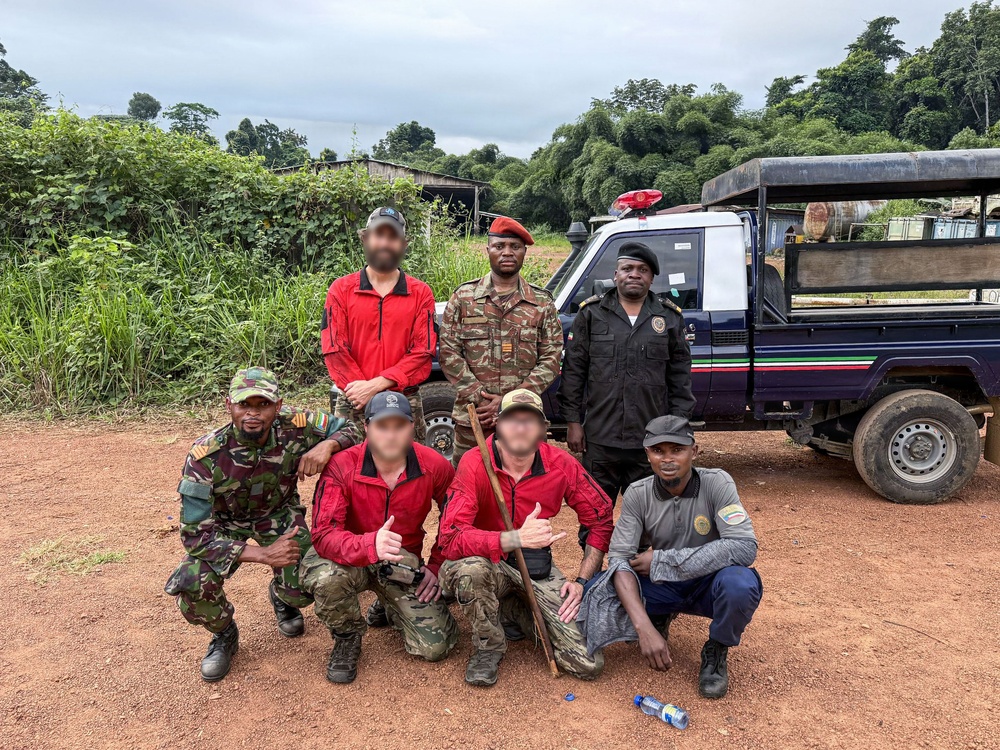
Courtesy Photo | U.S. Air Force Guardian Angel Team, assigned to the 406th Air Expeditionary Wing, Combined Joint Task Force – Horn of Africa, pose for a photo with members from the Armed Forces of Equatorial Guinea in Equatorial Guinea, July 23, 2026. The forward-deployed Guardian Angel team integrated with the Armed Forces of Equatorial Guinea to provide tactical coordination and specialized search patterns under a dense, restrictive jungle canopy successfully locating the helicopter after a weeks-long search. (Courtesy Photo) see less
| View Image Page
U.S. Guardian Angel Team Enabled Search for Downed Equatorial Guinea Military Helicopter
CAMP LEMMONIER, Djibouti – A U.S. Air Force Guardian Angel Team attached to Combined
Joint Task Force – Horn of Africa recently partnered with the Fuerzas Armadas de Guinea
Ecuatorial (FAGE) (Armed Forces of Equatorial Guinea) in search operations for a downed
Harbin Z-9 military helicopter July 7-10, 2026.
The government of Equatorial Guinea requested assistance through the U.S. Embassy of
Equatorial Guinea.
The Guardian Angel Team is a U.S. Africa Command forward deployed unit assigned to the
406 th Air Expeditionary Wing that supports the AFRICOM Joint Personnel Recovery Center,
which plans, coordinates, and manages the recovery of any isolated, missing, or captured U.S.
military personnel and civilians across the continent.
“Every mission is different, but our commitment remains the same,” said Mr. Cameron Hystad,
AFRICOM JPRC director. “We bring the right capabilities anywhere in the world, when lives are
on the line.”
With agile forces ready to defend, enable, and respond, AFRICOM works closely with Allies and
partners to support swift and efficient crisis response.
"We got the call from AFRICOM's JPRC saying there was a downed helicopter, and they needed
help finding it," said U.S. Air Force Capt. Jason Hill, 82nd Expeditionary Rescue Squadron
commander. "We wanted to send the military's best rescue experts to advise and assist with
locating the helicopter crash.”
The unit dispatched a team of two pararescuemen and one tactical air control party/joint
terminal attack controller who are trained to operate in remote and austere environments. By
the time the team arrived, despite a two-week effort by Equatorial Guinea forces, the search
remained unresolved until the arrival of the highly specialized U.S. team.
"We knew we were coming into something that potentially would have no success," said the
team pararescue element lead. "When we got there, we brought all the information to a
central point, created a plan and narrowed a very wide search area down to a very small one.
The local forces put in a tremendous amount of effort; we just brought additional expertise in
joint search and rescue planning."
The Guardian Angel Team advised and assisted local leaders and the FAGE on how to divide the
search area into manageable sectors and developed search patterns for the large force already
operating in the jungle.
"It was like walking into a thousand-piece puzzle," said the team TACP/JTAC. "We started with
the corners and the edges, and using the background and skills we have, we were able to help
put the data together and complete the puzzle."
Conducting this operation under the cover of a thick jungle canopy presented significant
challenges, but the team’s extensive training prepared them for the task.
"The jungle is brutal," said the team TACP/JTAC. "It's hot, it's wet, visibility is incredibly limited, and every step is challenging. It was the most difficult terrain I've ever worked in, which makes what the local search teams accomplished even more impressive."
Working alongside the FAGE, the Guardian Angel team directed specialized teams of ground
forces and local hunters toward the areas with the highest probability of success.
"By the end of the third day, we received word that they had located the helicopter,” said the
team medic. “Although we knew the initial chances for success were low, hearing the news
was incredibly uplifting, and we were proud to play a role in this mission.”
"The local teams deserve huge credit," the team TACP/JTAC said. "We helped with where to
look, but they were the ones out there every day for weeks. They did the hard work, and they
were the reason the search was successful."
The partnership between the FAGE and the United States helped provide answers and closure
for the families of the missing service members. Surrounded by local leaders and dignitaries,
the team attended a funeral, July 21, 2026, honoring the lives of the four service members
from the crash.
"We're honored that they trusted the United States enough to ask for our assistance," the
pararescue element lead said. "We're grateful their government reached out to the U.S.
Embassy, and we're thankful we were able to contribute with capabilities only the U.S. can
provide. It was incredibly rewarding to help support their efforts and see the search come to a
successful conclusion."

 Subscribe






