
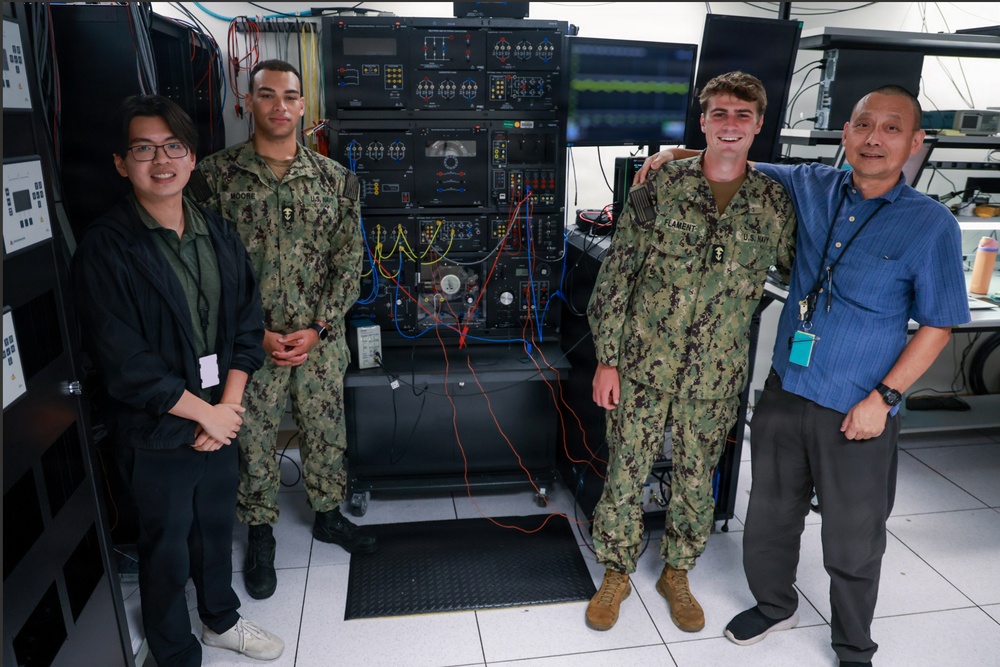
Photo By Jay Butterbaugh | When Midshipman 1st Class Logan Flament arrived at Naval Surface Warfare Center,...... read more read more
 Subscribe
When Midshipman 1st Class Logan Flament arrived at Naval Surface Warfare Center, Philadelphia Division (NSWCPD), he stepped into a vital side of the Navy he had never seen before.
By the time his three-and-a-half-week internship ended, the electrical engineering major from Youngstown, Ohio, had developed a far different view of the civilian engineers, scientists, and technical experts who support the fleet.
“I’ll be honest, I didn’t know that there was a Philadelphia Division before arriving here,” Flament said. “They don’t really talk about that at the Academy, so it has been a great learning experience.”
Flament and Midshipman 1st Class Brandon Moore of Richmond, Va., spent their time at NSWCPD working alongside electrical engineers Dr. Qing Dong and Kevin Lin. These engineers work specifically on the LHD-8, LHA, LCS, guided-missile cruiser (CG) classes, Nuclear-Powered Aircraft Carrier (CVN), and Coast Guard Icebreaker, as well as Modeling and Simulation (M&S) for shipboard electrical plant and electric propulsion. The internship combined laboratory research, facility tours, mentoring, and discussions about engineering, leadership, and Navy career paths.
Similar internships across the Naval Surface Warfare Center Enterprise introduce U.S. Naval Academy (USNA) midshipmen to the Navy’s science, technology, engineering, and research communities. Previous programs at NSWCPD have emphasized two goals: helping midshipmen understand the broader naval research and development community and showing how their academic majors apply to operational Navy challenges.
At NSWCPD, Flament and Moore received an up-close look at the engineering behind shipboard electrical power.
Working closely with mentors Dong and Lin, the midshipmen were introduced to control and power hardware-in-the-loop (HIL) testing, as well as modeling and simulation (M&S) using a small-scale motor-generator system, real-time simulation equipment, physical electrical components, and control hardware. Through this, the team reproduced elements of a larger shipboard electrical system in the laboratory.
Flament had recently completed his first power systems course at USNA. The laboratory gave him an opportunity to connect classroom instruction on motors and generators with equipment that represented a Navy application.
“Being able to simulate a real system without spending thousands of dollars on a massive generator, and then connect that simulation to physical hardware, was a pretty cool experience,” Flament said. “I had never seen that used at the Academy.”
The approach allows engineers to examine how parts of an electrical system respond under different conditions without building a full-scale shipboard installation. Each component can be examined independently before engineers integrate them and study how the larger system behaves.
Moore said working directly with the hardware was among the most memorable parts of the internship.
“It was really cool to help with a project that could achieve the goal through software and hardware rather than building the full system,” Moore said. “Working with my mentor also taught me a lot about the scientific process and how to approach it.”
The lessons extended beyond electrical engineering. During tours and conversations with employees and command leaders, the midshipmen learned how NSWCPD provides real-time fleet support, investigates shipboard problems, develops emerging technologies, and helps sustain systems throughout their service lives.
“It is easy to see Sailors working on the plant and think it stops there,” Moore said. “In reality, there are many more teams and a lot more collaboration with technical experts required to accomplish the mission.”
Moore noted that this collaborative dynamic is a key lesson for future division officers. “You are expected to lead people who may know far more than you about a system,” Moore said. “Your job is to help them come together and combine those ideas to accomplish the mission.”
For Flament, who plans to enter the surface warfare community, the internship offered an early look at the electrical power challenges he may encounter aboard a destroyer. Future shipboard capabilities will place new, rapidly changing demands on electrical systems, making coordination between operators and engineers increasingly important.
The experience also gave both midshipmen a greater appreciation for the years of development, testing, and collaboration that go into the equipment that arrives aboard a ship.
“Seeing all the rigorous testing that equipment has to go through, sometimes years before it is implemented in the Navy, gives me more trust in the systems and ships that I will rely on to protect my Sailors’ lives,” Flament said.
Moore said meeting the people behind that equipment replaced anonymous organizational names with faces and personal connections.
“Hardware represents people’s time,” Moore said. “Every part of a ship has people behind it.”
Flament left NSWCPD describing the command as a collaborative group of experts developing capabilities the Navy may depend on for decades.
“NSWCPD is hundreds, or maybe thousands, of experts in their fields working together on cutting-edge technology,” Flament said. “The projects here are going to make a difference in the Navy’s success and in the country’s future.”
Dong offered a final engineering lesson that also captured the internship’s broader value.
“In engineering, every component has a purpose,” Dong said. “Those components integrate to make the larger system operate.”
NSWCPD employs approximately 2,700 civilian engineers, scientists, technicians, and support staff. The team focuses on research and development, testing and evaluation, acquisition support, and in-service and logistics engineering for non-nuclear machinery, ship machinery systems, and related equipment and materials for Navy surface ships and submarines. NSWCPD also serves as the primary organization responsible for cybersecurity across all ship systems.
| Date Taken: | 08.21.2026 |
| Date Posted: | 08.21.2026 09:56 |
| Story ID: | 572908 |
| Location: | PHILADELPHIA, PENNSYLVANIA, US |
| Web Views: | 55 |
| Downloads: | 0 |

This work, Future Fleet Leaders Connect Classroom Theory to Shipboard Power at NSWCPD, by Steven Infanti, identified by DVIDS, must comply with the restrictions shown on https://www.dvidshub.net/about/copyright.

No keywords found.




