
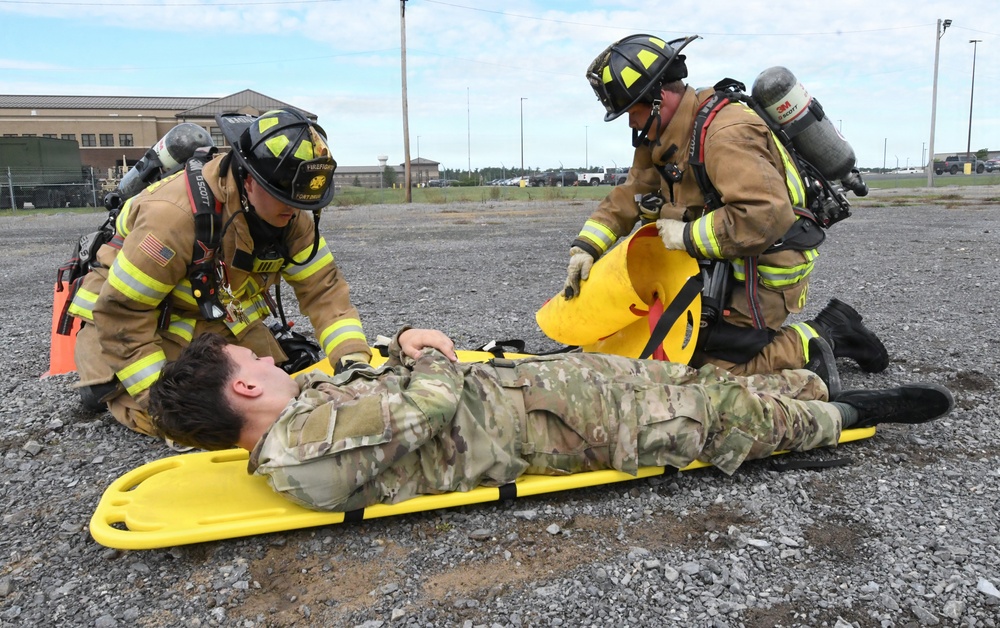
Photo By Michael Strasser | Fort Drum first responders move casualties away from the site of a simulated fuel tank...... read more read more
FORT DRUM, N.Y. (Aug. 19, 2026) -- Fort Drum first responders rushed to the incident scene on Aug. 18, encountering dozens of simulated casualties in urgent need of medical attention following a fuel tank explosion.
Officials at the incident command post directed and coordinated the response efforts, joined by local and state emergency services personnel, including Carthage Area Rescue Squad, Black River Emergency Medical Service, Guilfoyle Ambulance Services, South Jefferson Rescue Squad, and Thousand Islands EMS.
While the crisis was notional, the response was entirely real during the installation’s annual Integrated Protection Exercise (IPE).
“The exercise includes a mass casualty incident involving a group of Soldiers assembled for a training event,” said Rich Hughes, Directorate of Plans, Training, Mobilization and Security installation emergency manager. “So we have 25 role players in various states of injury that will be triaged and treated by medics and first responders and transported by ambulances. From there, it transitions to securing the incident site and a law enforcement investigation.”
Hughes said the annual exercise serves to execute and evaluate force protection measures and emergency response and recovery procedures in a controlled environment.
“We do this every year to make sure all of our systems are tested, to get lessons learned, and to make sure we are consistently refining how we do things,” he said.
Just-In-Time Training
Unlike previous iterations, fire, police and EMS personnel gathered early for Just-In-Time (JIT) training. Hughes said this is a way for first responders to review roles, responsibilities, and other task-specific knowledge, immediately before deploying to an incident.
Jefferson County EMS Director Paul Barter explained that in a typical drill, local first responders enter a scene of “organized chaos.” They provide medical aid, quickly load patients into ambulances, and depart to area hospitals, without getting a big picture view of the incident.
“So, they would never really get the training about who is the incident commander or triage officer, and what are their roles,” Barter said. “They get that ICS (Incident Command System) training while going through their Basic Emergency Medical Training program, and that’s the only time they ever see it. That’s why it was a fabulous idea to do this today.”
Barter noted that every ambulance is equipped with a “First 15 Minutes” pouch containing information pertinent to initial incident response procedures. He said that helps minimize confusion in an already chaotic situation and reduces response errors.
“Any first responder – I don’t care if it’s fire, EMS or police – they all have that helper gene,” he said. “They’re not going to sit around and wait while people are suffering. They’re going to respond. That’s why we came up with that pouch, so they know going in what their role will be for that first 15 minutes.”
Role players were loaded into local EMS ambulances and transported to Samaritan Medical Center in Watertown, which participates in the exercise annually to validate its emergency department’s disaster response capabilities. This year’s exercise also provided them with an opportunity to operate decontamination lanes to treat patients exposed to simulated fuel contamination.
Hughes noted that community partnerships are critical to successful crisis management.
“Coordination and resource sharing between Fort Drum and our community partners ensures a seamless, unified response in a real-world situation,” he said.
Inside the Emergency Operations Center
Upon garrison command approval, an emergency operations center (EOC) activated to share information and synchronize efforts with the division’s Mountain Operations Center (MOC).
“The EOC is the central location for all information gathering and analysis,” Hughes said. “So that any support to the incident site can be quickly arranged or resourced. It’s also how we keep the command informed and build decision support tools for the commanders, and command-and-control the response and recovery.”
The EOC team comprises representatives from key agencies across the installation, including the Directorate of Plans, Training, Mobilization and Security, Directorate of Emergency Services, Public Affairs, Directorate of Human Resources, and U.S. Army Medical Department Activity.
EFAC teams provide community support
As first responders secured the simulated incident site, the Emergency Family Assistance Center (EFAC) was established inside Clark Hall to provide community support.
“The EFAC promotes short and long-term recovery and the return to a stable environment and mission ready status for DoD personnel and their families following any all-hazards incidents,” said Andrew Hillabrandt, Fort Drum Mobilization and Deployment program manager. “We can provide coordinated information and referral resources, as well as humanitarian assistance from governmental and non-governmental entities to the military community.”
Hillabrandt, who served as the EFAC chief during the exercise, said the center tailors its services to the specific crisis. Typically, those services include legal, religious, housing and medical services information, alongside non-medical counseling, financial services, casualty and mortuary affairs, and personnel locator assistance.
“The primary objective when testing EFAC operations during an exercise is to evaluate and validate the installation’s capability to function as a seamless ‘one-stop shop’ that provides timely, coordinated crisis support, accurate information, and essential human services to Soldiers and their families during a simulated disaster or emergency,” Hillabrandt said.
Although the large-scale IPE occurs annually, Hughes said that force protection is a continuous, year-round effort.
“Every event is a learning event for emergency responders and leaders across the installation,” he said. “When you look ahead to the winter, we learn something after every snowstorm we get, and we incorporate those lessons learned into our plans and procedures. Wherever our emergency services go they learn something and they figure out how to work better with our partners. So, the exercise is a culmination of a yearlong process. In fact, we have all kinds of tabletop exercises leading up to this and training events to prepare the teams.”
Stay ALERT!
To keep the community informed, Fort Drum used the ALERT! Mass Warning Notification System to send information about exercise-related activity to registered Soldiers, civilian employees and family members.
“If they aren’t already enrolled in ALERT!, I would highly recommend that Soldiers and family members do so,” he said. “It’s the best way to make sure they receive emergency messages when it matters.”
To learn how to register for ALERT!, visit https://home.army.mil/drum/about/post-status-weather-alert-messaging.
| Date Taken: | 08.19.2026 |
| Date Posted: | 08.19.2026 08:17 |
| Story ID: | 572726 |
| Location: | FORT DRUM, NEW YORK, US |
| Web Views: | 17 |
| Downloads: | 0 |

This work, Fort Drum tests emergency readiness during integrated protection exercise, by Michael Strasser, identified by DVIDS, must comply with the restrictions shown on https://www.dvidshub.net/about/copyright.


No keywords found.





