
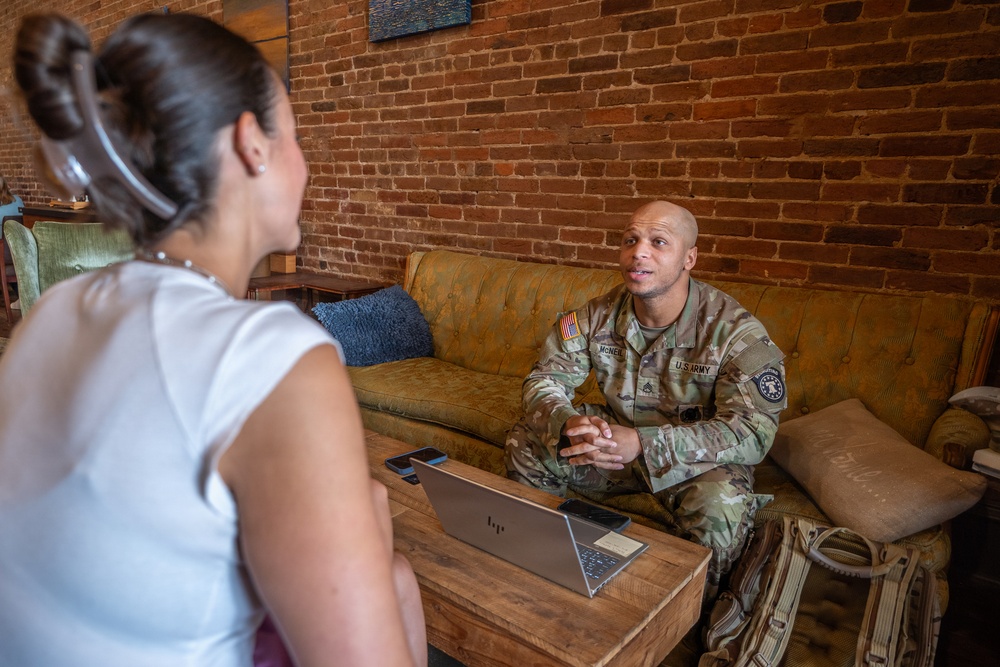
Photo By Staff Sgt. Gerald Holman | Staff Sgt. Christopher McNeil, Recruiter, conducts a field prospecting interview with...... read more read more
 Subscribe
The U.S. Army Recruiting Division differs from other Army organizations, spanning from a division to a brigade, a battalion and companies. However, what truly gives USARD its uniqueness is its foundational layer, the Recruiting stations. Traditionally, these brick-and-mortar storefronts vary significantly in size, scope of responsibility and the number of assigned Recruiters based on their geographic location. For example, a small, sparsely manned rural Recruiting station operates on a vastly different scale than a high-traffic, bustling Recruiting station in New York City's Times Square.
As the U.S. Army undergoes significant modernization, USARD is proactively seeking innovative ways to evolve alongside it. In Daly City, California, this proactive approach is taking shape through a new pilot concept that trades fixed office spaces for an agile, highly mobile footprint. Inspired by decentralized civilian frameworks such as state trooper models, this "stationless" approach grants Recruiters the flexibility to operate remotely from alternative community locations, ensuring the Army's talent acquisition strategies modernize to meet the needs of the future force.
Recruiters are meeting Gen Z applicants directly on their own turf.
“We’re looking to find ways to negate some of the inflexibility of the standard Army processes, where you lock somebody into a fixed location,” said Brig. Gen. Sara Dudley, U.S. Army Recruiting Division commanding general. “The ability to be mobile and flexible to where the community is, or those individuals we’re trying to reach, is very important for our Recruiters to be at the right place, at the right time, with the right message, as we continually progress toward precision Recruiting.”
This digital-first, "stationless" pilot program represents a massive operational shift in how the U.S. Army builds its future force, bridges the community trust gap, and modernizes talent acquisition to mirror modern business practices.
“The community and the population are moving a lot more than it used to,” Command Sgt. Maj. Danny Basham, U.S. Army Recruiting Division, said. “If you’re applying for a job, you walk into a coffee shop, there’s business happening. Folks are doing interviews, reviewing paperwork, as opposed to going to a company’s HR department. Every place they can find a seat and grab a cup of coffee, that’s where they are doing business and we should be able to match that as an organization.”
According to U.S. Army Recruiting Division leaders, from a regional command perspective, the decision to eliminate physical storefronts in favor of a mobile force is a calculated, strategic evolution.
“Daly City was deliberately chosen to lead this pilot because of its geographic dispersion and unique digital media landscape that perfectly align with the Army’s strategic modernization priorities,” Col. Ryan Kendall, 6th Recruiting Brigade commander said. “A static physical footprint is no longer the most effective way to achieve deep community engagement in this region.”
According to Kendall, the transition leverages the Army's most valuable asset, its people.
“Modernizing our footprint means moving away from legacy storefronts and toward a dynamic, agile recruiting force,” Kendall said. “We do not need a sign on a building to represent the U.S. Army; our Recruiters are our best brand ambassadors. By transitioning to a stationless model, our noncommissioned officers are freed from the administrative and physical constraints of a static office. They are now fully mobile and embedded in the community fabric.”
According to Kendall, operating successfully without a physical headquarters requires an incredibly high level of personal discipline. To mitigate risk and ensure the pilot's success, the brigade hand-selected experienced NCOs capable of operating under the decentralized military framework of mission command.
“Operating in a decentralized environment demands a high degree of maturity, discipline and trust,” Kendall said. “We are strictly assigning proven, self-starting NCOs who possess the organizational discipline and operational fortitude to execute decentralized operations and execute command objectives without the scaffolding of a traditional office.”
According to USARD leaders, this shift gives Recruiters the freedom they need to succeed in a modern landscape.
“At the end of the day, I think it’s going to increase a Recruiter’s individual ownership of the mission for the Army and the increased responsibility for everything we’re asking them to go do,” Basham said. “It allows them more autonomy, which everyone wants. They know what they need to do. Let me go do it.”
According to USARD leaders, for the Daly City Recruiters, this translates into a highly structured and self-driven daily battle rhythm.
Without a traditional storefront, the Recruiters rely on public spaces to take care of administrative paperwork, conduct Army interviews, process applicants and prepare future Soldiers.
“I use the public library and local cafes for Army interviews and processing,” Staff Sgt. Keithrunie Cabanilla, Daly City Recruiting Station Recruiter, said. “It helps the future recruits feel comfortable, but it also shows our presence and builds bridges with the community. Also, I invite future recruits to the future Soldier training every Friday to build trust.”
According to USARD leaders, this transition into public spaces addresses a longstanding hurdle in Recruiting; the intimidation factor of military facilities.
“Walking into a Recruiting station can sometimes be an intimidating thing or the simple fact of the unknowns on the other side of that door that you’re going to run into,” Basham said. “Meeting folks out in the community is exactly the best icebreaker for us.”
According to Dudley, removing this friction is essential for engaging today's youth. She believes it helps drop a lot of barriers that future recruits may have had concerns about just walking into a Recruiting station. This establishes asecure, comfortable spacefor recruits to initiate conversations and have their first live touchpoint with a Recruiter.
According to Sgt. 1st Class Jason Doll, Daly City Recruiting Station commander, managing a team of dispersed, mobile Recruiters requires a delicate balance of data-driven targeting and localized intuition. While the regional level uses computers and spreadsheets to track down talented recruits. On the ground, Doll relies on his years of experience living and working in the community to get the job done.
“Knowing the Recruiter attributes and personalities, I can push and pull them in directions that may be more effective,” Doll said. “I also have some working knowledge, having been in the Bay Area for six years now. I understand the climate and views of the public. I realize where they do or don’t go based on the time of year.”
According to Doll, this localized understanding is critical when traditional outreach methods like cold-calling yield lower returns with a digitally savvy Gen Z demographic.
“I rely on community networking," Doll said. "If someone cannot find me, I must go find them. I can read their body language or gauge their personality based on their presence. Most people will shut you down quickly over the phone, but a dialogue can be built easier in person. As a station commander, I stress to the Recruiters not to just jump into the Army pitch but build the rapport and connect with people.”
To aid this, Doll gives Recruiters creative liberty to speak like “real people” on social platforms such as Instagram and Facebook, noting simply that "Gen Z responds to authenticity."
“I post on every different Bay Area group on Facebook, LinkedIn and Craigslist,” Cabanilla said. “I reach out to my previous Soldiers to see if they know anybody and I visit tennis clubs, basketball clubs, boxing clubs and fitness gyms.”
According to Cabanilla, walking into civilian spaces rather than inviting them into a military-controlled office has fundamentally changed how Recruiters communicate.
“I always start with small chit-chat, and I don't talk about the Army,” Cabanilla said. “I get to know them more, identify their goals and then try to chip in some Army programs that can help them.”
According to Cabanilla, this nonintimidating, community-embedded approach is already reaching applicants who likely would never have stepped foot inside a storefront Recruiting station.
Cabanilla recalled a story of a recruit he was working with in the past, a local resident who worked at a local coffee shop where the Recruiters frequently set up a mobile office. The recruit had previously tried to enlist in another military branch but was denied, leading him to believe military service was out of reach. Additionally, his family had mixed feelings about the military.
“I conducted an Army interview at his house because he mentioned that his family was against it,” Cabanilla said. “But after hearing what the Army can do for him and hearing my personal Army story, it put them at ease.”
According to Kendall, while the stationless model has successfully eliminated the overhead and administrative constraints of legacy brick-and-mortar storefronts, commanders are keeping a close eye on the performance metrics.
“The data shows our 'flash-to-bang' from initial contact to contract remains consistent with our 12-month historical average,” Kendall said. “Proving that the lack of a physical office does not slow down the enlistment pipeline. The reality is that statutory, medical and regulatory requirements dictate the enlistment timeline, not the physical building a Recruiter sits in.”
According to USARD leaders, the success of the Daly City pilot points to a possible permanent modernization of the U.S. Army's footprint; one that trades concrete walls for agile, human connections depending on the geographic dispersion and unique digital media landscape.
“The Recruiting station for decades has been our comfort zone. We like to be in the station. That’s our world,” Basham said. “So really, it’s us getting out of our comfort zone and going around the community, engaging them, because we’re America’s Army. They need to have access to us as much as possible.”
According to USARD leaders, ultimately, the "stationless" pilot program is about securing the future of the force.
“We have to transform in front of the Army’s transformation, and if we can’t do it first, then we won’t be able to provide the people the Army needs in its formations of the future,” Dudley said. “I think the real focus that we’ve had this past year is to empower leaders at all echelons to understand the level of risk that they can assume themselves and then go try new things.”
The stationless Recruiting model is just the beginning of this widespread organizational evolution.
“Stay tuned for future stories on innovations in the works at USARD and all other echelons throughout the division,” Dudley said.
| Date Taken: | 08.18.2026 |
| Date Posted: | 08.18.2026 13:44 |
| Story ID: | 572671 |
| Location: | DALY CITY, CALIFORNIA, US |
| Web Views: | 33 |
| Downloads: | 0 |

This work, Beyond the Storefront: Inside the Army’s "Stationless" Recruiting Revolution in Daly City, by SSG Gerald Holman, identified by DVIDS, must comply with the restrictions shown on https://www.dvidshub.net/about/copyright.


No keywords found.




