
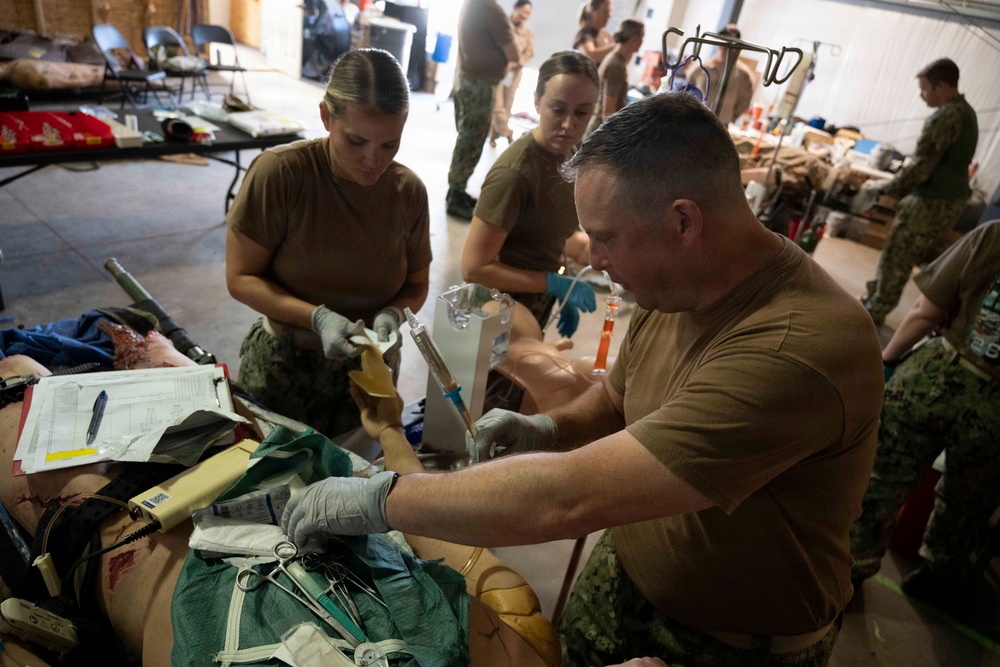
Photo By Petty Officer 2nd Class Alec Kramer | Officers and Sailors assigned to Navy Medical Readiness and Training Command Bethesda,...... read more read more
By Mass Communication Specialist 2nd Class Alec R. Kramer
BETHESDA, Md. - Advanced medical providers from Navy Medicine Readiness and Training Command Bethesda completed the Department of Defense’s most rigorous battlefield medical training during a Tactical Combat Casualty Care (TCCC) Tier 4 course at Walter Reed National Military Medical Center.
The grueling curriculum, known as the Combat Paramedic/Provider course, pushed highly trained clinicians out of sterile, well-staffed hospital environments and tested their ability to perform complex trauma life support under simulated combat conditions in austere environments.
"Most providers, especially ones who have only been in a hospital or civilian treatment facility, are very accustomed to having plenty of resources at their disposal, a specialist they can call, and lab capabilities," said Hospital Corpsman 2nd Class Evan C. Selinger, the Tactical Medicine TCCC Program Manager and course instructor. "The biggest lesson we try to impart on our students is that it is very likely they will not have all, or potentially any, of these resources when they are deployed. The combat or austere environment is not sterile or clean, resources and equipment will be limited, and the patient load will likely be astronomical."
Selinger added that the course prepares clinicians for the harsh realities of operating forward. "When forward deployed, you may be the only provider around or available, so you may have to provide care that would normally be considered outside of your scope of practice. In the combat or austere environment, the provider’s scope of practice is to do everything possible to save the patient. This course exposes them to that reality and gives them an opportunity to train and practice some of those advanced interventions that they may not normally get to perform."
Unlike lower TCCC tiers focused on basic and intermediate life-saving skills for standard service members and combat medics, Tier 4 is reserved strictly for advanced medical professionals; including physicians, physician assistants, nurse practitioners, and independent duty corpsmen.
Students must master highly invasive procedures such as surgical cricothyroidotomies, chest tube insertions, intraosseous access, and whole-blood transfusions while operating under extreme physical exhaustion.
"It’s not necessarily that Tier 4 is so much more difficult than the other tiers, as the approach to combat casualty care at the point of injury is the same: stop them from dying, resuscitate if possible, and keep them alive until they can get to a higher echelon of care," Selinger explained. "However, Tier 4 brings into play additional advanced interventions like intubation and chest tubes. These procedures can be quite difficult to perform in a combat or austere situations, especially if it’s not something the provider does on a regular basis in their day-to-day clinical practice. The biggest takeaway from these courses is to understand what is happening with your patients under extreme resource constraints and learning how to do the most amount of good with what you have."
The intensive 14-day training cycle also heavily tested the providers endurance in Prolonged Casualty Care, requiring them to sustain critically injured patients for hours or days without immediate evacuation.
The training culminated in a grueling mass casualty scenario, validating the class's ability to triage, treat, and sustain multiple critical casualties under simulated enemy fire.
According to Selinger, this pre-deployment preparation is vital, even for clinicians who may not expect to see direct frontline action.
“We present the course as exposure and reinforcement to what their Corpsmen and Medics will be performing on the frontline,” said Selinger. “It is critical that the providers understand what their people are going through and working with regarding their patients at the point of injury, prior to receiving them in the clinical environment."
By maintaining TCCC Tier 4 certified personnel, NMRTC Bethesda maximized military medicine’s support of the warfighter, ensuring combat forces have access to the highest tier of life-saving medical care in the world's most hostile environments.
NMRTC Bethesda’s mission is to maximize warfighter performance through optimized medical readiness tailored to operational requirements; enhance the readiness of the medical force to sustain expeditionary medical capability; and train and develop the Navy Medicine Force.
| Date Taken: | 08.18.2026 |
| Date Posted: | 08.18.2026 12:37 |
| Story ID: | 572662 |
| Location: | MARYLAND, US |
| Web Views: | 22 |
| Downloads: | 0 |

This work, NMRTC Bethesda Tests Elite Medical Providers in Brutal TCCC Tier 4 Training, by PO2 Alec Kramer, identified by DVIDS, must comply with the restrictions shown on https://www.dvidshub.net/about/copyright.

No keywords found.





