
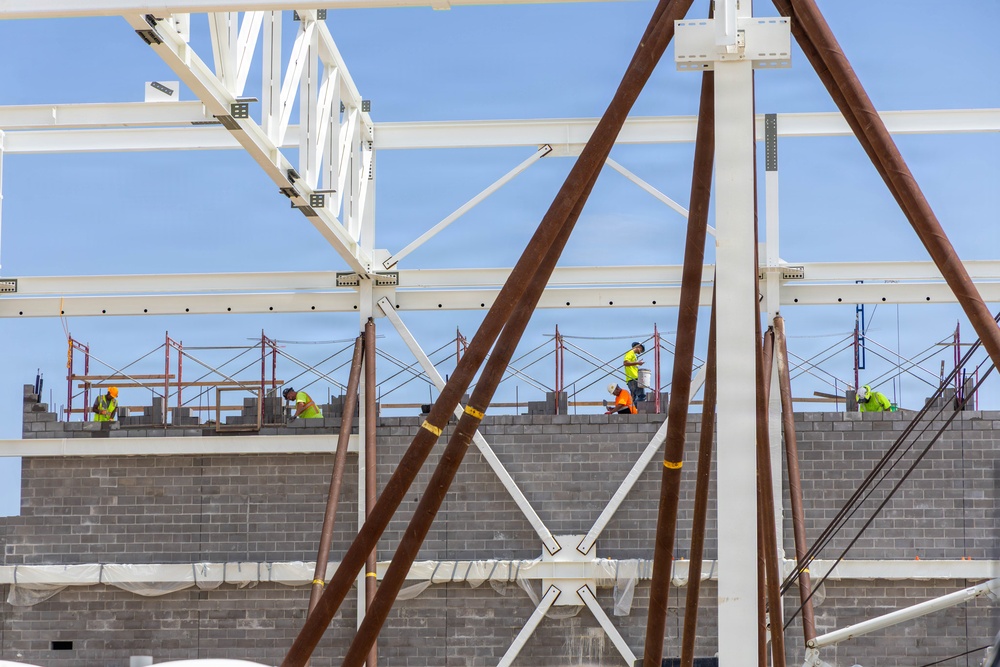
Photo By Lawrence Brooks | Contractors placing cinder block to build the concrete masonry unit which is the...... read more read more
At Marshall Army Airfield, a massive transformation is underway that brings modern maintenance capabilities and administrative rigor to the Army’s evolving aviation mission. Led by the Kansas City District, U.S. Army Corps of Engineers’ Fort Riley Resident Office, the new 119,000-square-foot Attack Aviation Battalion Complex at Kansas’s largest Army airfield has an estimated price tag of $83 million.
It was designed to create more room for a growing Apache helicopter squadron that operates out of an adjacent hangar built more than a decade ago. The new facility can store six more aircraft under normal operating conditions and during inclement weather, it can be configured to store more if needed.
But according to senior construction control representative, Nathan Mccarn, the complex is much more than just an enormous hangar.
“There is a two-story administrative facility that's attached to the maintenance hangar bay. [There is] parking, armament and ammunition storage vaults for the helicopters and security forces, support infrastructure and specialized fire suppression systems,” he said.
For the district’s Military Construction Branch, delivering a structure of this scale and magnitude of importance is nothing new — especially once you get the opportunity to marvel at the newly opened, state-of-the-art General Leonard Wood Community Hospital in southern Missouri or the sprawling National Geospatial-Intelligence Agency West campus in St. Louis, Missouri that opened in 2025.
So, this level of keen precision requires commitment and attention to detail at every stage of the construction process — from the design phase to final inspection once that last contractor exits the finished building or project.
"We work together to move forward, and that's day-to-day life," said Bodie Richardson, quality assurance lead for the district’s Kansas Area Office.
Teamwork makes the dream work
Currently, construction is moving through the structural phase of the project, with approximately two-thirds of this stage complete, Richardson stated, pointing toward a finished portion of the burgeoning structure.
“Approximately 60% to 70% of the structural portion of the main building is complete,” Richardson said. “That figure primarily reflects the exterior concrete masonry unit, or CMU.”
Tangibly, this means the concrete foundation slabs, exterior concrete masonry unit walls and portions of the hangar’s steel skeleton have been built.
The maestro of this massive undertaking is https://www.walshgroup.com/. As the prime contractor, they’re tasked with coordinating and directing all subcontractors. Some have poured and finished concrete and are stacking masonry now.
As aspects of the structural work move toward completion, Mccarn stated that Walsh will deploy the additional contractors who will install plumbing, electrical and telecommunications systems, heating and cooling, insulation, drywall, windows and many other types of specialized work.
“The exterior facade will be split-face stone with concrete masonry units behind it and metal panel [reinforcements] in some areas. The vaults have concrete that is two or three feet thick, with double vault doors on each one of them,” he said.
Digging into the details
The aforementioned structural work for the Attack Aviation Battalion Complex and the sheer scale of it, are clearly seen as you pass Fort Riley driving through the rolling hills and prairies of central Kansas on Interstate 70.
However, much of the detailed work conducted onsite often goes unseen by the public. It is here where Richardson thrives using USACE’s military construction quality assurance protocols.
Following these procedures ensures contractors are adhering to design plans and meeting material specifications, so they can potentially identify issues before they compound into larger problems that increase budgets or prolong the project timeline.
"With any construction project, you have tolerances for all aspects of work, whether it’s your concrete slab being constructed or the cinderblocks used to construct the concrete masonry units," Richardson said.
Some of the quality assurance checks include checking concrete temperature and air pressure, conducting moisture and density tests on backfilled soil and making sure work areas are safe.
Richardson detailed some of the quality assurance checks he and his team completed that day while taking a cold drink of water and a much-needed break from the heat.
“Today we checked a slab-on-grade metal for concrete placement on the second floor,” he said. “Before that, you're checking that all your concrete reinforcement is in place, whether it’s rebar, wire mesh or whatever.”
Outdoors, Richardson said the team was also conducting density testing around the underground, 30,000-gallon water storage tank used for firefighting as crews continued backfilling the area. That means every quality assurance inspection they conduct represents one small piece of the larger puzzle.
This process is collaborative since USACE personnel, the prime contractor and subcontractors work together to identify problems and determine proper corrections to keep construction moving on schedule.
"You're complying with the specifications, or if there’s something out of tolerance, what is the process to correct it moving forward?" Richardson said.
Richardson’s daily presence provides an additional layer of accountability as the project moves from concrete and masonry toward the mechanical and interior systems that will ultimately make the facility operational.
The project is currently scheduled for completion in August 2027, although contract modifications may affect the original set schedule.
When complete, the complex will provide Fort Riley with a modern aviation facility designed to support Army operations for decades to come.
But for the USACE personnel like Richardson and Mccarn overseeing its construction, the mission is measured one inspection, one test and one completed piece of the project at a time.
"Working side by side with the contractor verifying that we have witnessed this so we’re on the same page," Richardson said.
| Date Taken: | 08.18.2026 |
| Date Posted: | 08.18.2026 15:38 |
| Story ID: | 572650 |
| Location: | FORT RILEY, KANSAS, US |
| Web Views: | 18 |
| Downloads: | 0 |

This work, Where the Apache’s future takes flight, by Lawrence Brooks, identified by DVIDS, must comply with the restrictions shown on https://www.dvidshub.net/about/copyright.


No keywords found.





