
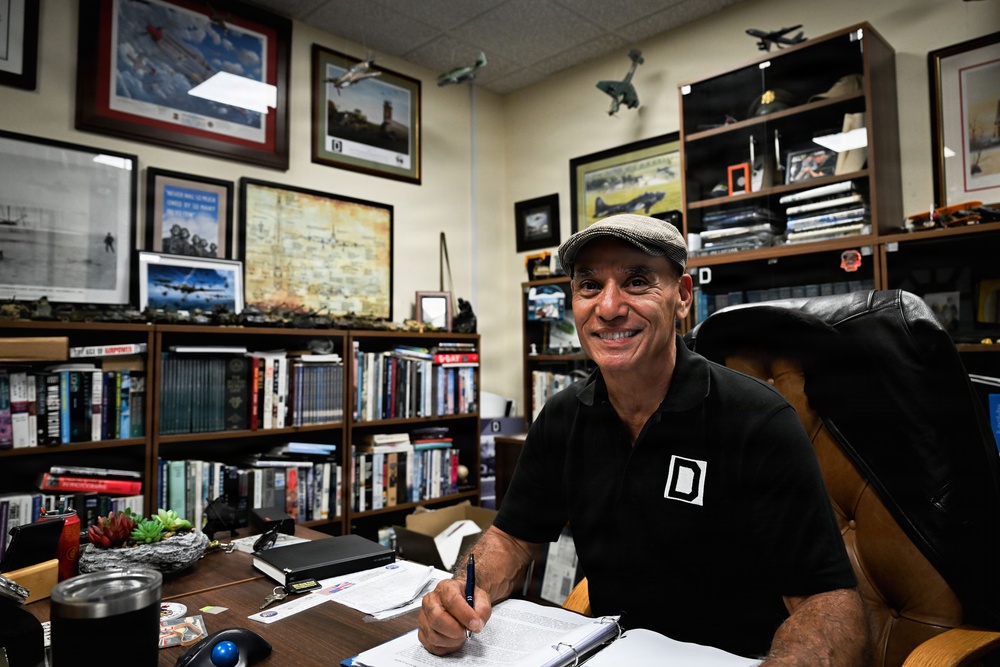
Photo By Airman 1st Class Iris Carpenter | Robert Paley, 100th Air Refueling Wing historian, sits at his desk at RAF Mildenhall,...... read more read more
 Subscribe
Silver dollar sparks heart-felt promise of first salute at West Point
By Airman 1st Class Iris Carpenter
100th Air Refueling Wing Public Affairs
Editor’s note: This is the first of a two-part article on Robert Paley, 100th Air Refueling Wing historian, and shares how his passion for World War II history began when he was 7 years old, how he kept a promise to his father, and how his passion for history still thrives today with the 100th Bomb Group and 100th ARW.
RAF MILDENHALL, England — When his father, a U.S. Army sergeant major, returned home from temporary duty in 1973, 7-year-old Rob Paley was expecting a toy.
Paley, now 100th Air Refueling Wing historian, said his father’s return from a trip usually meant something new, like a model, a toy truck or, ideally, an action figure. Instead, his father unpacked his suitcase and handed him a book.
“Really, Dad?” Paley remembered thinking.
He said the book contained 365 stories from history, one for every day of the year. Its watercolor-like illustrations did little to impress a boy who would rather have been playing with his toys, so he set it aside.
More than five decades later, Paley said he still remembers reluctantly opening the book and stopping at the page for June 6, 1944.
The page showed the Allied invasion of Normandy. His father happened to be walking through the hallway when he noticed his son looking at the book.
“I remember asking him, ‘Daddy, what’s D-Day?’ said Paley. “He reacted with surprise and offered to explain it to me.
Paley described his father as tall, slender and an “all-American boy,” who ran the household with the punctuality of a sergeant major. Dinner began at 5 p.m., and his voice could summon his family from anywhere in the neighborhood.
“My father was gregarious in public, but at home, he was more serious. However, he became gentler when he sat with me and began explaining how Allied forces crossed the English Channel to liberate Europe from Nazi occupation,” he said.
Curiosity sparks life-long love for history
“That’s when my disappointment gave way to curiosity, and that curiosity became a fascination with World War II. At 7 years old, I had no way of knowing that more than five decades later, I would be living in England, working as RAF Mildenhall’s historian and dedicating myself to keeping military history alive.”
What began with a single page became a lifelong pursuit of the people, sacrifices and traditions connecting today’s Airmen to those who served before them.
In Paley’s office, a portrait of his father sits in an area dedicated to his family’s military service. Headgear belonging to his father, uncle and Paley himself rests nearby. All three pieces are the same size and still fit him.
His office looks like a museum built around World War II and his family history. Aircraft models hang from sections of the ceiling, tilted as though in flight. Enemy aircraft are displayed alongside Allied ones.
School doesn’t stop for blizzards!
Paley said his father also taught the neighborhood during the Blizzard of 1978, when snow buried the neighborhood so deeply that parked cars disappeared beneath it and fences no longer separated one yard from another.
He recalled how he and the other children climbed across the hardened snow, building tunnels and igloos while their schools remained closed.
“We expected the cancellation to mean days of freedom, but my father had another plan,” he said.
Paley said his father began calling parents throughout the neighborhood. At 9 a.m. the next morning, school began inside the Paley home.
Children arrived carrying their books and left a pile of winter boots near the entrance. They gathered cross-legged across the living room floor while his father sat on the couch with an encyclopedia in his hands. Older teenagers stood along the edge of the room, smirking at the unofficial classroom, Paley said.
“My father announced that we would all learn about the ozone layer that day. I was less than thrilled. While snow covered the neighborhood outside, my friends and I were sitting through another day of school, this time taught by my father. When he asked questions, my dad called on the neighborhood children instead of favoring me and my siblings,” said Paley, adding that years later, his childhood friends still remembered learning about the ozone layer in his living room before encountering it in their own science classes.
“I never forgot about the ozone layer,” Paley said. “That’s the kind of person he was.”
He explained how his father could summon the neighborhood with the voice of a sergeant major, but could also hold a room long enough to make a lesson remain with his listeners.
Silver dollar marks life-changing moment
He said that although the book awakened his interest in military history, five years later, it was his father’s declining health that made service personal.
Paley said that in 1978, the day before his father’s brain surgery, he watched his mother reach into the closet.
“She took out a leather case. I knew where she kept it because I used to hide in her closet during hide-and-seek,” he said. “It contained approximately 18 silver dollars. Each coin had been presented to my father by a newly commissioned officer after receiving a first salute.”
By military tradition, an officer gives a silver dollar to the enlisted service member who renders their first salute, as a gesture of gratitude for helping shape the officer into a leader.
Paley said that as his mother explained the tradition, he realized each coin represented an officer who had chosen his father for that honor.
“I remember asking her if she had a 1978 silver dollar. She went into her bedroom and found me one from her own coin collection in her jewelry box. It was a coin bearing Dwight D. Eisenhower’s profile that she handed me, as she asked what I wanted it for,” Paley said.
“I told her, Mom, not only is Dad going to make it through surgery tomorrow, but I’m going to be an officer, and he’s going to be my first salute,” Paley said. “I’m going to West Point!”
“My mother doesn’t show emotions usually, but she had tears in her eyes,” Paley said. “She thought that was the sweetest thing.”
West Point dream marks start of journey of a lifetime
Paley said he made a promise that sounded simple to a 12-year-old. He would attend West Point, become an officer and give that same dollar to his father. First, however, his 45-year-old father had to survive the next morning’s surgery.
The historian recalled how, as a child, he thought of hospitals as a place where people died. His former second-grade teacher had entered one and never returned. When his family first asked whether he wanted to visit his father, he refused.
When 12-year-old Paley eventually entered the hospital room, the man in the bed looked as though someone had placed him inside a casket, he said, explaining that his father’s head had been shaved, white gauze circled it, and blood showed through near his right ear. Tubes also extended from his body, he said.
“I said, ‘Hi, Dad,” Paley recalled, “but it broke my heart when my father asked who I was. At the time, I didn’t understand what brain damage was.”
More than four decades later, Paley’s voice slowed as he repeated those words during the interview. Tears filled his eyes as he paused. No one in the room spoke.
“My father never recovered from the surgery. His short-term memory remained severely damaged, and he lived with full disability in the care of the Veterans Affairs hospitals for the rest of his life,” he said. “Family members could visit him, leave the room, and later learn that he was already asking when they would arrive.”
Paley shared that his father repeatedly asked when he could come home. For 12 years, the family gave him the same answer – “Soon.”
The brain damage that Sergeant Major Paley suffered during the emergency surgery was permanent, and he had lost his short-term memory. At just 45 years old, he would join much older veterans who served in World War II and were permanently assigned to the Chillicothe VA hospital in Ohio. These veterans affectionately referred to the elder Paley as the “young man.”
Remembering the moment vividly, the historian said he told his father he was glad he had survived because he planned to attend West Point, become an officer and choose him to render his first salute.
Some way, somehow, his father heard his son’s words, because Paley said that on another visit, his father asked whether he wanted to become an officer.
“I will be an officer, Dad,” Paley replied to him, saying that his father responded approvingly.
Two weeks later, Paley’s mother told him his father had remembered the promise in spite of his severe memory loss, as he’d asked whether Bobby (Robert Paley) was going to West Point.
That question changed the way Paley approached his own future. He said he began exercising and moved into advanced classes the following school year.
Before the surgery, West Point had been a promise made by a scared child. After his father remembered it, the promise became a plan.
“My mother visited my father every day, even though he often could not remember the visit afterward. When I later asked why she continued making the trip, her answer was simple -- She continued visiting because he was her husband,” said Paley.
Dream of first salute comes true
As a senior at West Point, Paley obtained his father’s medical records and read what had happened during the years his family tried to protect him from the details. The records were devastating, he said, but they also showed how consistently his mother had remained beside his father.
“I graduated from West Point and received my commission in 1989, 11 years after making the promise. My father rendered the first salute, and I was finally able to give him the 1978 silver dollar,” he said.
Paley said though the moment did not repair his father’s memory or return the years the family had lost, he had completed what he promised to do.
Editor’s note: Read Part 2 of the story on our website soon!
| Date Taken: | 08.18.2026 |
| Date Posted: | 08.18.2026 11:09 |
| Story ID: | 572644 |
| Location: | GB |
| Web Views: | 17 |
| Downloads: | 0 |

This work, Silver dollar sparks heart-felt promise of first salute at West Point, by A1C Iris Carpenter, identified by DVIDS, must comply with the restrictions shown on https://www.dvidshub.net/about/copyright.

No keywords found.




