
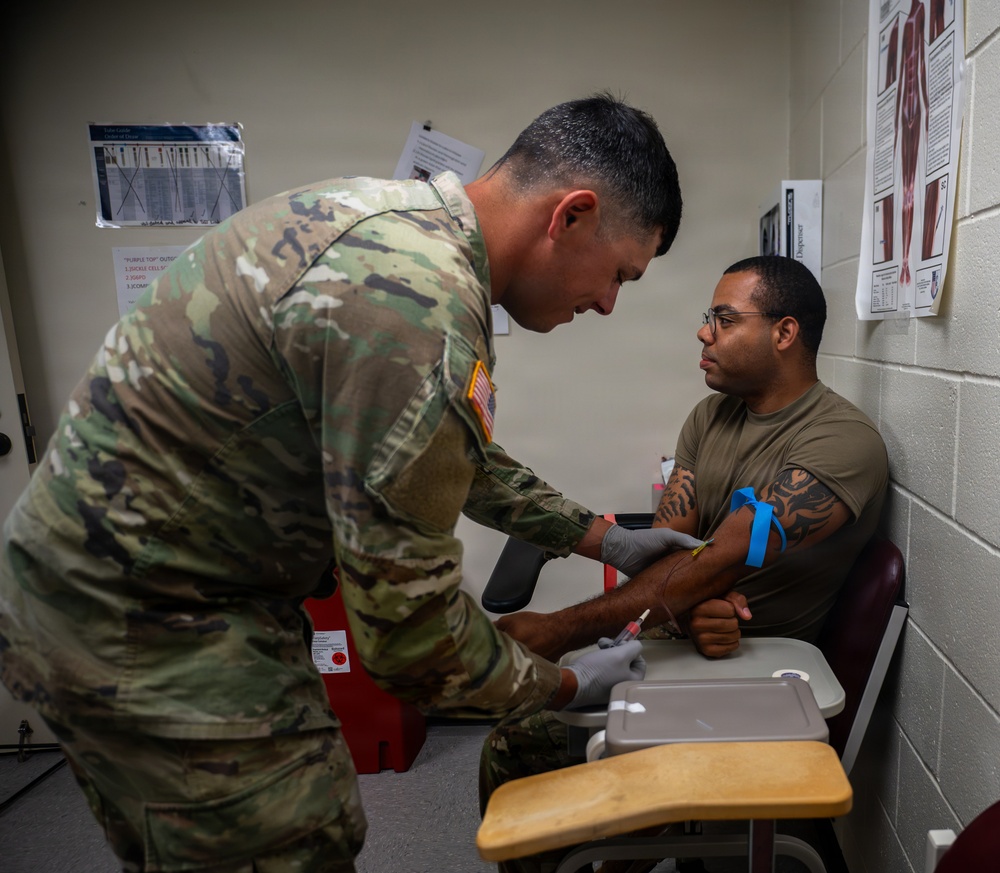
Photo By Spc. Samantha Jensen | A Texas Army National Guard Soldier attached to the Soldier Medical Readiness Center...... read more read more
 Subscribe
Texas Army National Guard Soldier Medical Readiness Program By Spc. Samantha Janssen 100th Mobile Public Affairs Detachment
AUSTIN, Texas — Whether responding to devastating floods, hurricanes, wildfires or other state emergencies, the Texas Army National Guard depends on a force that is ready to deploy at a moment's notice. Behind every successful mission is a Soldier Medical Readiness Program that ensures Soldiers are physically and mentally prepared before they step into the field.
At the Texas Army National Guard's Soldier Medical Readiness Center, medical professionals work year-round to monitor, evaluate and improve Soldier readiness through annual health assessments, dental examinations, immunizations, behavioral health screenings and medical tracking systems. Those efforts provide commanders with information they need to rapidly mobilize healthy personnel when Texans need their help the most.
1st Sgt. Donnel Norris, first sergeant for Camp Mabry's SMRC and Spc. Savannah Saavedra, a patient administration specialist assigned to the Soldier Medical Readiness Center, explained how medical readiness serves as the foundation for operational success across the Texas Army National Guard.
For commanders, medical readiness is much more than an administrative requirement. Annual Periodic Health Assessments, dental exams and other screenings allow leaders to know exactly which Soldiers are capable of responding immediately instead of relying on outdated information or assumptions. Norris explained that Soldiers with expired medical requirements become an unknown factor for commanders. By maintaining accurate medical records throughout the year, leaders can confidently build response teams that are fully capable of accomplishing the mission.
"When Soldiers complete their medical requirements every year, commanders know exactly what resources they have available," Norris said. "That allows them to respond faster and more effectively.”
The medical readiness team also helps Soldiers resolve medical issues before they become obstacles to future missions. Providers educate Soldiers on the documentation required to address temporary medical profiles, coordinate with civilian physicians and guide them through the process of returning to full duty.
Saavedra said education plays a significant role in maintaining readiness, especially for younger Soldiers who may be unfamiliar with military medical programs, unsure how to document injuries, and where to receive care.
"We see a lot of Soldiers who simply don't know what resources are available to them," Saavedra said. "Helping them understand the process keeps them healthier throughout their careers and ultimately makes the entire force stronger."
Medical readiness becomes especially important during state emergency operations, where every Soldier must be capable of performing physically demanding tasks under stressful conditions.
"The wrong time to find out your Soldiers have medical issues is when you already have boots on the ground," said Norris, “because now you're trying to help them and a community, so that's more resources used on helping you than helping the people that actually need it.”
The Texas Army National Guard has continued improving its medical readiness program through expanded medical tracking systems and increased access to care. Norris highlighted the opening of an additional Soldier Medical Readiness Center at Camp Swift, allowing more Soldiers to complete required medical evaluations . Those improvements have helped increase the Guard's medical readiness while giving commanders greater confidence in the force available for future missions.
Medical readiness does not end when a mission is complete. Following operations, returning Soldiers complete post-deployment medical evaluations and behavioral health screenings before returning home. The process helps identify physical or emotional concerns early while connecting Soldiers with additional care if needed. Saavedra said those post-mission evaluations are just as important as preparing Soldiers before deployment because they ensure Guardsmen receive the support they need after responding to difficult situations.
For Texas lawmakers and community leaders, the Soldier Medical Readiness Center represents an investment in the readiness of the Texas Army National Guard and its ability to protect communities during times of crisis. Every health assessment completed, immunization administered and Soldier educated contributes directly to the Guard's capability to respond whenever disaster strikes. Norris said the mission ultimately comes down to ensuring Texas always has a force prepared to answer the call.
"Medical readiness is important, and it's needed," Norris said. "We have a large number of motivated medical professionals in the Texas National Guard who are eager to help this state on any mission."
As Texas continues to face natural disasters and evolving emergency response requirements, the staff of the State Medical Readiness Center remains committed to ensuring the Texas National Guard stands ready—healthy, trained and prepared—to serve the people of Texas whenever they are called.
| Date Taken: | 07.18.2026 |
| Date Posted: | 08.19.2026 16:47 |
| Story ID: | 572619 |
| Location: | AUSTIN, TEXAS, US |
| Hometown: | KEMPNER, TEXAS, US |
| Web Views: | 31 |
| Downloads: | 0 |

This work, Texas Army National Guard Soldier Medical Readiness Program, by SPC Samantha Jensen, identified by DVIDS, must comply with the restrictions shown on https://www.dvidshub.net/about/copyright.


No keywords found.




