
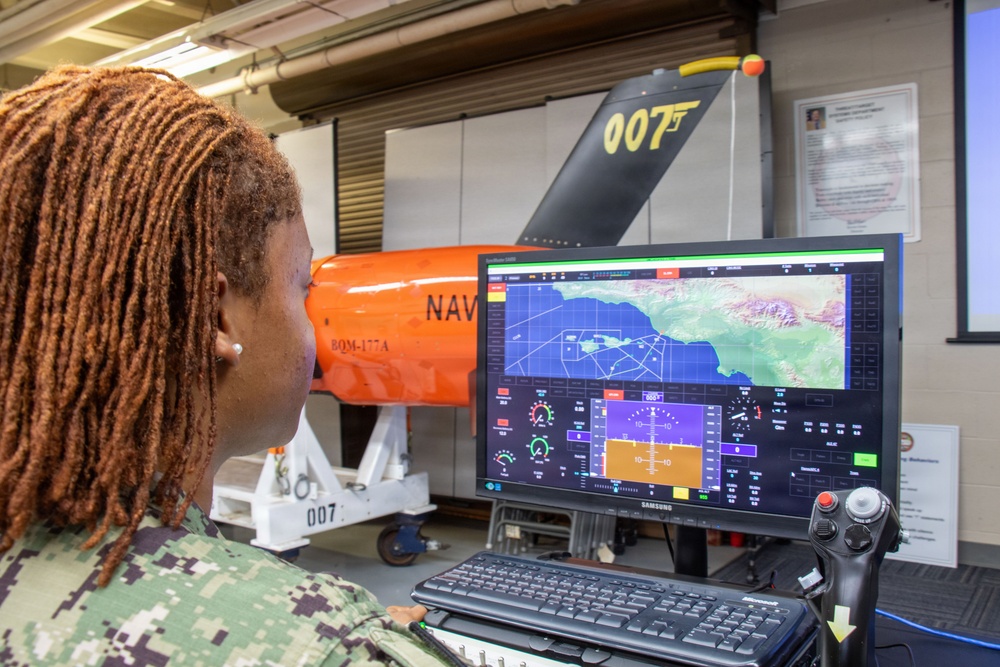
Photo By Michael Smith | POINT MUGU, Calif. (June 24, 2026) U.S. Navy Aviation Structural Mechanic 2nd Class...... read more read more
Petty Officer 2nd Class Alexandria Culpepper sat in the classroom with console data frozen on the screen at the front of the room. The recording showed a BQM-74E aerial target holding course toward a guided-missile cruiser. The numbers looked normal. The operators' voices on the radio stayed steady. Nobody in the control room that day knew control had already slipped to another console.
Culpepper, an aviation structural mechanic from Pacific Missile Range Facility Detachment Far East in Okinawa, Japan, flew to Point Mugu for the course. The Target Training and Operating Procedures Standardization program, known across the range as TTOPS, is the standard she came to meet. She and her teammates spent three weeks in the classroom, the simulator and the control room before they could fly a live aerial target.
The recording they watched is real.
On Nov. 16, 2013, a BQM-74E struck USS Chancellorsville (CG 62) during a tracking exercise off Point Mugu, tearing a hole in the ship and injuring two Sailors. Investigators found equipment failure, communication breakdowns and emergency procedures that existed on paper but failed under pressure. No enterprise-wide training system stood behind them. What the target community lacked, the investigation found, was a single written standard for how it trained and certified its operators. Kevin Gross wrote that standard.
A retired Marine Corps colonel and trained aviation safety officer, Gross served on the mishap investigation. He now directs the Threat Target Systems Department at Naval Air Warfare Center Weapons Division and teaches the course himself.
The course trains remote control operators who fly the targets and operations conductors who run the events. Students face two written exams, 15 simulation exercises and a final simulated evaluation. They rehearse emergency procedures in a simulator, learning what to do when a target loses its connection to the operator or strays from its programmed flight path. Seconds can separate a safe recovery from a repeat of 2013.
“The one decision that the students should carry with them is verbalize what is happening and gain help from your fellow RCOs and your fellow ops conductors,” Gross said. “We need to exercise solid teamwork to ensure that we respond appropriately to emergency procedures.”
The TTOPS Model manager sets the training and currency for each target type. During the most critical minutes of a flight, only the people running the mission stay in the control room. Only mission traffic goes over the net. Every event opens with a standard safety brief that fixes the words the crew will use. That includes the call for a target gone out of control and the criteria for stopping the mission.
Operators face an evaluation every year. Their units face one every 18 to 24 months.
For Culpepper, the course changed how she understood the job.
“This training was extremely useful for my team from PMRF Det Far East,” she said. “When operating at sea, it is vital to understand the background of our procedures. While we always say safety is paramount, this course helped us see exactly why we do what we do.”
Crew resource management runs through the entire program. Alistair Lord, the lead instructor for remote control operators, said the program drove “a change from a Mission-Above All to a Safety-First culture.”
Lord said human error is the leading cause of aviation mishaps. Disciplined communication, he said, raises a crew's awareness before, during and after an operation.
A formal course existed years earlier, but it lapsed, and operators learned the job alongside someone who already knew it. NAWCWD rebuilt the course and ran the first class in April 2016. Today the Point Mugu classroom trains operators from Navy commands across the country to one set of requirements.
Gross said the department's targets let a crew make its mistakes in training, not in the moment it has to protect the ship. Every ship that deploys needs realistic aerial targets to prepare its crews to recognize threats and defend themselves. The crew at the console determines whether that training is safe enough to keep running.
Culpepper qualified July 1 on the BQM-177A and returned to Okinawa. Two days later she flew to Hawaii for Rim of the Pacific, the Navy's largest international maritime exercise. She shadowed civilian direct control operators, who handle the target at launch and recovery. Ground emergencies turned out to be more common than she expected. When the primary target had a problem, she launched the backup under their supervision. The training, she said, is why it added no stress.
“I have not flown since school, but I noticed that having an efficient scan on the console can literally save the mission and lives,” she said.
Back in the classroom, Gross lets the recording run past the point where he stopped it. The students hear what the range crews heard that afternoon: a voice from the ship, over the radio.
“Drone hit our ship.”
“Something we never want to hear again,” Gross said.
| Date Taken: | 08.17.2026 |
| Date Posted: | 08.17.2026 18:20 |
| Story ID: | 572609 |
| Location: | POINT MUGU NAWC, CALIFORNIA, US |
| Web Views: | 23 |
| Downloads: | 0 |

This work, Inside the course that qualifies every naval aerial target operator, by Michael Smith, identified by DVIDS, must comply with the restrictions shown on https://www.dvidshub.net/about/copyright.


No keywords found.





