
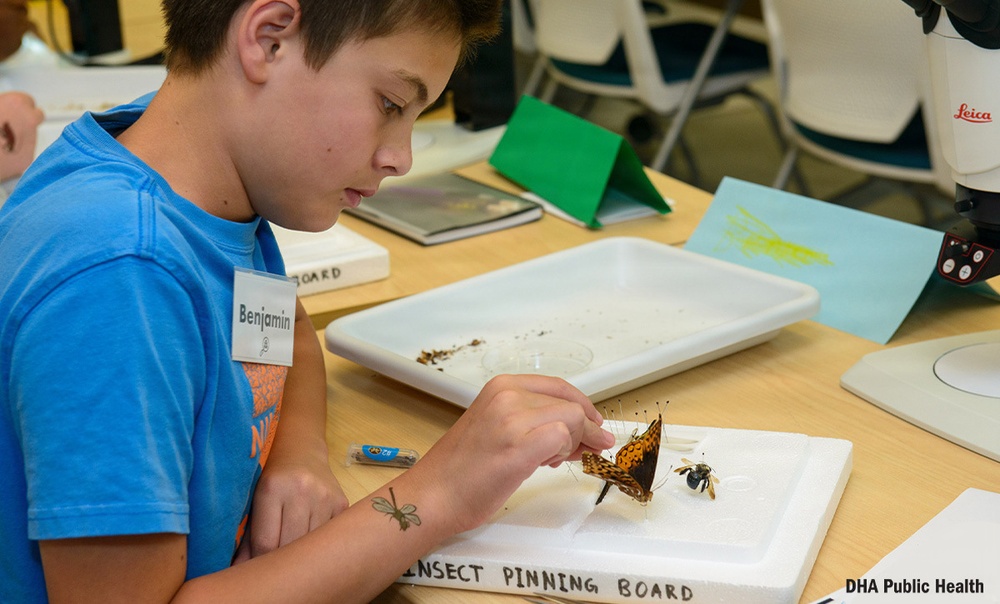
Courtesy Photo | Benjamin Trautner, a 12-year-old student at Southampton Middle School in Bel Air,...... read more read more
 Subscribe
You don't usually find eighth graders calibrating professional dissecting scopes. You also don't see them conducting tick drags in the woods, collecting mosquitoes, or isolating tick DNA. Yet, at Aberdeen Proving Ground, Maryland, that is exactly how 13 local middle schoolers spent nearly a week of their summer vacation.
Defense Health Agency-Public Health hosted its second annual Bug Camp, held from June 29 to July 2, at Aberdeen Proving Ground. This science, technology, engineering, and mathematics, or STEM, program is supported by the https://usaeop.com/blog/introducing-the-new-army-stem-education-consortium/. The camp puts high-tech tools in the hands of local students from Maryland and Pennsylvania. By studying how U.S. military scientists defend against insect-borne diseases, these young researchers get a first-hand look at military public health.
"We can't fight the enemy if we don't know what it is," said Jennifer Carder, the DHA-PH Integrated Pest Management Branch chief and Bug Camp director. "It's not just about the bright, pretty butterflies. We need to identify mosquitoes and ticks so we can keep our service members safe, no matter where they are deployed."
This year, camp organizers modified the curriculum to provide more hands-on activities and less classroom lecture time. The changes that were implemented improved campers’ ability to see the key features of public health pests. The adjustments were based on feedback from the inaugural camp held in July 2025.
"We added instruction on how to calibrate and focus a dissecting microscope before we even used it to look at specimens," said Kevin Harkins, a DHA-PH entomologist who helped design the curriculum. "That was really helpful. Last year, we didn't do that, and they had a lot of trouble because they couldn't focus on specimens, which made the exercises after that more difficult.”
Students used the same professional equipment that DHA-PH scientists work with in the $248 million, state-of-the art public health lab. Campers set up three different types of mosquito traps around the facility. They collected their catches and brought them back to the laboratory to identify them.
"The equipment here allows them to do things that we can't normally do for our other events," said Harkins. "We can't bring microscopes and traps to a lot of our normal outreach events, like career days or local safety fairs."
The students also conducted active tick surveillance in the field with canvas tick flags. They brought back live specimens in vials, identified them, and performed polymerase chain reaction laboratory analyses with resident tick expert Robyn Nadolny, chief of the DHA-PH Vector-borne Disease Branch, to test the specimens for pathogens like Lyme disease. Nadolny also operates the MilTICK and SURE Path collection programs, which help local doctors gain a better understanding of their local “tickscape.”
"Public health is not really taught in schools," said Harkins. "This is a unique field where they get practical experience with real tools."
For educators, the camp offers resources that are difficult to replicate in a traditional school setting. The differences between public school science laboratories and a federal research facility are clear.
"When you have 30 or more kids in a school classroom, you're limited on time, resources, and the knowledge you bring," said Molley Brennan, who teaches engineering at Southampton Middle School in Bel Air, Maryland. "But here, because there are so many scientists — students work directly with mosquito, tick, and urban entomology experts."
Brennan noted school laboratories often require teachers to simulate scientific experiments rather than conducting them with actual specimens and chemical solutions.
"At school, we have to mimic," said Brennan. "We tell students, 'This is the process, but you wouldn't actually use these materials.' Here, they are using tick parts, running gels, and using real pipettes instead of little plastic droppers. It is so much more real-world and hands-on."
Brennan also observed the students' focus during the laboratory blocks. She noted they were quiet while using microscopes and showed pride in their findings.
The level of engagement led students to ask complex questions. During a session on mosquitoes, one student asked why some wingless insects share classifications with winged families. Brennan explained that the scientists clarified that reproductive ants develop wings. This shows how the campers synthesized complex information. "The questions they ask make me feel like I need to step up my game," said Carder. "They are noticing some really specific things and synthesizing, not just learning. They are meshing information together and asking questions that have significance and impact."
For some of the participants, going into the field required wearing specialized protective gear to stay safe from tick-borne diseases. This region of Maryland has active populations of ticks that carry Lyme disease, requiring strict safety procedures before field collection begins.
"It felt like wearing an astronaut suit," said 11-year-old Henry Newman, who lives in Maryland. Newman caught two ticks on his flag and noted that they were small and flat.
Benjamin Trautner, a 12-year-old student at Southampton Middle School, explained how he would describe the camp to his friends.
"I'm going to tell them about pinning and catching bugs," said Trautner. "But I'm not telling them about the tick part. They won't want to go then!"
Although Trautner plans to pursue engineering rather than entomology, he enjoyed running the DNA analysis. Both students left with an understanding of how the camp connects to military readiness.
"They do this so people in the Army stay safe, and other people nearby stay safe too," Newman said. Other students, like 12-year-old Aubrie Chaney from Joppatowne, Maryland, used the camp to explore their career interests. Aubrie, who attends Swan Creek School in Aberdeen, Maryland, heard about the camp through a Facebook post.
"I really want to go into the field of environmental science," said Aubrie. "I got to feel how it's going to be if I go into that field, like going out to the forest with my tick flag."
Chaney also enjoyed insect pinning, an activity she had previously seen on Instagram. Under the microscope, she identified the white spot on a female Lone Star tick.
"I knew mosquitoes and ticks carried some diseases," Chaney said. "I knew mosquitoes carried malaria, but I didn't know different ticks carry different diseases. And I didn't know mosquitoes usually stay in the area. I thought they were coming from everywhere."
DHA-PH staff members hope the camp helps the community learn more about the installation's public health mission.
Katherine Ponterrelli, a water quality engineer under the DHA-PH Environmental Health Directorate's Water Quality Engineering Branch, brought live native Cecropia caterpillars and Luna moth pupae to share with the campers.
"A lot of them are scared, and then they hold them and you can see how they understand how that insect lives a bit more," said Ponterrelli. "This camp shows our base isn't a closed-off, scary place. It's a community learning center."
By teaching military families and local youth about vector safety, DHA-PH hopes to spread public health awareness throughout the region. If your child would like to participate in next year’s Bug Camp, look for applications in January 2027. The program is currently supported through https://usaeop.com/program/gems/ using the Gains in the Education of Mathematics and Science, or GEMS, link.
The Defense Health Agency is a Combat Support Agency, serving as a force multiplier for the joint services by optimizing lethality through warfighter medical readiness.
NOTE: The mention of any non-federal entity and/or its products is for informational purposes only, and is not to be construed or interpreted, in any manner, as federal endorsement of that non-federal entity or its products.
| Date Taken: | 08.17.2026 |
| Date Posted: | 08.17.2026 17:00 |
| Story ID: | 572532 |
| Location: | ABERDEEN PROVING GROUND, MARYLAND, US |
| Web Views: | 12 |
| Downloads: | 0 |

This work, Professional tools, real-world science: Bug Camp inspires future STEM leaders, by Douglas Holl, identified by DVIDS, must comply with the restrictions shown on https://www.dvidshub.net/about/copyright.


No keywords found.




