
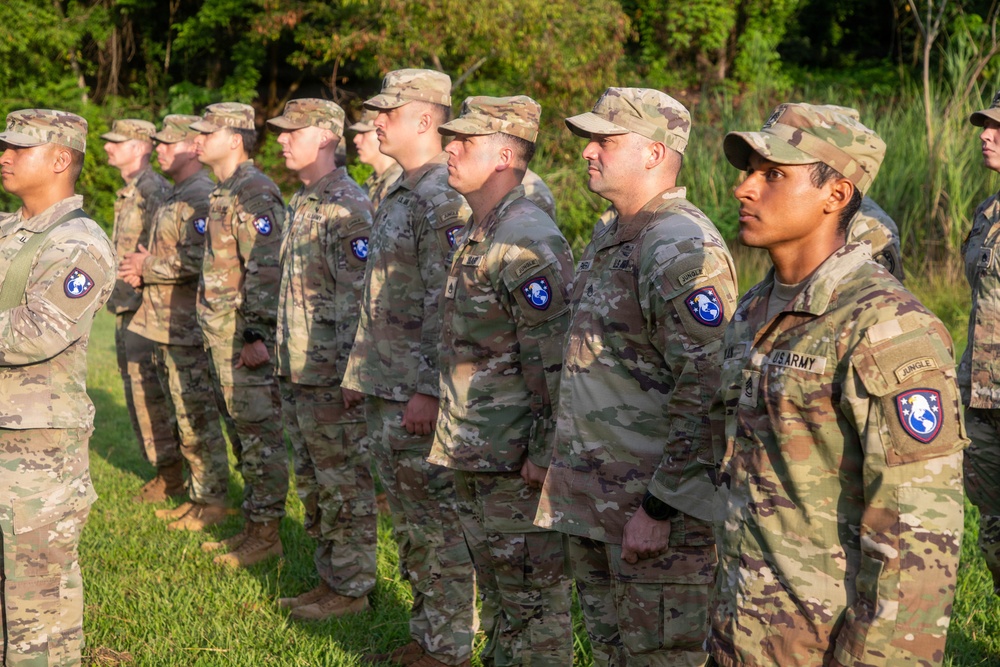
Photo By Maj. Val Bryant | Army Security Cooperation Group-South redesignates to 551st Infantry Regiment in...... read more read more
551st Infantry Regiment Redesignated in Dual Ceremonies
By Maj. Val Bryant
FORT BENNING, Ga. — The Army Security Cooperation Group–South was officially redesignated as the 551st Infantry Regiment during simultaneous ceremonies held Aug. 14 at Fort Benning and in Pan Pacifico, Panama.
The dual ceremonies represented more than a change of colors. They symbolize the regiment’s unique identity: one headquarters rooted at Fort Benning, home of the U.S. Army’s airborne and infantry heritage, and the other forward in Panama, where soldiers work daily alongside Panamanian security forces.
By restoring a storied regimental lineage synonymous with courage and operating in austere terrain, the Army is reinforcing its commitment to strengthening partnerships throughout the region and preparing U.S. service members to operate in an environment where cartels in our hemisphere find safe haven.
“Presence here matters,” said Gen. Joseph Ryan, commanding general of U.S. Army Western Hemisphere Command, from the Panama ceremony. “The 551st is the face of our Theater Army, but its mission is not symbolic — it delivers operational capability, unmatched jungle expertise, and partnerships which are necessary, substantial, and purposeful. Few armies in the world maintain genuine jungle expertise. Fewer still can teach it. The men and women of the 551 must do both.”
Building Readiness in the Western Hemisphere
The 551st Infantry Regiment is assuming its place under the U.S. Army’s Western Hemisphere Command, executing missions designed to enhance interoperability with partner nations while increasing U.S. readiness for operations in tropical and jungle environments.
Central to the regiment’s mission are two complementary organizations in Panama: the Joint Security Cooperation Group–Panama and the Jungle Operations Training Course–Panama.
JSCG-P serves as the U.S. military’s forward security cooperation organization in Panama, coordinating engagements with Panamanian security forces while facilitating U.S. and multinational training throughout the country. The organization enables bilateral exercises, operational planning, reception and staging of visiting U.S. forces, and strengthening relationships that contribute to regional security and stability.
The JOTC-P was built upon the jungle training tradition established decades earlier at Fort Sherman, Panama. Conducted in the dense tropical terrain surrounding the former Canal Zone, the course develops individual and small-unit proficiency in jungle survival, movement, patrolling, tracking, sustainment, and tactical decision-making under conditions that test physical endurance and leadership.
Together, JSCG-P and JOTC-P form the operational heart of the regiment’s mission by strengthening partnerships while preparing forces to succeed in settings where technological advantages get neutralized and where winning the next fight depends upon disciplined soldiers and cohesive teams.
Honoring a Distinguished Legacy
__ __The redesignation also restored one of the Army’s most distinguished airborne lineages.
The original 551st Parachute Infantry Battalion was activated during World War II and earned a reputation for aggressive action and exceptional toughness. Trained as an elite airborne force, the battalion participated in operations throughout the Caribbean before deploying to Europe during the final months of the war.
The battalion participated in the only daytime airborne assault of World War II during Operation Dragoon in southern France on Aug. 15, 1944. But they became best known for their extraordinary actions during the Battle of the Bulge, where they fought under the 82nd Airborne Division. Their initiative and tenacity achieved every objective, at one point requiring a bayonet charge on a German machine-gun position — one of only a few documented during WWII and even fewer that were successful.
Their last major action was the assault on Rochelinval, Belgium, where the battalion suffered devastating casualties, including the loss of their battalion commander, Lt. Col. Wood Joerg of Eufaula, Alabama, while successfully accomplishing its mission against determined German resistance.
“The cost was staggering,” Ryan recounted. “Of more than 800 paratroopers who entered the Ardennes, only about 110 men walked out. Those left standing were reassigned, and the formation disbanded. The 551st was eventually — and properly — awarded the Presidential Unit Citation, but it never again stood together as a formation.”
Although the battalion was inactivated following World War II, its legacy endured as one of the most respected in airborne history.
A Legacy Renewed
The redesignated 551st Infantry Regiment inherited more than a numerical designation — it assumed responsibility for carrying forward the spirit of a unit defined by resilience in unforgiving environments.
Like the original 551st, the modern regiment stands headquartered out of Fort Benning. Likewise, the regiment’s operational focus extends beyond Georgia, with soldiers serving in Panama’s dense jungles — a region where physical endurance, disciplined small-unit leadership, and adaptability remain decisive advantages.
Although separated by more than eight decades and vastly different strategic contexts, both organizations share a common purpose: preparing soldiers to succeed where terrain, climate, and uncertainty test every aspect of military professionalism.
The original battalion trained for difficult missions requiring initiative and toughness. The modern regiment carries those same qualities forward through persistent engagement with regional partners and realistic jungle operations that prepare forces for competition, crisis, and conflict across the Western Hemisphere.
Carrying the Colors Forward
As the old colors were furled and the new colors of the 551st Infantry Regiment were unfurled, the ceremonies on Aug. 14 represented both the culmination of one chapter and the beginning of another.
“The joint force requires skill and profound resilience,” Ryan said to the soldiers of the 551st. “You own the path through which warfighters enter these jungles, train in the toughest conditions, and build the very strength which keeps our adversaries at bay. You ensure today’s force is tested, hardened, and ready for the next fight. You have inherited a proud and sacred lineage. You carry the legacy of the soldiers who froze, bled, and never returned home. Honor their past by how you forge our future.”
From Fort Benning to Panama’s “Green Hell,” the 551st Infantry Regiment begins its next chapter by building trusted partnerships, advancing jungle warfare expertise, and preparing U.S. and allied forces for the challenges of tomorrow while carrying forward the legacy of the soldiers who first made the 551st name synonymous with courage, hardship, and sacrifice in defense of the homeland.
| Date Taken: | 08.14.2026 |
| Date Posted: | 08.14.2026 16:24 |
| Story ID: | 572458 |
| Location: | PA |
| Web Views: | 42 |
| Downloads: | 0 |

This work, 551st Infantry Regiment Redesignated in Dual Ceremonies, by MAJ Val Bryant, identified by DVIDS, must comply with the restrictions shown on https://www.dvidshub.net/about/copyright.


No keywords found.





