
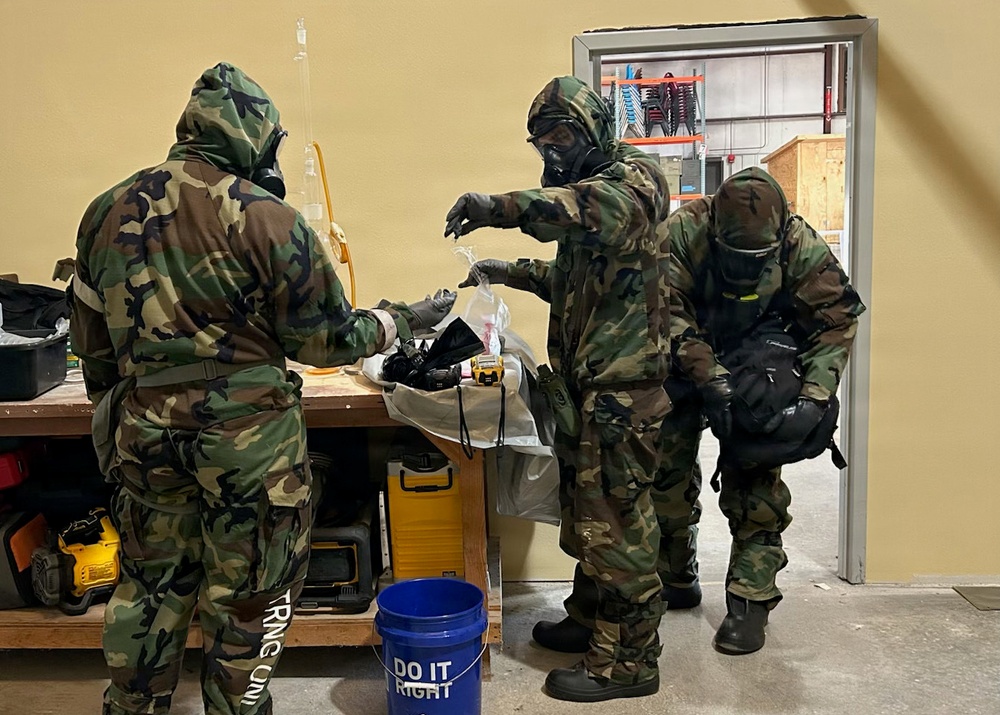
Photo By Senior Master Sgt. Theodore Daigle | U.S. Airmen assigned to the 307th Civil Engineer Squadron and 2nd CES collect a...... read more read more
Teamwork makes the dream work. It’s an old cliché, but it can still ring true.
Such was the case when Emergency Management personnel from the 2nd and 307th Civil Engineer Squadrons pooled their resources and talent for two readiness exercises here from July 15-30.
The active-duty 2nd CES and Air Force Reserve Command’s 307th CES combined personnel, equipment and experience to accomplish training neither organization could have conducted as effectively alone.
Master Sgt. John Gibson, 307th CES emergency management superintendent, said it was the first training partnership of its kind between the two units in recent memory.
“Building trust and fidelity with the host [2nd CES] is really important,” said Gibson. “They have the equipment we need, and we have the people they need to train effectively.”
The collaboration included an Initial Response Force exercise followed by chemical, biological, radiological and nuclear (CBRN) small-team tactics training and a field capstone. Together, these events tested the Airmen’s ability to combine their organizations’ capabilities during complex emergency operations.
Combining capabilities
Tech. Sgt. Christopher Mathis, Gibson’s active-duty counterpart in the 2nd CES, helped secure his unit’s participation in the training. “It’s something that I wanted to do since I got here,” Mathis said.
When Mathis learned that training developed by the 307th CES emergency management leadership aligned with his flight’s requirements, he saw an opportunity for the two organizations to help one another.
The partnership began with a two-day Initial Response Force exercise involving a small-scale hazardous incident and possible radiological compromise of a simulated munition during movement and storage operations.
This scenario required coordination among multiple 2nd CES emergency-response elements, including the Explosive Ordnance Disposal Flight, Fire Emergency Services Flight and Emergency Management Flight, along with emergency management personnel from the 307th CES.
The IRF allowed Airmen to practice critical tactics and coordinate actions between CES flights and teams, including Explosive Ordnance Disposal, Fire Protection, and Emergency Management Support Teams.
The respective flights and teams ensured tactics, including stabilizing and securing munitions, conducting initial entry,and site and personnel decontamination were executed to mitigate damage and avoid further contamination.
Master Sgt. Christopher Canady, 307th CES emergency management noncommissioned officer in charge, helped develop the exercise plan.
“This kind of training is critical,” Canady said. “The ability to respond quickly and effectively to this kind of incident can mitigate damage and potentially save lives.”
Preparing the force
The Initial Response Force exercise was followed by CBRN small-team tactics training designed to strengthen individual proficiency before placing the Airmen in integrated teams for a capstone exercise.
As part of the preparation, the 307th CES used a teach-back model to train its participating Airmen. Junior enlisted members and NCOs received course outlines and lesson plans, developed the material and taught it under the mentorship of senior emergency management personnel.
“We are experts, and we have to be able to teach these things to other Airmen,” Gibson said. “I want them to be as effective as possible as instructors, and the research part of that is key.”
The training method required the 307th CES Airmen to do more than memorize procedures. They had to understand the material well enough to explain it, respond to questions and apply it during field operations.
For Staff Sgt. Carrie Weiss, a newly promoted 307th CES NCO, the experience provided both technical training and an early opportunity to lead.
“It was my first time being responsible for other troops, so having to teach our leadership provided us all an opportunity to show initiative and make decisions on our own,” Weiss said.
According to Canady, that leadership development was intentional. Senior NCOs challenged the participants with questions during the teaching phase, requiring them to demonstrate a deeper understanding of the material.
“The goal was not just to transition them from students to subject matter experts,” Canady said. “The teach-back method forces junior members to master the material while giving them confidence and leadership experience.”
One team in the field
For the capstone, 2nd CES Emergency Management personnel joined the 307th CES participants for a scenario designed to test their ability to apply CBRN response procedures under field conditions.
Planners combined the Airmen into integrated teams and assigned responsibilities according to experience and leadership level.
One real-world factor all participants had to deal with was weather.
Louisiana summers are notoriously hot, and this one tested the participants as they worked in full Mission-Oriented Protective Posture (MOPP) gear.
The equipment simulated the protection required in a contaminated environment, but it also trapped heat and added physical strain to an already demanding scenario.
“There are going to be a few communication issues when working with a new team, but working in full MOPP gear in the heat was probably the biggest challenge,” she said.
Exercise planners reduced the heat-related risks by beginning early in the day and implementing safety procedures that would also be used during an actual response.
When the protective equipment came off and the exercise ended, the exercise planners agreed that Airmen from both components had demonstrated that their different resources and experiences could be combined into one operational capability.
Total Force in practice
For Gibson and Mathis, the training demonstrated the practical value of Total Force Integration and also showed the value in learning the nuances in how each component operates.
“It’s like having two different professional football teams coming together,” said Gibson. “We both know the fundamentals, we just have to learn each other’s plays.”
While Gibson emphasized the complementary resources, Mathis pointed to the experience and specialized knowledge of the 307th CES emergency management leadership as another factor in the training’s success.
“Master Sgt. Canady has more than 20 years of experience specializing in CBRN and hazardous materials, which is longer than I’ve been in the Air Force,” Mathis said.
Gibson and Mathis both expressed hope that future plans for further training between the two entities come to fruition.
If not, they were emphatic about the success of what they were able to accomplish.
“We rarely get to train together as a joint force, and we did it well,” said Gibson.
| Date Taken: | 08.14.2026 |
| Date Posted: | 08.14.2026 15:02 |
| Story ID: | 572447 |
| Location: | BARKSDALE AIR FORCE BASE, LOUISIANA, US |
| Web Views: | 133 |
| Downloads: | 0 |

This work, Two wings, one response: Barksdale Airmen put Total Force Integration into action, by SMSgt Theodore Daigle, identified by DVIDS, must comply with the restrictions shown on https://www.dvidshub.net/about/copyright.


No keywords found.





