
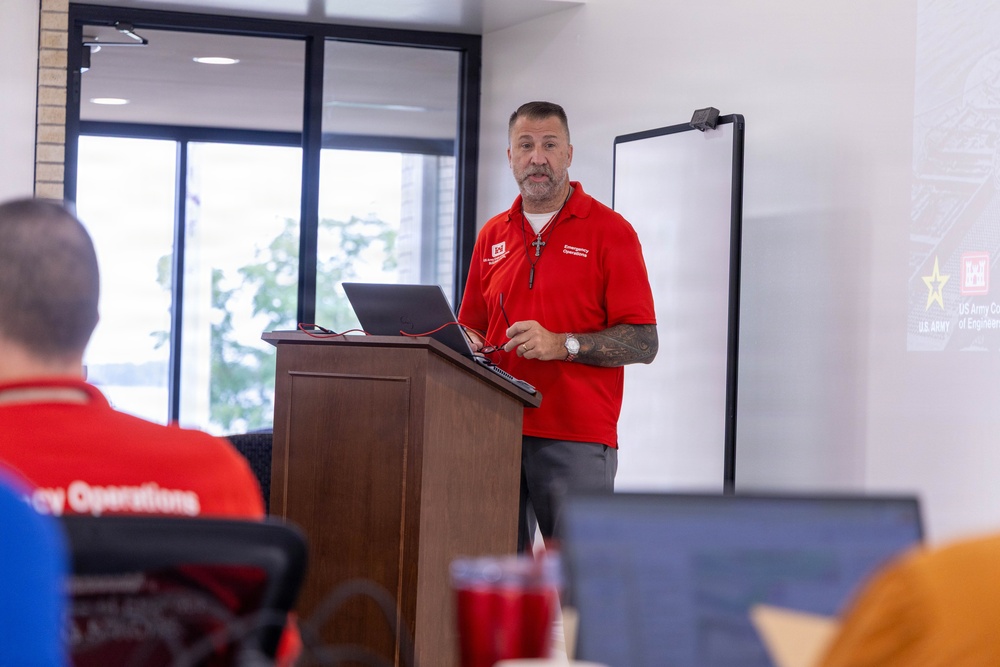
Photo By Christine Reinhardt | Rick Weixelbaum, Kansas City District continuity of operations program administrator,...... read more read more
It’s said that failing to plan is planning to fail. Having a plan, whether in your personal or professional life, in the event of a natural disaster or other emergency situation is sometimes easier said than done. With September being National Preparedness Month, there is no better time than the present to make a plan for the worst-case scenario.
All federal agencies are required by a Presidential Policy Directive to have a continuity of operations program. These programs ensure agencies can continue to operate mission essential functions in the event normal operations are disrupted. Practicing continuity of operations is an essential part of the program, allowing agencies to prepare before a real emergency.
The Kansas City District, U.S. Army Corps of Engineers held a continuity of operations exercise at Smithville Lake in Smithville, Missouri on Aug. 13, 2026. The exercise was a district-wide effort, involving leadership from across the district’s business lines.
“If you don't rise to the occasion, you fall to the level of your training. Teams that skip the reps because ‘we're good enough now’ are the ones who look disorganized when something breaks,” said Lt. Col. John Meyers, Kansas City District deputy commander. “The exercise isn't insurance against a specific scenario — it's insurance against improvising badly under pressure.”
According to the continuity of operations program’s mission statement, the Kansas City District aims to ensure the continuity of mission essential functions at all facilities and begin critical business within 12 hours of a disruption to normal operations; maintain a plan allowing staff to perform mission essential functions at alternate locations with minimal disruptions to service; and prepare to conduct emergency operations to save human lives, prevent human suffering and mitigate property damage.
In the event the district experiences a disruption to normal operations and activates its continuity of operations plan, pre-identified offices and employees are mobilized and moved to an alternate location where mission essential operations will be performed until the disruption ends.
“Simply put, we’re going to execute our mission essential functions within 12 hours, for up to 30 days or more,” said Rick Weixelbaum, continuity of operations program administrator with the district’s Readiness and Contingency Operations Office.
The exercise held on Aug. 13 started with a practical exercise – physically setting up an alternate location fully equipped with the necessary physical and IT infrastructure. Then, the exercise continued with a briefing to participants by the district’s Readiness and Contingency Operations Office, which was responsible for organizing and executing the exercise.
Two important questions were posed and discussed during the exercise: what are the district’s mission essential functions – functions directly related to accomplishing the district’s mission as defined by statute, regulation or other legal authority – and when would the continuity of operations plan need to be activated?
Mission essential functions at the Kansas City District vary and include operating and maintaining water resource projects, designing, constructing and supporting military infrastructure, environmental restoration projects and water resource projects, regulatory permitting and preparing and responding to national emergencies.
“What drives the continuity of operations plan activation will dictate how we look at the district’s mission essential functions and the resources available to us,” said Jud Kneuvean, chief of the Kansas City District’s Readiness and Contingency Operations Office.
As for when the district might activate a continuity of operations plan, Kneuvean said it can vary. Everything from natural disasters to national emergencies can be cause for activation. But there are also events some might not think about as requiring the plan’s activation.
“You think about the worst-case scenario, but [USACE] has had districts affected by bed bugs,” said Kneuvean. “There are also scenarios that are low probability but have high consequences, which we also plan for.”
There are four phases to the district’s continuity of operations plan. Phase one is readiness and preparedness. This includes exercises like the one held at Smithville Lake, which allow the district to prepare, plan and practice for a disruption of normal operations.
Phase two is activation of the continuity of operations plan, which includes relocation of personnel and equipment to alternate locations, and the district commander’s initial assessment of its ability to perform mission essential functions.
Phase three is the continuity of operations. This phase varies in length depending on the disruption. During phase three, mission critical staff execute the pre-determined mission essential functions of the district.
Lastly, phase four is establishing the new normal. That is, the district transitions from the alternate location and resumes operations until a new normal is established. This could mean operations resume to their pre-disruption level, or it could mean operations remain limited at their normal location, at a new temporary site or at a new permanent facility.
The Kansas City District last held a continuity of operations exercise in 2018. In that time, the district saw significant shifts in leadership, so the Aug. 13 exercise was a perfect opportunity to revisit the plan and adjust it for the district’s present posture, as needed.
“We plan for the worst but hope for the best,” said Weixelbaum. “Effectively planning before an event builds resiliency.”
| Date Taken: | 08.14.2026 |
| Date Posted: | 08.14.2026 09:13 |
| Story ID: | 572401 |
| Location: | MISSOURI, US |
| Web Views: | 27 |
| Downloads: | 0 |

This work, Ensure, maintain and prepare: Kansas City District holds continuity of operations exercise, must comply with the restrictions shown on https://www.dvidshub.net/about/copyright.


No keywords found.





