
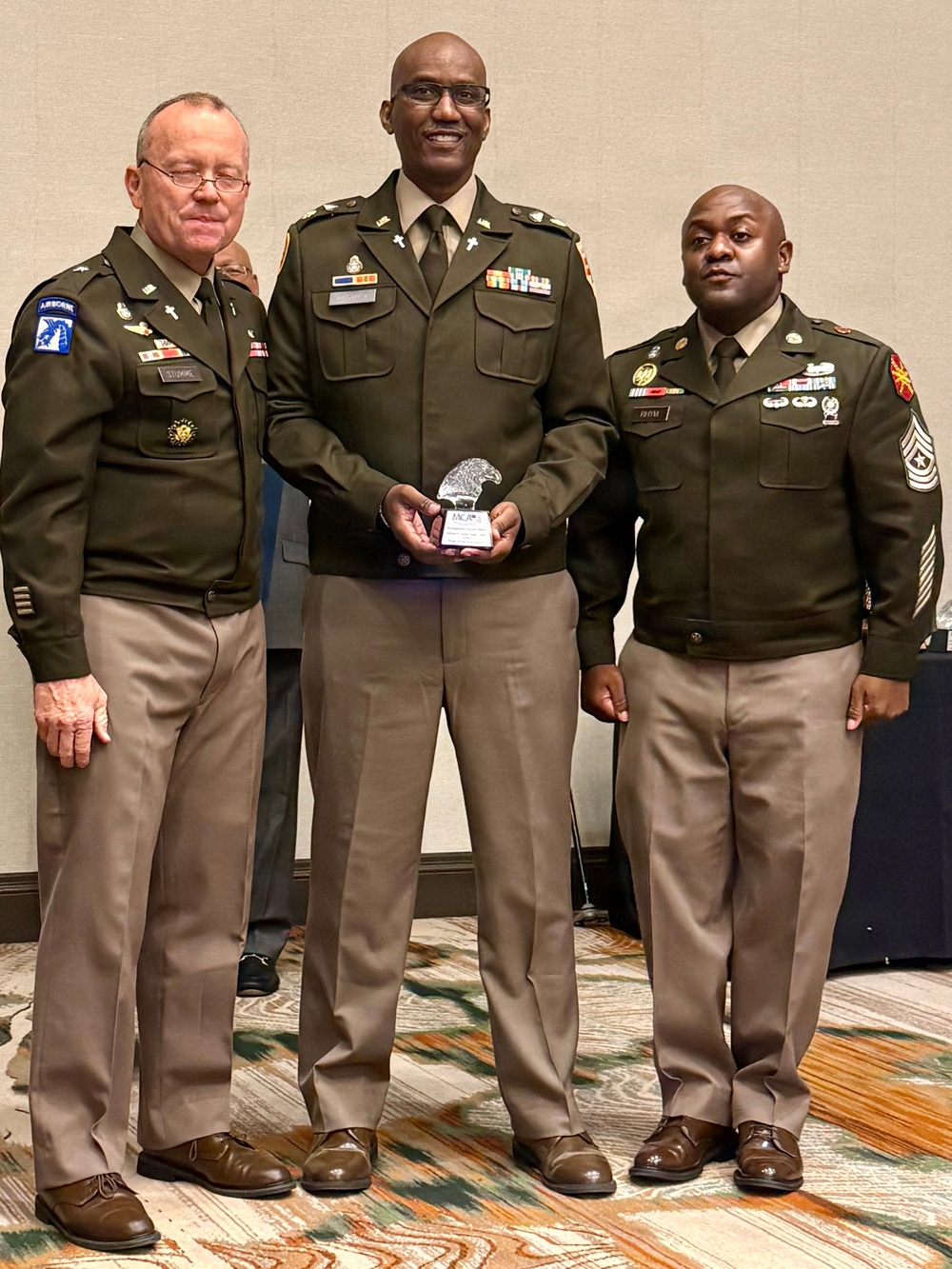
Courtesy Photo | U.S. Army Chaplain Edward Lartey with the District of Columbia National Guard,...... read more read more
In the Trenches: Chaplain Edward Lartey’s Life of Service Earns Distinguished Honor There are moments when a chaplain has to carry the weight of a room without letting anyone see how heavy it has become.
Chaplain Edward Lartey knows those moments well.
He has stood beside grieving families in hospital rooms. He has watched Soldiers endure challenging times in the streets of Washington. He prayed beside a young Soldier knowing she would soon die, then stepped into a hallway filled with people who still needed him to be steady.
In those moments, there is no audience and no award waiting at the end. There is simply a Soldier, a family or a fellow service member who needs someone willing to remain present.
For Lartey, that is the heart of being a chaplain.
So, after spending hours visiting service members throughout Washington, D.C., he was caught off guard when he sat down at his desk and received a phone call from retired Army Maj. Gen. William D. Razz Waff, executive director of the Military Chaplains Association.
Lartey had been selected to receive the Military Chaplains Association Distinguished Service Award. “I was very surprised,” Lartey said.
The recognition is a competitive honor presented annually to chaplains and religious affairs professionals who demonstrate excellence in ministry, resilience and operation support. For Lartey, however, the significance of the award extends beyond professional recognition.
It affirmed something far more personal.
“The work that I’ve done in the past and present has not gone unnoticed,” he said. “It means the path I’m on is not a single lane, but a multi-lane path of service and serving.”
Lartey’s path toward the chaplaincy began long before the award.
Twenty-one years ago, at 35 years old, he entered Basic Combat Training as a youth director surrounded largely by Soldiers between 18 and 21 years old.
Even while navigating the demands of training himself, he found people turning to him.
He ministered to Soldiers, cadre and drill sergeants. Instead of seeing those interactions as coincidence, Lartey began to see them as confirmation of where his life was loading.
One Soldier in particular helped make that calling clear.
During Basic Training, a Soldier learned that he had lost everything during Hurricane Katrina and did not know where his family was. For weeks, Lartey became more than a fellow trainee. He became a mentor, spiritual adviser and father figure, staying beside the Soldier until graduation.
When Lartey later arrived in Washington, his role continued to take shape. During only his third drill in 2005, his first sergeant approached him after learning he was a chaplain assistant and minister and asked him to begin holding Sunday services.
Then came Iraq.
During Operation Iraqi Freedom in 2007, the unit lost a Soldier and others were injured. Serving as a Religious Affairs Specialist (56M) at the time, Lartey was asked by leadership to provide spiritual support to Soldiers.
Again and again, the same theme emerged: when Soldiers encountered some of their hardest moments, Lartey found himself being called toward them rather than away.
Years of service would eventually put that calling to the test.
Lartey remembers standing in the hospital as a soldier died with her family nearby, then later speaking at her funeral. He remembers the civil unrest surrounding Lafayette Park following the death of George Floyd and watching service members wrestle with their feelings.
The experience changed how he understood his responsibility.
The Soldiers needed more than a chaplain who was available somewhere in the background, he said. They needed “a chaplain in the trenches with them” – someone who could help them withstand adversity and replenish them spiritually and emotionally.
Sometimes that ministry meant prayer.
Sometimes it meant something as ordinary as diapers.
While supporting the family of Staff. Sgt. Andy Wolfe at a hospital, Lartey learned that relatives had traveled from West Virginia with limited supplies for a newborn. As people discussed the family’s need for diapers, wipes and milk, Lartey decided discussion was not enough.
“I said,’ I got this’,” he recalled.
He found the specific brands the family needed, delivered the supplies, gave Wolfe’s sister one of his chaplain coins and quietly left the room.
Other moments were considerably harder to leave behind.
Lartey recalled standing in a hospital room beside Spc. Sarah Beckstrom, praying while knowing the young Soldier would soon die.
Then he had to walk out of the room.
Outside were other Soldiers, fellow chaplains and leaders who still needed encouragement. Internally, Lartey wanted to break down and go home to his own daughters and son.
He could not.
“There were many people who needed the chaplain Lartey that they are used to,” he said.
That tension — Carrying his own emotions while helping others carry theirs – is one of the less visible realities of the chaplaincy.
When soldiers entrust him with the most difficult parts of their lives, Lartey said he grounds himself in prayer, scripture, humility and the responsibility to protect the privileged and confidential nature of what they share.
But eventually, the chaplain who helps everyone else carry their burdens must confront his own. Sometimes that happens after everyone has gone home.
Lartey described sitting alone in his office long after others have left, thinking and praying about ways to bring greater peace to service members, leaders and his own family. He looks for ways to relieve the pressure on the people around him. Then, sometimes, the emotions come.
He prays. He washes his face. And he gets in the car to pick up his daughter from cheer practice, talking with her all the way home.
His strength, he said, comes first from his faith in Jesus Christ and then through the people placed in his life to support him. He compares them to Aaron and Hur, who held Moses’ arms up during battle when he could no longer hold them up himself.
That strength has been tested throughout his career.
Even becoming a chaplain required perseverance.
Lartey failed the chaplain boards twice despite his experience in civilian ministry, military service and time as a chaplain candidate. Mentors, including retired Col. Chaplain King and retired Col. Chaplain Patton continued to encourage him.
Former commanding general Maj. Gen. Walker also believed in him and advocated for his opportunity to become a chaplain in the district of Columbia National Guard.
Lartey kept going.
Years earlier, he had unknowingly demonstrated that same persistence after a near-fatal car accident in 2012. He returned to drill wearing his boots and using crutches.
A soldier approached him.
The soldier had heard about the accident and could see the pain Lartey was enduring. But seeing the chaplain continue to show up had affected him deeply.
The soldier told Lartey that his own daughter was very sick with cancer.
Seeing Lartey there, despite his injuries, had encouraged him to keep going too.
It was a reminder that ministry does not always happen from behind a podium. Sometimes simply being present is enough. “Soldiers have taught … that being present in their life and their duty is relevant and welcomed,” Lartey said.
That presence is also how Lartey builds relationships with soldiers whose beliefs and backgrounds may differ from his own. He listens.
He asks questions.
He seeks to understand their experience and looks for the common ground that allows genuine connection to form. The goal is not merely to appear when something goes wrong, but to become a trusted part of soldiers’ everyday lives.
Perhaps that is why, when asked what makes him proudest after years of service, Lartey does not point first to rank, assignment or awards.
He points to soldiers.
He is proud when he sees them elevate themselves, their families and their careers – especially when they accomplish more than they once believed they could.
“Every time I see one of those soldiers, I run up to them, give them a big hug and say, ‘I’m so proud of you,” he said. The Distinguished Service Award now recognizes the chaplain who has spent years offering that encouragement to others. But Lartey does not view the honor as a finish line.
To him, it recognizes what has already been accomplished while reminding him of what remains.
“I’ve been called all my life to serve,” he said. “Since there’s more serving to do, it goes in with my calling and my mission from God.”
Eventually, the award may hang on a wall. Years from now, it may even end up packed away in a box. Lartey hopes something else lasts longer.
He hopes soldiers remember that when they needed someone, he was there.
That he cared for them.
That he loved them.
That he fought for them.
And that whenever he walked into a room, they knew they did not have to carry everything alone.
| Date Taken: | 08.13.2026 |
| Date Posted: | 08.26.2026 13:16 |
| Story ID: | 572387 |
| Location: | DISTRICT OF COLUMBIA, US |
| Web Views: | 10 |
| Downloads: | 0 |

This work, In the Trenches: Chaplain Edward Lartey’s Life of Service Earns Distinguished Honor, by SPC Shretha Broderick, identified by DVIDS, must comply with the restrictions shown on https://www.dvidshub.net/about/copyright.

No keywords found.





